Basics
What Is Specialty Coffee?
Specialty coffee is recognized for distinctive attributes that give it greater value in the market. The familiar 80-point threshold is a long-used industry convention, not a legal guarantee printed on every bag.
 Add More Coffee
 Basics
Specialty coffee is recognized for distinctive attributes that give it greater value in the market. The familiar 80-point threshold is a long-used industry convention, not a legal guarantee printed on every bag.
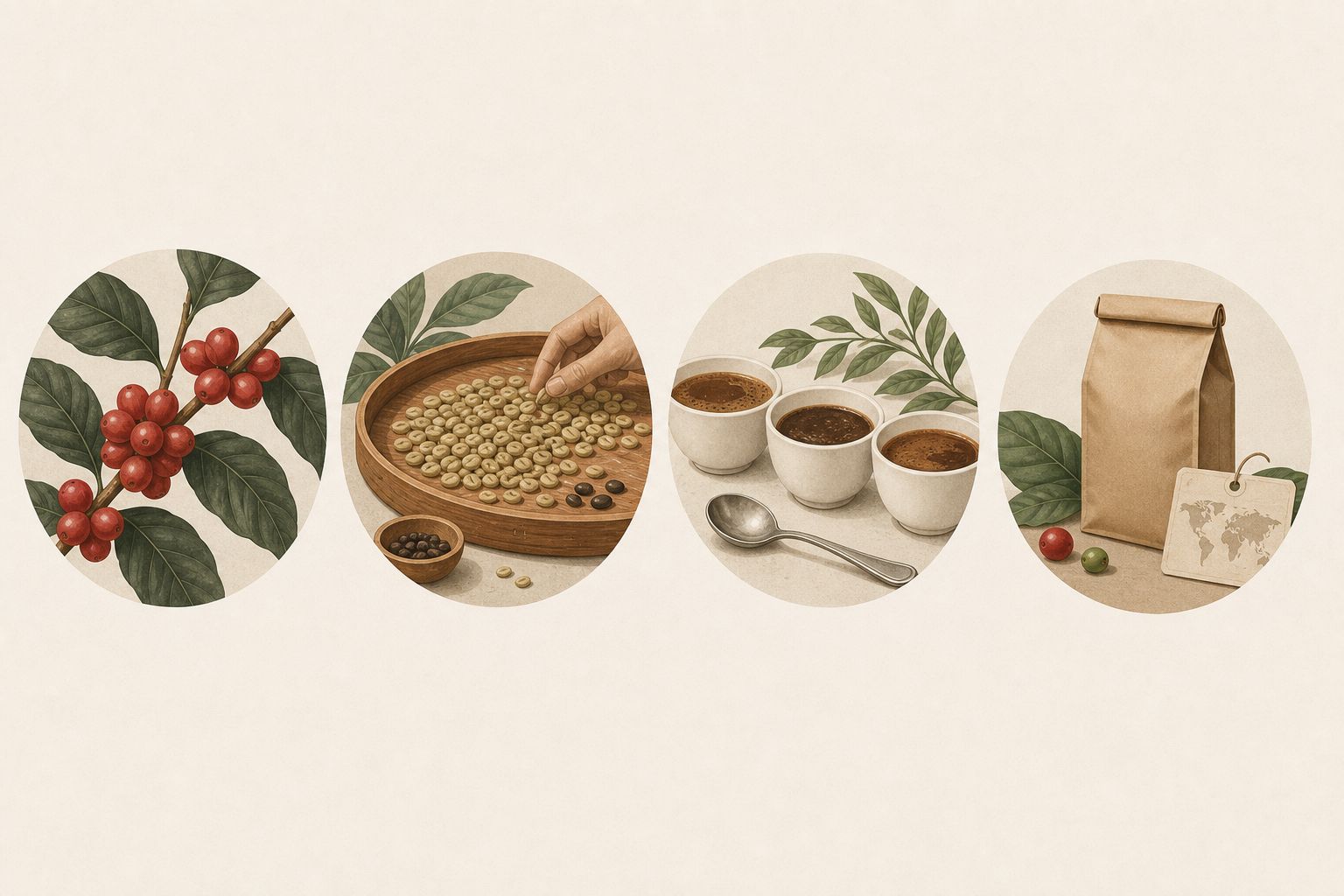
Specialty coffee describes coffee whose distinctive attributes are recognized and give it greater value in the market.
The Specialty Coffee Association traces the term to Erna Knutsen, who used “specialty coffee” in a 1974 trade-journal article to discuss coffees with particular qualities and growing contexts. Later specialty associations gave the idea more formal methods and vocabulary.
The current SCA definition focuses on two connected ideas: the coffee has distinctive attributes, and those attributes create significantly greater marketplace value. That makes specialty both a quality concept and a trade concept. A coffee is not automatically specialty merely because it has no obvious defect, nor because the word appears on a label.
For a shopper, the practical signal is usually more information. A specialty bag is more likely to name an origin, processing method, variety, producer, or lot and to be treated as a coffee worth evaluating for its own character.
The familiar statement that specialty coffee must score at least 80 points comes from an influential industry workflow, but it is not the only way the concept is now described.
The former SCAA cupping form expressed quality impressions on a 100-point scale, and buyers still commonly use 80 as a working boundary. Green-coffee grading also included physical-defect limits. Under the 2004 system, a 350-gram sample of specialty-grade green coffee could contain no category 1 defects and no more than five full category 2 defects. How those categories are counted is on coffee defects.
The SCA has since replaced the old cupping protocol with Coffee Value Assessment. CVA separates evaluation into physical characteristics, objective sensory description, affective or preference-based assessment, and extrinsic information such as origin, processing, and certification. The purpose is to describe value more completely than one score can.

This is why two vocabularies still coexist. A green-coffee buyer may discuss points and defects, while a current SCA document describes distinctive attributes and market value. When a label is vague, ask who evaluated the lot, which method was used, and what information supports the claim.
When choosing a specialty coffee, look for its origin, processing method, variety, and producer. Information about how the lot was evaluated can also help explain what makes it distinctive.
Specialty is not a flavor recipe. A washed coffee, natural coffee, or honey-process coffee can qualify. Coffee from Kenya, Brazil, Taiwan, or any other producing country can qualify. The term does not promise high acidity, floral notes, or a light roast.
If you are beginning with single-origin coffee, washed processing can be a useful reference because it often presents a clean comparison point. Still, trust what you taste. A label supplies context; it does not override your preference.
No. The term signals recognized attributes and value, not a promise that every person will prefer the coffee. A high-scoring lot can still fall outside your taste preferences.
No. Single origin describes where the coffee came from. Specialty describes recognized quality, character, and value. A single-origin lot or a blend can use specialty-grade coffees.
Not by itself. Eighty points remains a common industry reference, but a bag may not identify who scored the coffee or which protocol was used.
No. Light roasting is often used to preserve origin character, but specialty is not a roast level. Medium- and dark-roasted coffees can also come from specialty lots.
There is no universal requirement that every bag carry one Q Grader score. Trained evaluation helps buyers communicate, while the current SCA definition is broader than a single credential or number.