What Are Coffee Defects, and How Do They Affect the Cup?
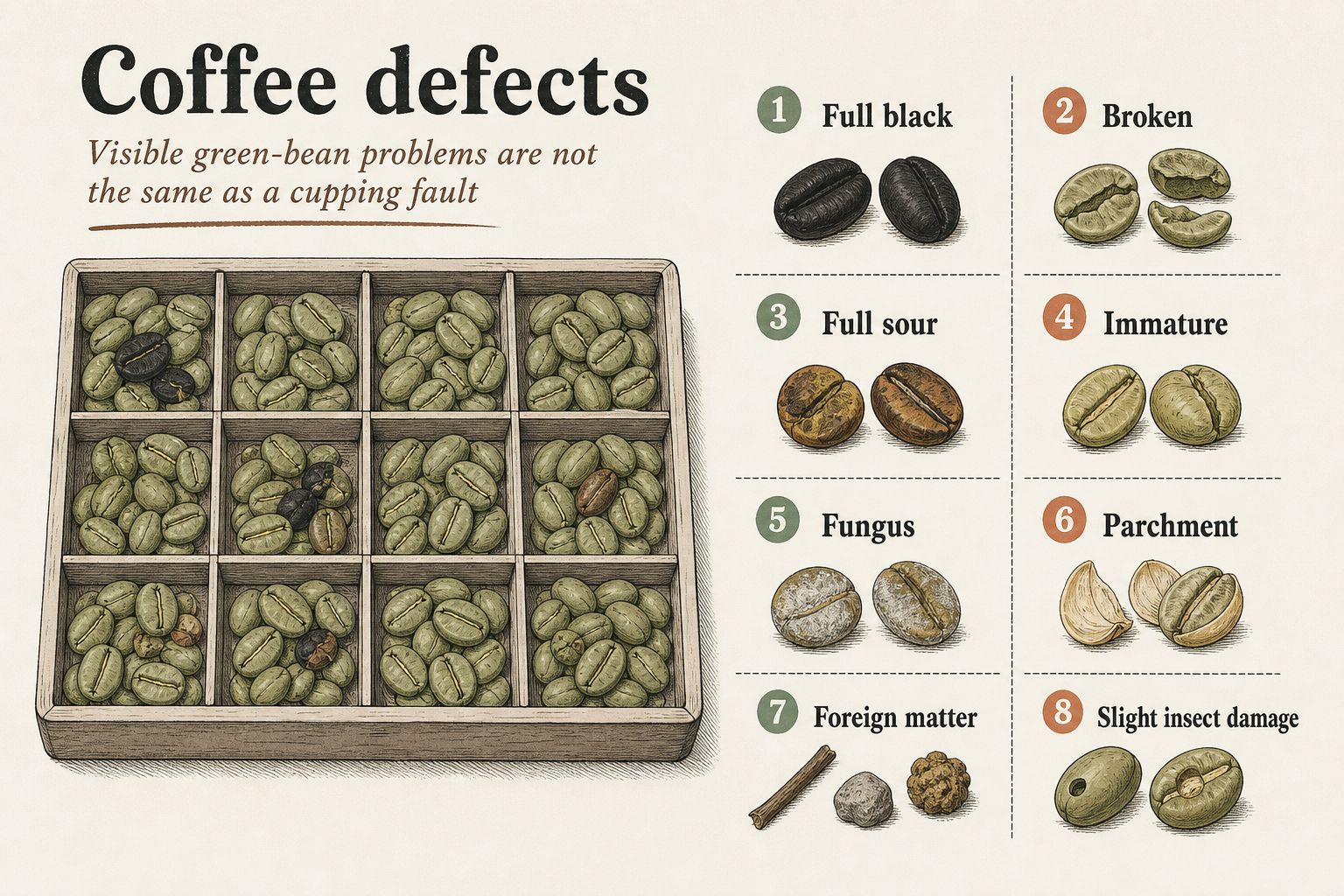
Coffee defects are physical properties of green or roasted beans that the trade treats as negative: full black or sour beans, fungus damage, foreign matter, broken beans, unripe seeds, and similar faults. Specialty buyers often count primary and secondary defects in a 350-gram sample. What you can see affects grade and price; it is not automatically the same as a cupping fault, and some off-flavors never show up to the eye.
Updated: Sep 7, 2026Reviewed by: Content and layout review
What “defect” means in coffee
When a green buyer, roaster, or cupping table talks about defects, the word is usually technical. It refers to a physical characteristic the trade considers undesirable.
The Specialty Coffee Association defines a defect as a material property of green or roasted beans that is broadly seen as negative. Some form on the tree, such as insect holes. Others form in processing, such as beans broken in a depulper. Others are objects that should never have been in the bag: stones, sticks, even a dried whole cherry. An SCA article quotes Camila Khalifé’s 2024 talk: coffee does not grow without defects. That is why picking, wet mills, and dry mills spend so much labor sorting. The work reduces the volume sold at a premium because the industry has long assumed those pieces pull quality and price down.
A retail bag rarely lists every defect. What you can usually ask is how the lot was graded, whether it was treated as specialty, and whether the cupping notes mention cleanliness or fault flavors.
How specialty grading counts them
The Green Arabica Coffee Classification System splits defects into two groups. Category 1, often called primary defects, includes full black, full sour, dried cherry, fungus damage, foreign matter, and severe insect damage. Category 2, often called secondary defects, includes partial black or sour beans, parchment, floaters, immature or withered beans, shells, broken or cut beans, hull or husk, and slight insect damage. Immature beans are also discussed with drying, astringent cups on why coffee feels astringent.
The count is weighted. Graders convert individual pieces into full defects on a 350-gram sample. The SCA’s own explanation uses a few clear cases: one full black bean is one Category 1 defect; three partial black beans equal one Category 2 defect; five broken, chipped, or cut beans equal one Category 2 defect. Primary defects carry greater weight in this system, while several secondary defects may be needed to count as one full defect.
The 2004 system wrote specialty grade as a hard physical limit: zero Category 1 defects and no more than five full Category 2 defects in 350 grams. If an irregularity is not in the Defect Handbook, it is not a defect for that protocol.
Those numbers still show up in contracts. SCA later replaced the 2004 cupping protocol with Coffee Value Assessment. Physical Assessment, the association says, remains based on the 2004 green-coffee grading system and still records color, defects, moisture, and size. Descriptive, affective, and informational assessments sit beside it. Defect counts are one part of the assessment and cannot establish the lot’s overall value.
One full black bean counts as one Category 1 defect; partial black and broken beans accumulate before they equal one Category 2 defect. The figure is a conversion sketch, not an identification chart.
What you can see is not always what you taste
Green grading examines visible characteristics, while cupping evaluates aroma and taste. Specialty coffee has long discussed both, but they answer different questions.
The working assumption is that visible defects bring negative flavors, which is why imperfect beans are removed. When the Coffee Science Foundation reviewed the literature, it found too little evidence to tie each physical defect to a cup fault with confidence. Sensory and chemical studies are now underway to inform a later revision of green classification. Those results are not a new standard yet.
The reverse problem is just as important. The same SCA feature notes that some of the most damaging cup faults—phenolic notes, including the so-called Rio defect, potato, and mold—are often invisible. A 350-gram sample can appear free of visible defects yet still have off-flavors during cupping, while a few visibly broken beans may have only a small effect on the brewed coffee.
Clean fruit acidity should also be described separately from vinegar-like flavors, harsh sourness, or fermentation faults. See why coffee tastes fruity.
The left panel illustrates green grading; the right illustrates cupping. The figure is a diagram, not a photograph of mold or phenolic taint.
Clean beans are not the whole specialty claim
A sample with no obvious defects is not automatically specialty. The current SCA definition asks whether distinctive attributes are recognized and whether the market assigns greater value. Physical grading can keep a damaged lot out of a premium channel. It cannot, by itself, prove that you will like the coffee.
At home, it is still reasonable to remove beans that look moldy, foreign, or drastically off-color. Do not treat a website diagram as a handbook, and do not treat a pretty sample as a cupping score. If the question matters when you buy, ask how the lot was graded and how cleanliness showed up in the cup. The exporter or roaster’s grading and cupping records provide more useful evidence than a photograph of one bean.
Common Misconceptions
If a bag contains defective beans, is it undrinkable?
Not automatically. Farms and mills already sort. Home roasting and brewing often include another pass. A few broken or unripe beans may not wreck a pot, but Category 1 defects such as full black beans, fungus, or foreign matter are treated as serious in grading.
Does a defect-free sample make the coffee specialty?
No. The current SCA definition looks for distinctive attributes and market value. Physical cleanliness is only one part of that picture. See the specialty-coffee page.
Are green defects the same as cupping defects?
No. Green grading counts visible material faults. Cupping describes and evaluates what the coffee smells and tastes like. Some of the most damaging flavors cannot be seen.
Will one black bean ruin the cup?
In the 2004 specialty-grade rule, one full black bean is already a Category 1 defect and disqualifies the sample. How strongly that bean changes a brewed cup is still being studied; do not read the conversion table as a flavor formula for every mug.
Can these illustrations be used to grade coffee at home?
No. These diagrams explain concepts; formal grading requires matching the handbook’s descriptions and counting full defects in a sample of the specified weight.
SCA, Grounding Green Grading in Sensory Science, 25 Magazine Issue 24: Defines a defect as a material property of green or roasted beans broadly seen as negative. Arabica green grading splits Category 1 and Category 2 defects and converts counts into full defects. One full black bean equals one Category 1 defect; three partial black beans equal one Category 2 defect; five broken, chipped, or cut beans equal one Category 2 defect. The 2004 cupping protocol required specialty grade to have zero Category 1 defects and no more than five full Category 2 defects in 350 grams; that cupping protocol has been superseded by CVA. The article also states that published evidence linking each visible defect to negative flavor is still thin, and that phenolic notes (including Rio defect), potato, and mold are often invisible.
Specialty Coffee Association, Coffee Value Assessment: Physical Assessment covers color, defects, moisture, and size and is based on the 2004 SCA green-coffee grading system. Full CVA also includes descriptive, affective, and informational assessments, so defect counts are not the whole value picture.
SCA Protocols and Best Practices, Grading Green Coffee: Green grading follows the April 2, 2004 Defect Handbook; an irregularity not in the handbook is not a defect for this system. Full defects are calculated on 350 grams. Specialty Grade requires zero Category 1 defects and no more than five Category 2 defects.