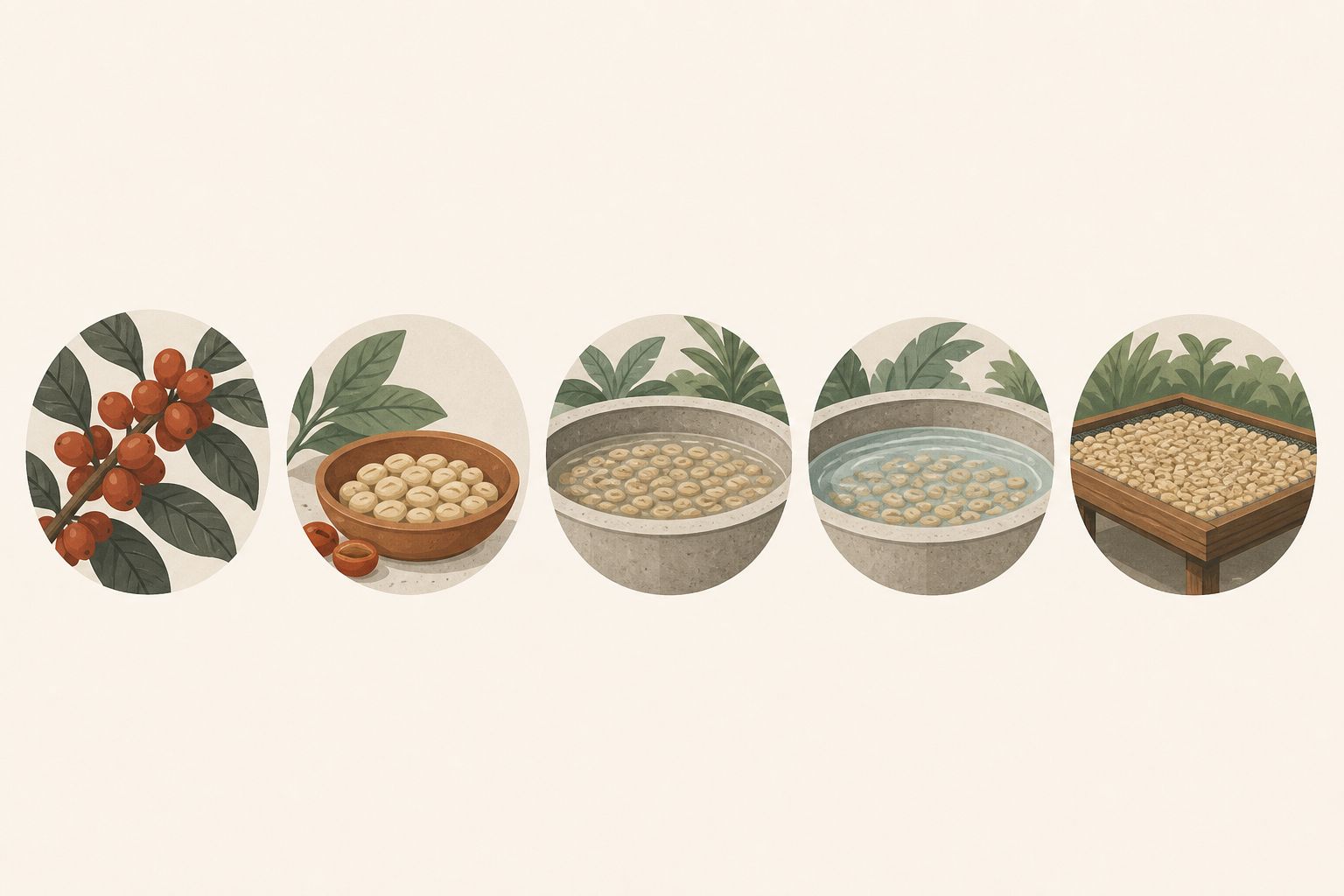
In washed processing, producers remove the fruit, clear away the sticky mucilage, and dry the coffee inside its parchment. The method often produces a clean, clearly defined cup, but it does not guarantee high acidity or a particular flavor.
Updated: Aug 31, 2026Reviewed by: Ah-Zhu (English-site batch review)
Washed Process
Pick ripe coffee cherries
Remove the skin and pulp
Break down the mucilage through fermentation
Wash the coffee
Dry the parchment coffee
Natural Process
Pick ripe coffee cherries
Dry the whole cherries
Turn them regularly
Remove the dried fruit and parchment
Prepare the green coffee
Honey Process
Pick ripe coffee cherries
Remove the skin while retaining some mucilage
Dry the coffee with mucilage attached
Remove the parchment after drying
Prepare the green coffee
Wet-Hulled Process
Pick ripe coffee cherries
Depulp, then briefly ferment or wash
Remove the parchment while moisture remains high
Continue drying
Prepare the green coffee
Anaerobic Fermentation
Pick ripe coffee cherries
Place the coffee in a sealed or low-oxygen vessel
Control fermentation time and temperature
Finish with a washed, natural, or honey process
Dry the coffee
What gets washed away
A coffee cherry contains skin, fruit pulp, a sticky layer called mucilage, parchment, and the seeds that eventually become roasted coffee. In a washed process, producers remove the skin and most of the pulp early. They then remove the mucilage before drying the seeds inside their parchment.
Mucilage can be loosened through fermentation and rinsed away, or it can be scrubbed off with a mechanical demucilager. A mill may also add enzymes to speed that step; see enzyme process. These routes can all produce washed coffee. This is why a bag labeled washed tells you the broad direction of the process, not the exact equipment, water use, or fermentation time.
An illustrated cross section of a coffee cherry. Washed processing removes the fruit and mucilage before the parchment-covered seeds are dried.
The usual sequence
Ripe cherries are sorted and depulped. The parchment-covered seeds may then rest in a tank while microbes break down the mucilage, or they may pass through mechanical equipment that removes it more quickly. After the loosened material is washed away, the coffee is dried on patios, raised beds, or in mechanical dryers. See drying.
Drying aims to make green coffee stable for storage. TechnoServe’s wet-mill guide uses roughly 10–12% moisture on a wet basis as a common operating range, with the time needed depending on drying conditions. This is an industry reference rather than a legal limit for every producing country.
Fermentation time can change with temperature, cherry ripeness, tank design, water quality, and the amount of mucilage present. A mill may use little water and rely on machinery, while another may use tanks and washing channels. Both bags can still say washed.
How washed coffee often tastes
Washed coffees are often described as clean, bright, or transparent. In tasting language, clean usually means that flavors feel distinct and the finish has fewer distracting notes. It is not a laboratory statement about purity.
Because less fruit material remains around the seed during drying, the variety and growing environment may be easier to recognize. Citrus-like acidity and a clearly defined finish are common impressions. They are tendencies, not guarantees: a dark-roasted washed coffee can taste heavy, while a carefully dried natural can taste exceptionally clean.
If you want a reference point for comparing origins or varieties, washed coffee is often a useful place to begin. Pairing the same origin—or, ideally, neighboring lots—across washed and natural processing can make the contrast easier to taste.
Common Misconceptions
Is washed coffee cleaner or safer than natural coffee?
Not automatically. Both are established processing methods. Sanitation depends on the water, equipment, drying surfaces, and handling at a particular mill—not on the process name alone.
Is washed coffee always acidic?
No. Clearly defined acidity is a common tendency, but variety, growing conditions, fermentation, roast, and brewing can all change the result.
Does washed coffee skip fermentation?
Many mills ferment depulped coffee to loosen the mucilage before washing, while others remove it mechanically or add commercial enzymes. The sequence varies; the enzyme-process and fermentation articles explain these approaches.
Does every producer use the same washed process?
No. Fermentation time, water use, equipment, climate, and drying practices differ. Washed is a process family, not one universal recipe.
TechnoServe, Wet Mill Processing Guide: Practical reference for depulping, fermentation or mechanical mucilage removal, washing, and drying coffee to a typical 10–12% moisture range.