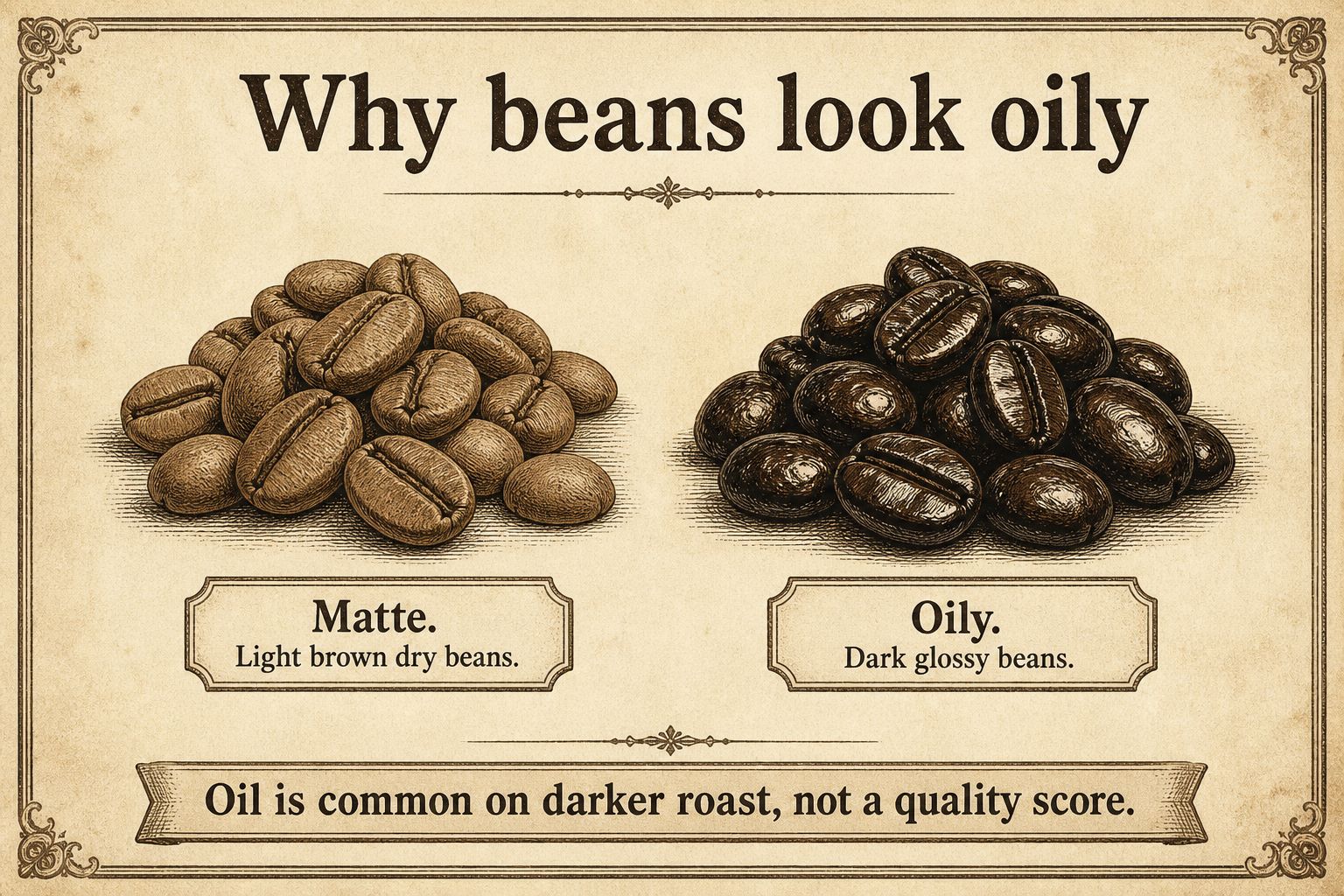
A shiny surface usually indicates a darker roast whose damaged cell structure allowed coffee oils to migrate outward. Oil does not automatically mean the beans are spoiled, though exposed lipids and aroma compounds can oxidize as coffee ages.
Updated: Aug 20, 2026Reviewed by: Ah-Zhu (English-site batch review)
Surface shine usually points to roast level
Light- and medium-roasted coffee is commonly matte. As roasting continues toward darker development and second crack, the bean becomes darker, more porous, and more brittle. Oils can move to the surface and create a glossy appearance.
That is a tendency, not a universal color chart. Roast labels are not standardized, and surface oil also changes with time and storage. Still, a freshly opened, evenly shiny dark roast is not automatically spoiled.
The oil was already inside the bean
Green coffee naturally contains lipids. A scientific review places green arabica and robusta broadly around 7–17% lipid, with averages near 15% for arabica and 10% for robusta in the reviewed data. Most coffee oil sits inside the endosperm; only a very thin wax fraction is naturally present near the exterior.
Roasting does not apply a new oil coating. Heat changes the cellular structure and some lipid components. A 2024 review explains that increasing roast development damages cell walls and makes the bean more brittle, allowing internal material to migrate more easily to the roasted surface.
This is why the visual difference between roast levels can be dramatic even when no ingredient has been added.
The appearance is a common roast tendency, not a standardized diagnostic color scale.
Roast oil and stale oil are different ideas
A dark-roast bean can be oily while fresh. Staling occurs as oxygen, moisture, heat, and time change lipids and aroma compounds. The coffee may lose definition, become flat, or develop a rancid odor or flavor.
Oil on the surface has greater exposure to air, so changes may become noticeable quickly. That does not make surface oil the cause or proof of spoilage; storage conditions and elapsed time determine the outcome.
Surface oil can be normal; oxidation over time is what pushes flavor toward flatness or rancidity.
What to do when a bag looks oily
Check the labeled roast and roast date. Smell the whole beans, grind a small dose, and brew it. A dark roast may deliver an intentional smoky, bittersweet, or chocolate-heavy profile. A flat aroma, cardboard-like character, or rancid oil note points more toward staling.
Keep the package tightly closed in a cool, dry, dark place and use sound storage practices. Do not discard coffee or rank its quality from the shine alone.
Common Misconceptions
Do oily beans mean the coffee is spoiled?
No. Surface oil is common in dark roast. Staling is better judged by age, storage, aroma, and a flat or rancid taste.
Do oily light-roast beans mean the bag is expired?
Surface appearance alone cannot prove it. Light and medium roasts are commonly matte, so verify the roast label, roast date, storage, and seller's description if a supposedly light roast is heavily oily.
Are oilier beans higher quality?
No. Surface oil mostly reflects roast development and time. It does not directly indicate cup quality.
Must espresso beans be oily?
No. Dark espresso blends often are, but espresso can be prepared from light or medium matte beans too.