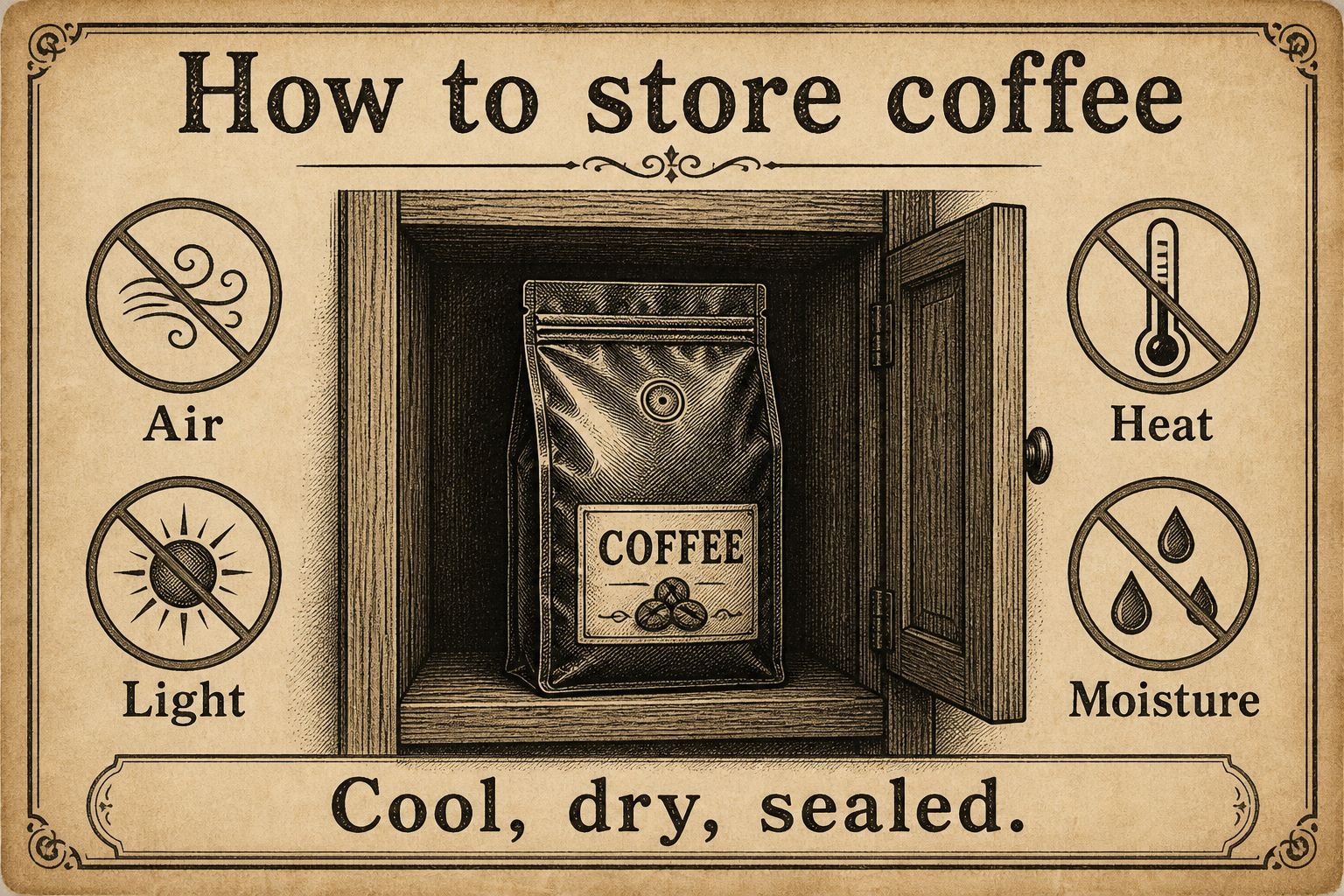
Protect opened coffee from oxygen, moisture, heat, and light. Reseal the original barrier bag in a cool dry cabinet and grind only what you need. Skip the refrigerator; for long storage, vacuum-seal small freezer portions and warm each sealed portion before opening.
Updated: Aug 20, 2026Reviewed by: Ah-Zhu (English-site batch review)
The four main enemies after opening
Oxygen, moisture, heat, and light accelerate flavor loss. For coffee you will use soon, the simplest good system is usually the original high-barrier bag: press out excess air, close the zipper or seal firmly, and place it in a cool, dry, dark cabinet.
Keep beans whole and grind immediately before brewing. Grinding creates far more exposed surface area, allowing gas and aroma to escape and oxygen to act quickly. SCA freshness material describes major carbon-dioxide change within roughly an hour after grinding, compared with a much longer whole-bean window.
Buy an amount that matches your pace. A very large half-empty bag contains increasing headspace every time it is opened. Smaller bags or divided portions reduce repeated exposure.
Storage and resting are not the same
Resting allows roast-generated carbon dioxide to dissipate until brewing becomes more stable. Storage limits damaging exposure throughout that period and afterward.
Early in the coffee’s life, escaping carbon dioxide can slow oxygen entry. As gas leaves, oxygen can enter more easily and react with aroma molecules and lipids. The result is often flatter aroma, less flavor definition, and eventually stale or rancid character.
SCA sources identify oxygen, moisture, temperature, and time as connected variables. Higher temperature speeds degassing and chemical change. Moisture supports molecular movement and can accelerate deterioration. Home storage cannot reproduce industrial low-oxygen packaging, but reducing air and avoiding humidity still helps.
Reducing headspace and closing the bag cannot stop aging, but it slows repeated oxygen exposure.
A cabinet is better than a refrigerator
A cabinet away from sunlight, an oven, steam, and strong spices is suitable for daily coffee. The original bag may be as effective as transferring coffee into a decorative container if its barrier and seal are sound.
Avoid the refrigerator. It is humid, contains food odors that coffee can absorb, and creates condensation risk as a package moves between cold and warm air.
There is no exact expiration day for flavor. Roughly three weeks after roast is one whole-bean freshness reference based on carbon dioxide, while industry advice often treats the first month as a practical drinking window. Packaging, roast, coffee, and personal preference can make the useful period shorter or longer.
Freezing works when the package is controlled
Cold temperatures slow degassing and chemical change. Home freezing can be useful when you buy more coffee than you can drink soon, but the method matters:
Divide coffee into single-use or short-use portions.
Vacuum-seal each portion so air and moisture cannot circulate around the beans.
Freeze the sealed portions and leave them sealed while warming.
Wait until an entire portion reaches room temperature before opening it.
Opening cold coffee allows room moisture to condense on the beans. SCA lecture guidance suggests that a sealed 200-gram portion may need at least about an hour to warm, while a kilogram takes longer. Touching a bag’s exterior is not proof that the center is warm.
Cabinet storage is simplest for daily use; freezing is for well-sealed portions, not repeated opening.
Freezer studies often track carbon dioxide because it is measurable. Aroma compounds do not necessarily change at the same rate, so theoretical months-long extensions are not guarantees of unchanged flavor. For most households, buying an amount they can use soon and keeping the bag sealed in a suitable cabinet is enough for everyday storage.
Common Misconceptions
Should coffee beans go in the refrigerator?
No. A refrigerator is humid, contains food odors, and exposes coffee to temperature changes. A cool dry cabinet is better for everyday use.
Can I freeze coffee beans?
Yes, if you vacuum-seal small portions. Warm an unopened portion fully to room temperature before opening it, and do not repeatedly thaw and refreeze the same package.
How long does opened coffee stay fresh?
There is no hard cutoff. Three weeks after roast is one carbon-dioxide-based whole-bean reference, and about one month is a common practical use window. Sensory quality and packaging vary.
Is resting coffee the same as storing it?
No. Resting is the planned post-roast degassing period; storage is the ongoing work of limiting oxygen, moisture, heat, and light.