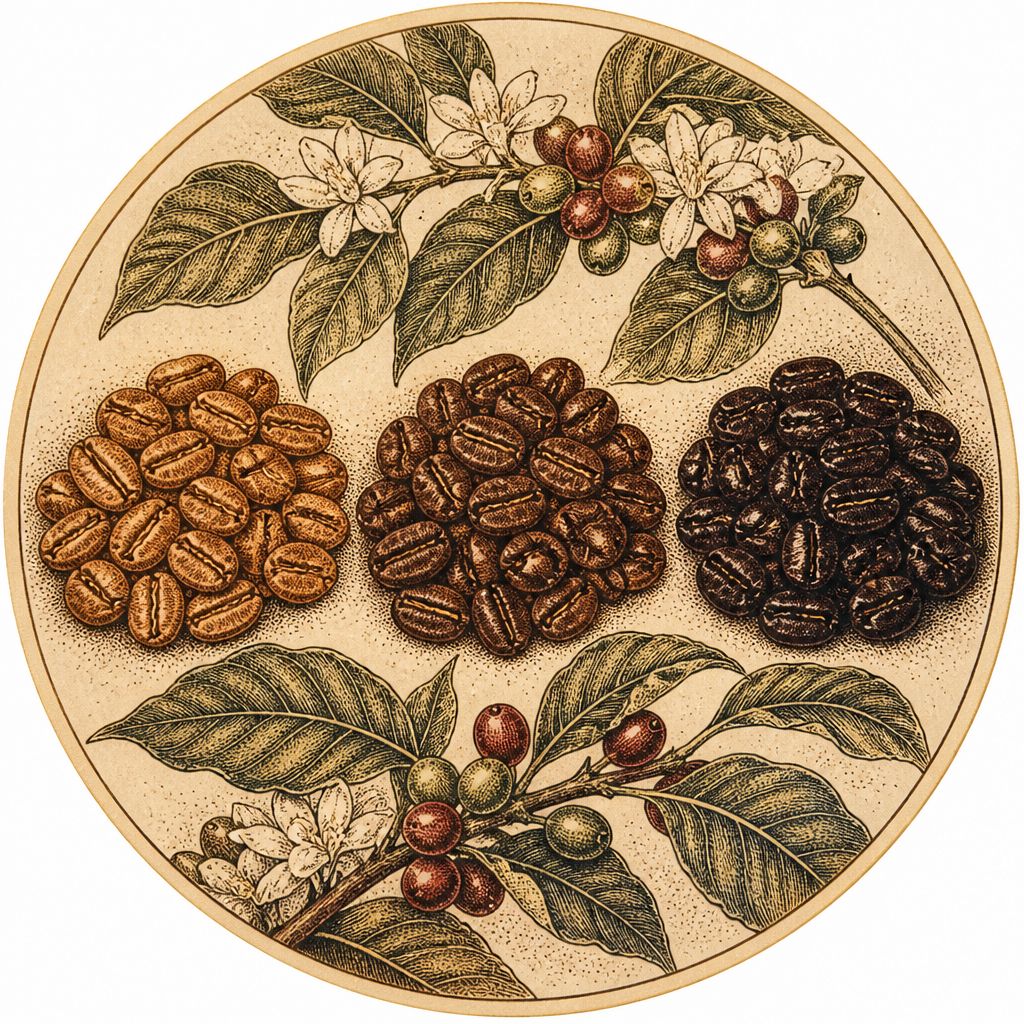
Light, medium, and dark describe how far green coffee has been roasted. Lighter roasts often preserve more origin acidity and aroma, while darker roasts emphasize roast-driven chocolate, smoke, and bitterness. The labels are not standardized across roasters.
Updated: Aug 30, 2026Reviewed by: Ah-Zhu (English-site batch review)
Roast labels are broad directions, not exact settings
Light, medium, and dark describe how far green coffee has progressed through roasting. The categories are useful, but they do not have universal cutoffs. One company’s medium roast can look and taste noticeably darker than another’s.
Roasters also use names such as Cinnamon, City, Full City, Vienna, French, and Italian. Some refer to color, some to traditional regional language, and some to audible stages in the roast. These names indicate approximate roast levels, and their meaning can vary between roasters.
The SCA specifies roast color when coffee is prepared for standardized sensory evaluation. Earlier guidance used an Agtron Gourmet target around 63; the 2024 Coffee Value Assessment standard describes ground-coffee CIELAB L* values of 26 to 29, roughly corresponding to an SCA roast tile near 65. These are sample-preparation targets, not legal boundaries for retail “medium roast.”
Darker color usually indicates a darker roast, but this illustration is not a universal roast chart.
First crack and second crack are roasting landmarks
As coffee absorbs heat, moisture becomes vapor and pressure builds inside the bean. The structure eventually opens with an audible series of pops called first crack. A later, lighter and faster crack marks further structural change and is called second crack.
Industry articles often place first crack near 205°C and second crack near 230°C, but measured temperatures vary by machine, probe, batch, and method. Light to medium roasts commonly finish between the cracks; darker roasts often enter or move beyond second crack.
Before first crack, beans move from green to yellow to brown. After first crack, roasters often call the remaining period “development,” although coffee has been changing throughout the roast. Some batches end shortly after first crack; others continue toward second crack.
First crack is a common landmark for light and medium roasting. Coffee entering second crack is more often described as dark.
Sweet Maria’s commonly places City after first crack, Full City near but before sustained second crack, and Vienna inside second crack. The temperature figures are equipment-dependent, so use visual, audible, and sensory context together.
Common flavor tendencies by roast level
Light-roasted beans are generally light brown and matte. They often preserve clearer origin acidity, floral aromas, and fruit character, with a lighter body. If insufficiently developed, they may taste grassy, cereal-like, or sharply sour.
Medium roasting extends farther beyond first crack while usually leaving the surface free of visible oil. It often balances acidity, sweetness, and body and may add caramel, nut, or chocolate associations.
Dark roasting moves toward or through second crack. Beans become darker, less dense, and more likely to show oil. Delicate origin aromas are often overshadowed by roast-driven dark chocolate, smoke, spice, bitterness, or char. Darker coffee is also more soluble, which changes brewing behavior.
There is no universally best level. Choose lighter coffee when you want a clearer view of origin and floral or fruit notes. Choose medium to dark when you prefer more roast character, heavier body, chocolate flavors, or a coffee that remains pronounced in milk. The bag label is only a starting point; taste and compare across roasters.
Common Misconceptions
Are light, medium, and dark roast legally standardized?
No. Roasters use the terms differently. Bean color, surface oil, aroma, acidity, body, and roast character give more context than the label alone.
Does dark roast have more caffeine?
The difference is smaller and more complicated than the common claim suggests. Roast changes bean mass and volume, while dose and brewing method usually matter more to the final drink.
Do oily beans always mean dark roast?
Oil is more common as roasting moves darker, especially around and beyond second crack, but age and storage also affect the surface.
Is light roast always more acidic or better?
Light roasting often preserves bright acidity and floral or fruit aromas, but underdeveloped coffee can taste grassy or sharply sour. Preference depends on the coffee and drinker.
What do City and Full City mean?
They are another family of roast names. Sweet Maria's places City after first crack and Full City near the beginning of second crack, but roasters do not use every name identically.
SCA, Coffee Standards, 2018, Roast Level for Cupping: Records the historical cupping-roast target of Agtron Gourmet 63.0 plus or minus 1.0. This target does not define the boundaries between retail roast labels.