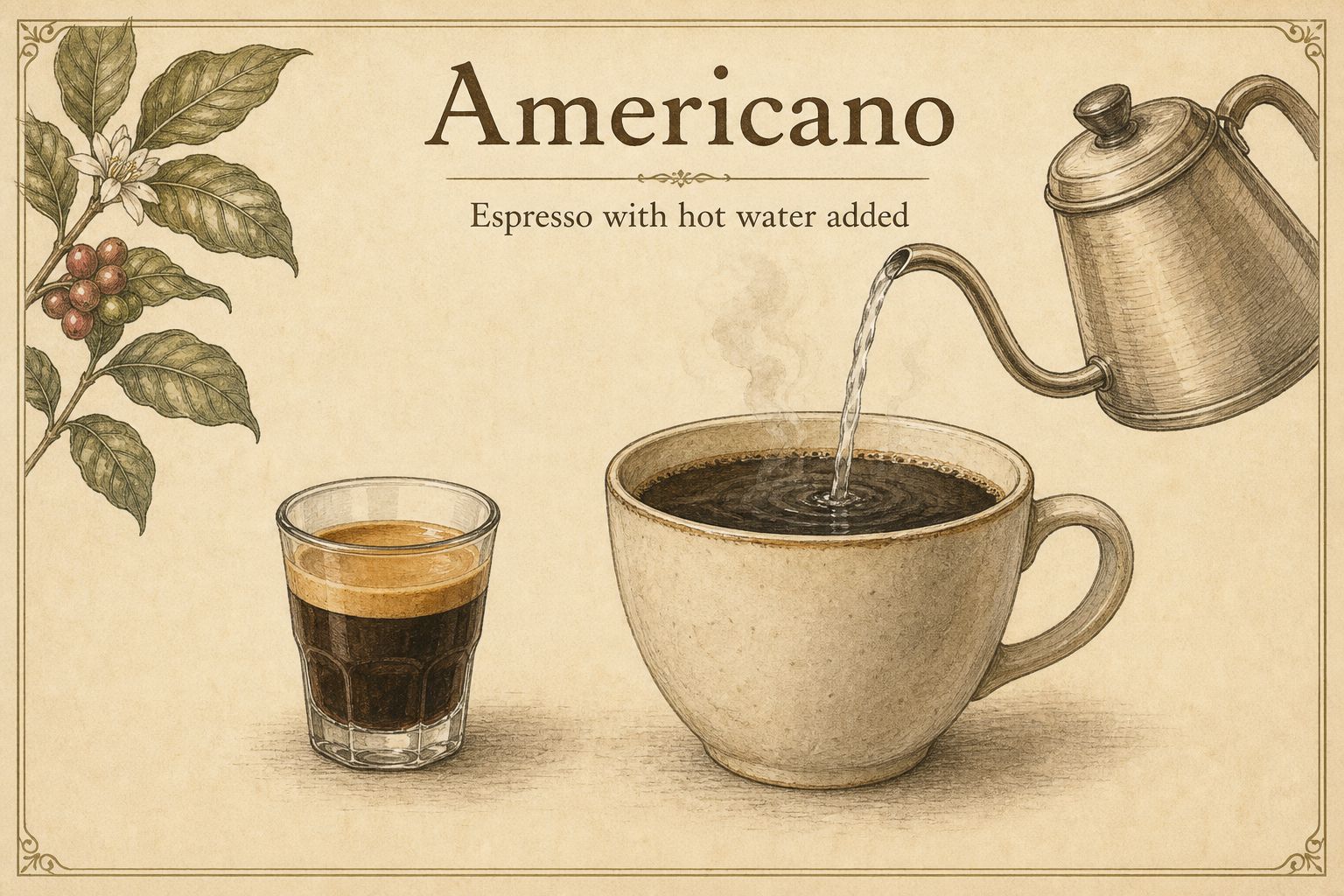
An Americano is espresso diluted with hot water, with the ratio varying by cafe and personal preference. Although it looks similar to pour-over, the preparation differs—an Americano starts with a finished espresso shot, while pour-over brews coffee by passing water through grounds and a paper filter.
Updated: Sep 2, 2026Reviewed by: Content and layout review
An Americano starts with espresso
An Americano is espresso diluted with hot water. On a cafe menu, the name describes how the drink is prepared rather than a type of coffee bean.
Preparation starts with a small shot extracted under pressure, followed by water to increase the volume and reduce the concentration. An iced Americano uses the same espresso base with water and ice.
There is no single required water ratio. A drink made with about one part espresso to two parts water is only moderately diluted and remains much more concentrated than a typical large cafe serving. Shops may add considerably more water to make a larger, milder drink, and they rarely change the serving size when they switch coffees. For a homemade Americano, the Americano water calculator can help estimate how much hot water to add.
A popular story says Italian baristas invented the drink for American soldiers in World War II who found espresso too intense. That origin is unconfirmed. The English word tracks Spanish café Americano by the mid-1960s. In 1950s Central America the same name was already a slightly cutting label for the milder coffee people associated with the United States.
How it differs from pour-over
An Americano and pour-over may look similar, but they are prepared differently. Pour-over uses gravity to move hot water through coffee grounds and a paper filter, while an Americano starts with espresso extracted under pressure and then diluted. Pour-over does not form espresso crema; the crema on an Americano comes from the shot and often thins or breaks apart when water is added.
Cafes usually make Americanos with the coffee they already serve as espresso. For pour-over, they are more likely to adjust the dose, grind, and pouring technique to the selected coffee. An Americano is sometimes assumed to be stronger, but its concentration depends on the amount of espresso and water used.
The illustration compares an Americano (left), made by diluting espresso, with pour-over (right), which uses gravity to pass water through grounds and a paper filter.
In Italy the names are easy to mix up: caffé americano for this drink, caffé all’americana for filter coffee. In the United States, asking for black coffee often gets you drip or pour-over. In the United Kingdom, the same request is more often read as an Americano.
Extract the espresso, then adjust the water
To make an Americano, extract the espresso first, then add hot water to reach the strength you prefer. There is no fixed water weight that every drink must follow. For an explanation of how the shot itself is extracted, see the espresso introduction linked above.
Water first or espresso first
The order in which espresso and water meet affects how much crema remains. An Americano commonly starts with espresso in the cup, followed by hot water, whose flow tends to break up the surface layer.
In Australia and New Zealand, a long black uses the same ingredients in the opposite order—hot water first, then espresso—which helps preserve the crema. It also usually contains less water than an Americano, giving it a more concentrated flavor and often a fuller mouthfeel.
The illustration shows the usual pouring order for an Americano (left), with water added to espresso, and a long black (right), with espresso added to water.
Another drink that can cause confusion is the lungo. It passes more water through the grounds during extraction, whereas an Americano adds water after the shot is finished.
The caffeine in an Americano comes from its espresso shots; adding water reduces the concentration without extracting more caffeine. Espresso contains more caffeine per unit of volume, but its serving size is small, so a full mug of pour-over may contain more caffeine than a single shot.
Common Misconceptions
Is an Americano a type of coffee bean?
Americano describes a drink made by adding hot water to espresso, rather than a type of bean. The same coffee can be used for pour-over, but the grind needs to suit the brewing method.
Is an Americano the same as pour-over?
The brewing methods differ. Pour-over uses gravity to move hot water through grounds and a paper filter, while an Americano starts with espresso extracted under pressure, then diluted with hot water.
How much water should you add?
There is no single required ratio. Less water keeps the drink more concentrated, while more water makes it milder. Cafes usually set their own serving size and ratio.
How is a long black different?
Both use espresso and hot water, but the usual pouring order differs. An Americano typically has water added to espresso; a long black has espresso poured into water, which helps preserve the crema. Long blacks also tend to use less water.
Is a lungo the same drink?
They add water at different stages. A lungo passes more water through the grounds during extraction, while an Americano dilutes the finished espresso shot.
Does an Americano always have more caffeine?
Not necessarily. Your caffeine intake depends mainly on the espresso shots used and how much of the drink you consume. Adding water dilutes the coffee without extracting more caffeine. The caffeine article compares amounts in different drinks.
Janice, What’s The Difference Between Americano And Filter Coffee?, Perfect Daily Grind, 2020: Compares Americano and filter preparation and describes espresso-to-water ratios ranging from 1:1 and 1:2 to 1:15, depending on the espresso and the drinker's preference. A 1:2 ratio remains much more concentrated than a typical large cafe serving. Interviewee Cole Torode explains that an Americano's strength depends on dilution; cafes generally use their existing espresso coffee and rarely change serving sizes when switching beans. Examples include 40 g espresso with 250 ml water and Tibor Hámori's double shot of 34 g espresso with 68 g water at about 75°C. These are individual practices rather than a standard recipe. The article also discusses long black pouring order, the similar Italian names caffé americano and caffé all’americana, and how black coffee often means filter coffee in the US but an Americano in the UK. The WWII origin story remains unconfirmed.
Janice, What Is A Long Black Coffee?, Perfect Daily Grind, 2020: Explains that a long black typically reverses the Americano's pouring order, adding espresso to hot water to help preserve crema. It usually uses less water and tastes more concentrated. A lungo differs because the additional water passes through the grounds during extraction. Levent Doganay describes the traditional Australian and New Zealand preparation as a double espresso or ristretto poured over 100 to 120 ml hot water; this describes regional practice rather than a universal recipe.
Douglas Harper, Americano, Online Etymology Dictionary: Traces Americano as a term for weak or diluted coffee, especially espresso. The English café Americano is recorded by about 1964 and comes from Spanish, literally meaning American coffee. The term was already used disparagingly in 1950s Central America for the milder coffee believed to be preferred in the United States. This record does not establish the WWII story as the drink's origin.
USDA FoodData Central, Coffee, brewed, espresso, restaurant-prepared (FDC 171891); brewed coffee (FDC 171890): Lists restaurant espresso at about 212 mg caffeine per 100 g, or roughly 60-plus mg in a 30 ml serving, and brewed coffee at about 40 mg per 100 g, or 95 mg in 8 fl oz. These are database reference values rather than measurements of every serving. An Americano's caffeine comes from its espresso; adding water dilutes the drink without extracting more caffeine.