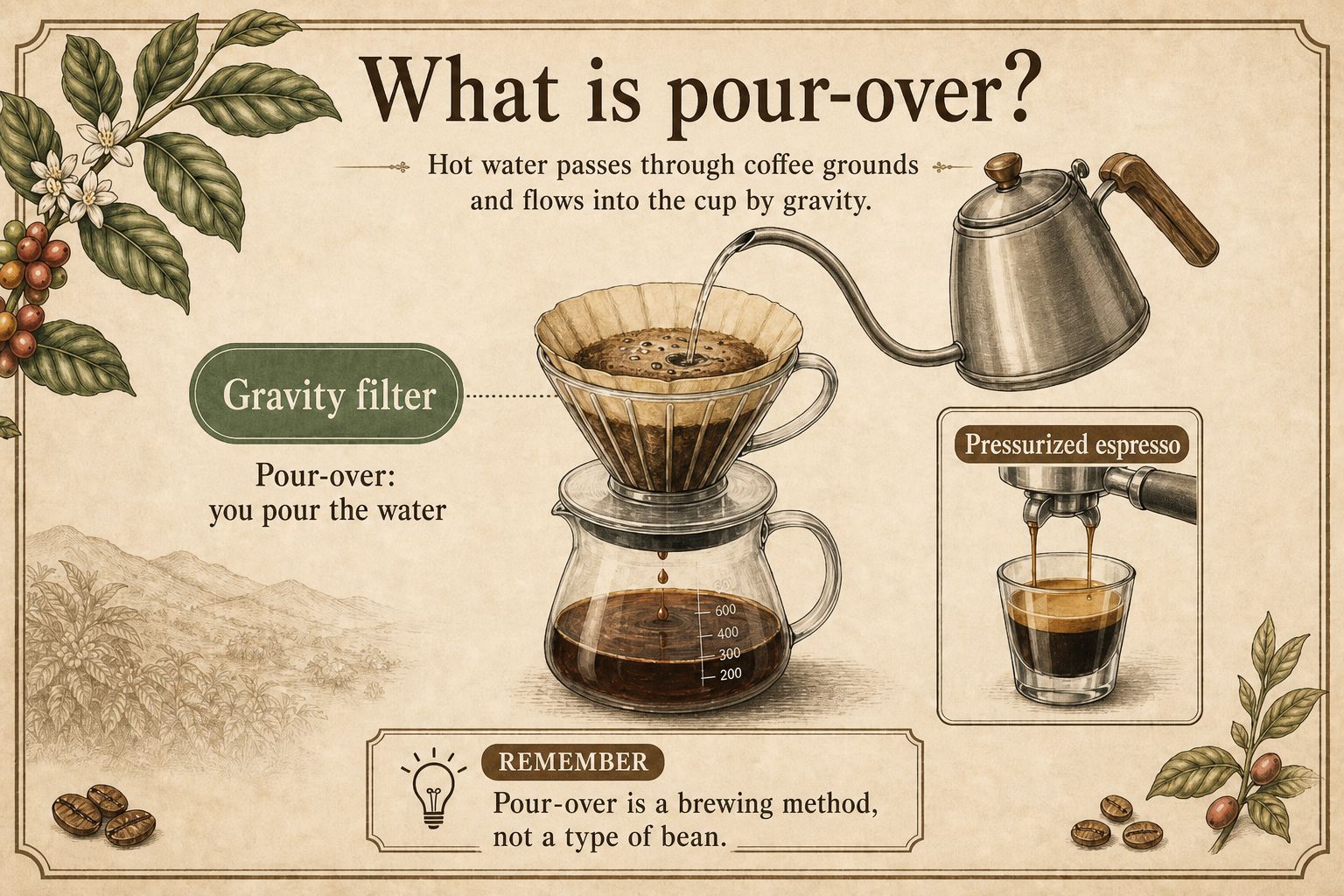
Pour-over is a filter-brewing method in which you pour hot water by hand and let gravity carry it through coffee grounds and a paper filter. Unlike espresso, it does not use pressure or form the same crema. Automatic drip machines also pass water through a coffee bed, but control the pouring for you.
Updated: Sep 14, 2026Reviewed by: Content and layout review
Pour-over is a brewing method
Pour-over involves pouring hot water over ground coffee in a filter and letting it drain into a carafe or mug. Cafe menus may use pour-over, filter, or drip, although the latter two terms can also include automatic brewers. Hand pouring is what distinguishes pour-over and gives it the name manual brewing.
The same bag of coffee can be used for pour-over or espresso, with the grind and recipe adjusted accordingly. Pour-over does not use espresso’s pressure, usually makes a larger serving, and does not form the same crema.
How water moves through the grounds
Water travels down through the coffee bed under gravity, carrying soluble material with it in a process called percolation. Pour-over keeps introducing fresh water, whereas immersion methods such as a French press keep the grounds in the same water as its concentration gradually approaches equilibrium.
Espresso forces hot water through a finer, compacted bed under pressure and yields a small concentrated drink. Without that pressure, typical pour-over does not form crema.
Pour-over on the left, espresso on the right. The same coffee can be brewed both ways, but the flavor profiles differ.
Paper filters hold back many oils and fines, so pour-over often tastes cleaner and more defined.
The SCAA Golden Cup standard gives reference ranges for filter coffee—ratio, water temperature at contact, brew strength, and extraction yield. Those figures describe a target window, not a home recipe for every dripper.
A basic sequence
A typical home pour-over starts with heating water and grinding coffee. Place the paper in the dripper, rinse it with hot water, and discard the rinse water before adding the grounds. Wet the coffee first, then add the remaining water and let it drain. See how to brew pour-over for the full process.
The first pour often makes the bed swell and bubble as carbon dioxide retained after roasting escapes. This stage is called the bloom. Perfect Daily Grind’s example uses about twice the coffee’s weight in water and waits 30 to 45 seconds for the bubbling to ease before continuing. That timing is a starting point to adjust for the coffee being used. Why the bed puffs up is in why coffee blooms.
After the bloom, you can continue in one stream or divide the remaining water into several pours. Grind size, brew ratio, and water temperature also affect the flavor. The minerals and alkalinity of brewing water have distinct effects worth considering. For an iced version, the iced pour-over calculator helps divide the recipe between ice and hot water.
Common drippers and pouring methods
Dripper shape and paper thickness affect how water moves through a gravity-fed brew. Common devices include the Hario V60, Kalita Wave, Chemex, and fan-shaped drippers such as Melitta.
The V60 uses a 60° cone with spiral ribs and one large hole at the bottom, while the Kalita Wave has a flat-bottom design. Chemex uses bonded paper that the manufacturer describes as about 20–30% thicker than most competing filters.
Pouring frameworks differ too. HARIO’s own V60 basics wet the grounds first, then split the rest into three pours. Tetsu Kasuya’s 46 method, presented when he won the 2016 World Brewers Cup, splits total water into the first 40% and the last 60%, which he describes as using the earlier portion to adjust the balance of acidity and sweetness and the later portion to adjust strength. This is his well-known competition pour-over method. To get grams for each pour, use the 4:6 method calculator.
Pour-over, drip machines, and immersion
An automatic drip or batch brewer also sends hot water through a bed of coffee. The machine does the pouring, and it can brew more cups at once. Perfect Daily Grind’s 2026 comparison describes batch brew as easier to keep consistent; pour-over is one cup at a time and gives more control over the pour.
Immersion brewers such as a French press steep the grounds in water, then separate them. Contact time is mostly set by the brewer, and more fines often remain in the cup. Grind size covers how flow-through and steeped methods respond differently to particle size.
A dripper is just the holder for the filter. Cone and flat-bottom shapes change how water moves, but they do not decide whether the coffee is good. Perfect Daily Grind quotes a World Brewers Cup champion: the cup matters more than picking one device over another.
Lighter roasts are often paired with pour-over to highlight delicate aromatics, but medium and dark roasts also work. Your choice of roast level shapes the acidity and flavor you want to bring out.
Common Misconceptions
Is pour-over a type of coffee bean?
Pour-over describes how coffee is brewed. The same beans can also be used for espresso, with the grind adjusted to suit that method.
Can pour-over make espresso?
No. Pour-over relies on gravity, not espresso pressure, and does not produce the same crema. An Americano starts with espresso and adds water.
Is pour-over always brighter or fruitier?
Not necessarily. The method is often paired with lighter roasts because delicate aromatics are easier to express. The coffee, process, and roast still shape the cup.
Do you need one specific dripper?
Both cone and flat-bottom drippers work for pour-over. Their shape affects flow, so use your brewing and tasting results to choose a setup rather than treating one model as essential.
Do you need a V60 or the 46 method for it to count as pour-over?
A V60 is a dripper design, and the 46 method is a pouring approach; neither is required. Pour-over involves pouring water by hand and letting gravity carry it through the grounds and filter.
Is pour-over better than a drip machine?
Not automatically. Batch brew is easier to keep consistent at volume. Pour-over brews one cup at a time and lets you adjust the pour.
Neil, Everything you need to know to brew great pour over coffee, Perfect Daily Grind, 2019: Explains pour-over preparation and distinguishes hand pouring from automatic filter brewing. Common devices include the Hario V60, Kalita Wave, Chemex, and Melitta. The example starts with rinsed paper and a bloom using about twice the coffee's weight in water for 30 to 45 seconds, followed by continuous or pulsed pouring. Paper retains many oils and often produces a cleaner taste, while fresh water continues through the grounds rather than remaining with them as in immersion. The article emphasizes clarity and the tasting result over loyalty to a particular device. It also reports the manufacturer's description of Chemex paper as about 20–30% heavier than other filters.
HARIO, V60 Series: Describes the V60's 60-degree cone, spiral ribs, and single large hole. HARIO's example rinses the paper and discards that water, blooms with about twice the coffee's weight in water for 30 seconds, then adds the remainder in three pours. This is one pouring approach rather than a requirement for all pour-over. The page also identifies the V60 02 KASUYA Model as supervised by the 2016 World Brewers Cup champion.
CHEMEX Bonded Circle Coffee Filters: The manufacturer describes Bonded paper as about 20–30% thicker than most competing filters. This helps explain the brewer's filter characteristics, but does not establish that every Chemex coffee will taste better.