Basics
What Is Espresso?
Espresso is a small, concentrated coffee brewed by forcing hot water through finely ground coffee under pressure. It often carries a golden-brown foam called crema, but it does not require a blend or a dark roast.
 Add More Coffee
 Basics
Espresso is a small, concentrated coffee brewed by forcing hot water through finely ground coffee under pressure. It often carries a golden-brown foam called crema, but it does not require a blend or a dark roast.
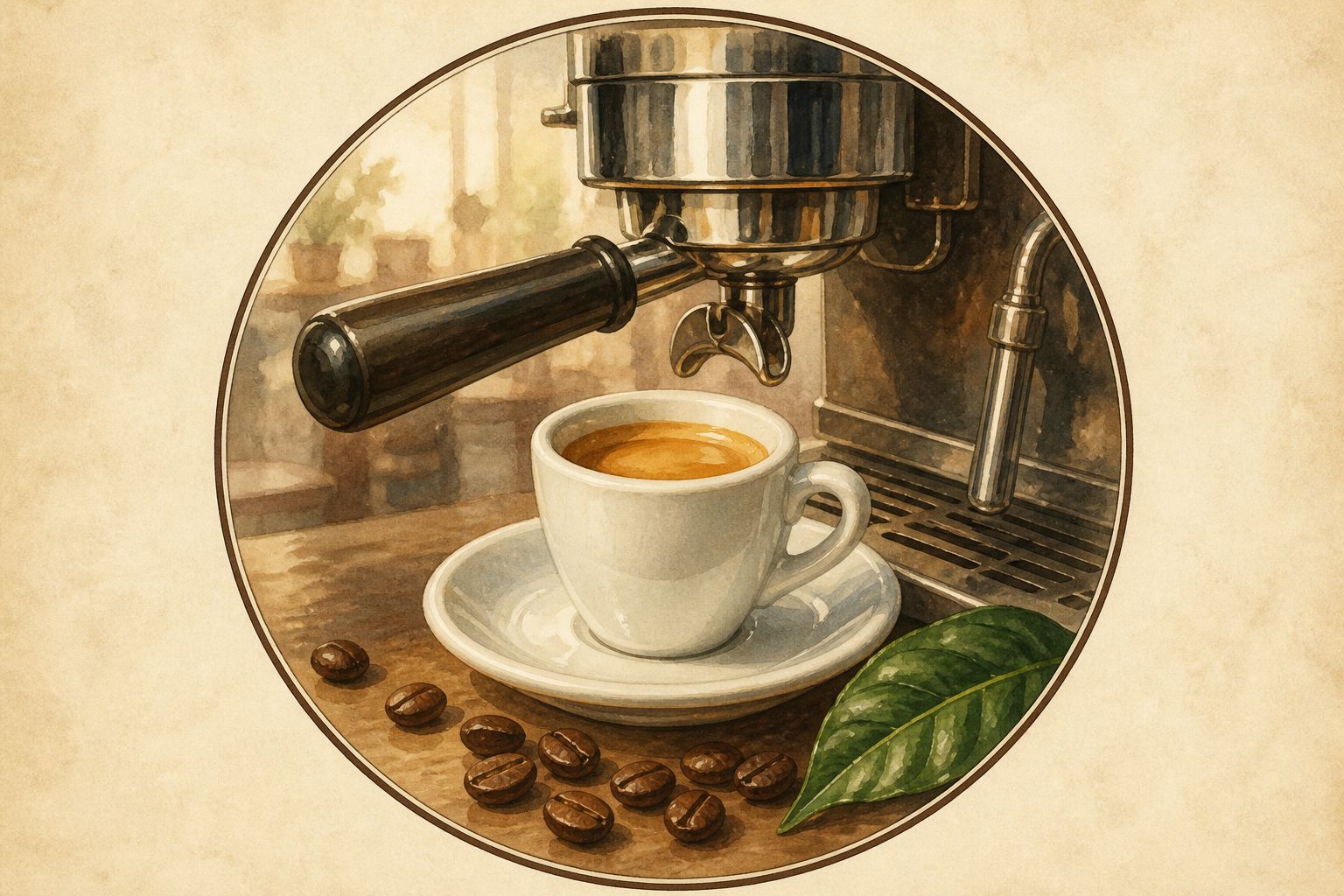
Espresso is made by forcing hot water through a compact bed of finely ground coffee under pressure. The result is a small, concentrated beverage that can be served alone or used as the base for an Americano, latte, cappuccino, and many other drinks.
The Italian Espresso Institute describes a certified single espresso with roughly 7 grams of coffee, about 9 bar of incoming water pressure, an extraction near 25 seconds, and about 25 milliliters in the cup. Its technical description also includes water and serving temperatures, fine-bubbled crema, and a balanced sensory profile.
Those figures define one certification, not every espresso served around the world. Earlier SCAA language described roughly 25 to 35 milliliters from 7 to 9 grams of coffee. A 2017 Barista Guild of America survey found that many respondents served double shots, commonly dosing 18 to 20 grams. Modern cafe recipes vary by coffee, basket, machine, and intended drink.

The Italian certification requires approved blends, equipment, and operators. That requirement belongs to the certification system; it is not a rule for all espresso.
Specialty cafes frequently serve single-origin coffee as espresso. A blend is popular because a roaster can design it for a stable flavor, balanced body, and enough presence to remain clear after milk is added. A single origin may emphasize one place or lot and can change more noticeably with the season.
Dark roasting is also not mandatory. Darker coffee is traditional in many settings and is generally easier to extract, but light- and medium-roasted coffees can be brewed under pressure. The roast level changes acidity, roast character, solubility, and how the barista approaches the recipe.

Crema is the golden to brown foam on top of espresso. Roasting traps carbon dioxide in coffee. Under brewing pressure, more gas dissolves into the liquid; when the coffee enters the cup and returns to atmospheric pressure, bubbles form and become suspended in the coffee’s oils and other compounds.
Pressure is essential to that effect, which is why ordinary pour-over does not create the same crema. Its color and thickness also vary with the coffee species, roast, age, pressure, and extraction, so a visually impressive layer does not guarantee good flavor.
Judge espresso by the whole cup: aroma, sweetness, acidity, bitterness, texture, finish, and how the flavors work together. Crema is one clue about the brewing system, not proof that the coffee will taste good.
No. Espresso is a brewing method. The same coffee can also be brewed as pour-over, although each method needs a different grind and recipe.
No. Certified Italian specifications may require an approved blend, but cafes also serve single-origin espresso. Blends are common because they support consistency and milk drinks.
No. Light, medium, and dark roasts can all be brewed as espresso. Roast level changes extraction behavior and the flavors in the cup.
No. Crema reflects pressure, gas, coffee freshness, and other variables, but poor coffee can still produce a thick-looking layer.
No. Pour-over relies mainly on gravity and cannot reproduce espresso pressure or the same crema. An Americano begins with espresso and adds water.
It is more concentrated by volume, but the serving is small. A full mug of brewed coffee may contain more total caffeine than one shot.