What Is Cold Brew—and How Is It Different From Ice Drip and Nitro?
Cold brew commonly steeps ground coffee in room-temperature or refrigerated water before filtering. It differs from hot coffee chilled over ice in its extraction temperature, and from ice drip in how water contacts the grounds. Nitro coffee often uses cold brew as a base, with nitrogen added after brewing.
Updated: Sep 1, 2026Reviewed by: Content and layout review
What cold brew means
On a menu, cold brew usually means coffee steeped in cool water for an extended time and then filtered. You can use the same beans for pour-over or cold brew. The cold brew calculator can work out coffee and water amounts or estimate dilution after filtering.
Research papers commonly describe cold brewing as extraction at room temperature or below over several hours. Córdoba and colleagues’ 2021 paper reports temperatures around 20°C to 25°C or lower, commonly for 8 to 24 hours. These are ranges found in the literature rather than a fixed home recipe.
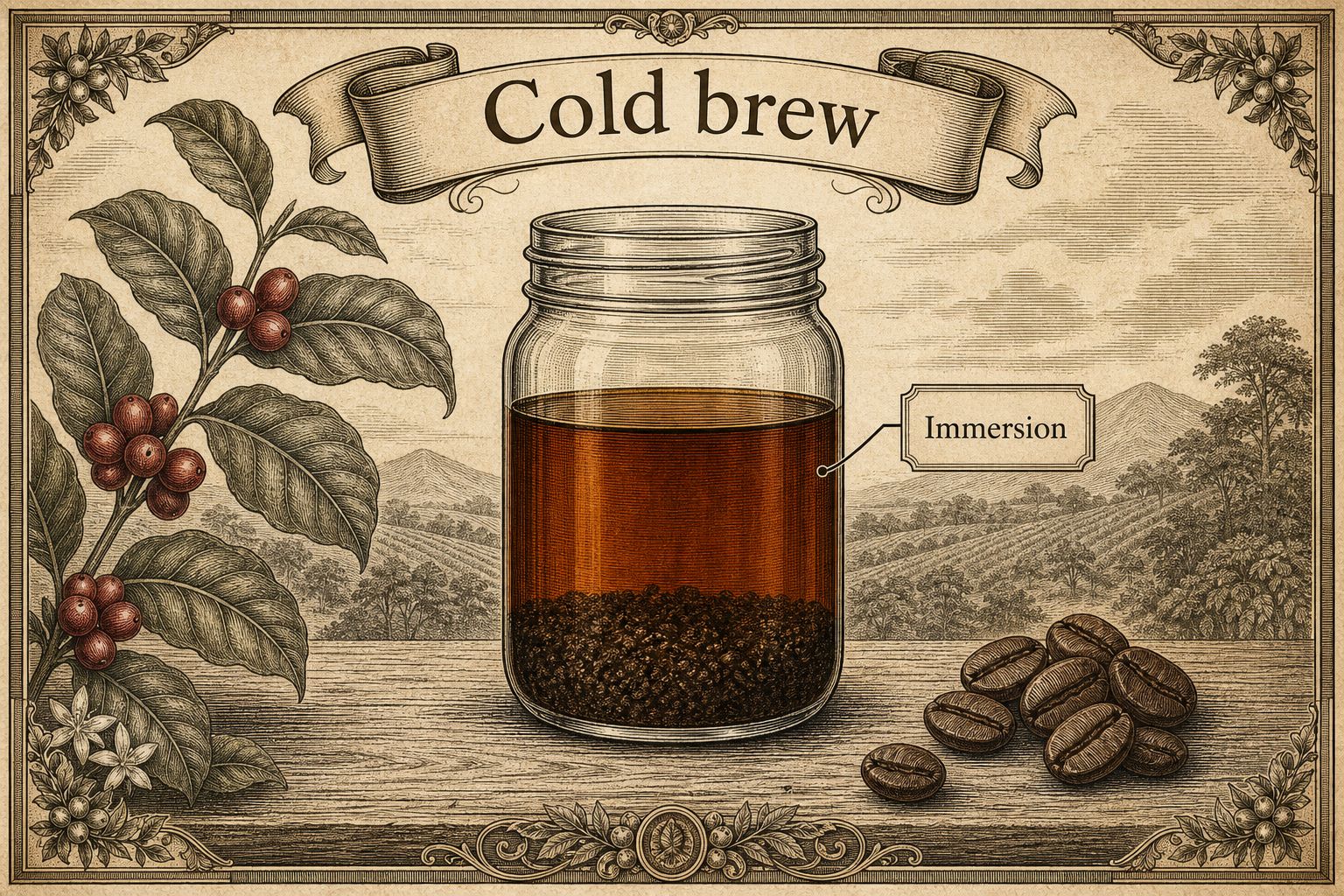
Brewing methods can be distinguished by water contact. In immersion, the grounds remain in the water; in percolation, water moves through a coffee bed. Everyday use of the term cold brew usually refers to immersion.
How it differs from hot coffee poured over ice
The differences between iced coffees begin before ice is added. Coffee brewed hot and chilled still uses heat during extraction. Cold brew starts with cooler water and a longer contact time to dissolve material from the grounds. For hot-brewed iced coffee, the iced pour-over calculator can divide the total water into hot water and ice.
In 2022, the UC Davis Coffee Center tested three origins and three roast levels using full immersion at 4°C, 22°C, and 92°C. Each brew reached equilibrium before being diluted to 2% TDS and served at 4°C to a trained panel. Hot-brewed samples had stronger bitter, sour, and rubbery notes, while cold-brewed samples were more floral. Origin and roast interacted, and individual coffees still produced different results.
The industry summary of the same research reports that, at matched strength, cold brew measured about 0.1 to 0.2 pH units higher, making it chemically a little less acidic. Roast level generally had a larger effect on pH, however, so the cold-brew label alone cannot guarantee lower acidity or greater sweetness.
They also measured how strength changed during the steep: a fast “rinse” of soluble material on first contact, then a slower climb to equilibrium. In that experiment, reaching equilibrium took about 20 to 30 minutes with hot water, about five hours at room temperature, and 10 hours or more in the fridge.
Cool-water steeping on the left; hot brew chilled on ice on the right. The diagram compares the two methods without specifying recipe quantities.
How it differs from ice drip
Ice drip—also called cold drip, and sometimes Kyoto-style or Dutch coffee—sends water through a bed of grounds drop by drop. The grounds are not sitting in a jar of water the whole time.
Both methods use cool water over a longer period, but common cold brew uses immersion and ice drip uses percolation. Córdoba and colleagues found that dripping extracted faster at the same water temperature. In their tasting, cold-drip samples were more bitter and roasty, while immersion samples were sweeter, nuttier, and more caramel-like. These were results for the particular coffee and equipment tested.
If a shop writes cold brew or ice drip, the first question is whether the water is sitting with the grounds or moving through them.
Immersion on the left; ice drip on the right. The figure shows contact, not a brand of tower.
How it differs from nitro coffee
Nitro coffee is nitrogen forced into a finished brew. Cafes often start from cold brew, then pour it from a stout-style tap.
Cold brew is therefore a common base for nitro coffee, but the nitro label describes gas added after brewing. Nitrogen flushing in coffee packaging serves a different purpose: preservation. The guide to nitro coffee explains both uses.
Common Misconceptions
Is cold brew just iced coffee?
Iced coffee can be brewed hot and then cooled over ice, while common cold brew uses cool water for a long steep. Both are served cold, but the temperature during extraction is different.
Is it always less sour and less bitter?
Not necessarily. With strength and serving temperature matched, the UC Davis study found less bitterness, sourness, and rubbery flavor in cold-brewed samples, along with more floral aroma. Origin and roast still affected the result, so this is not a guarantee that all cold brew is low in acidity.
Is it the same as ice drip?
Common cold brew keeps the grounds immersed in water; ice drip sends water through them drop by drop. Both use cool water over a longer period, but the contact method differs.
Do I have to steep 24 hours in the fridge?
There is no single required steeping time. In the Davis experiment, room-temperature brews reached equilibrium in about five hours, while refrigerated brews needed 10 hours or more. Those are observations from the study, not fixed requirements for home brewing.
Is nitro coffee the same as cold brew?
Nitro coffee often starts with cold brew, then has nitrogen added to the liquid. Cold brew describes extraction; nitro refers to adding gas after brewing. See the guide to nitro coffee for more detail.
William Ristenpart, Worth the Wait: How Cold Brew Differs from Chilled Hot Brew, SCA 25 Magazine, Issue 22: An industry summary of the same UC Davis research. At matched strength, cold brew measured about 0.1 to 0.2 pH units higher than chilled hot brew. Some material dissolved rapidly at first contact, followed by a slower approach to equilibrium. In this experiment, equilibrium took about 20 to 30 minutes with hot water, five hours at room temperature, and 10 hours or more at refrigerator temperature. These observations are not fixed home steeping times.