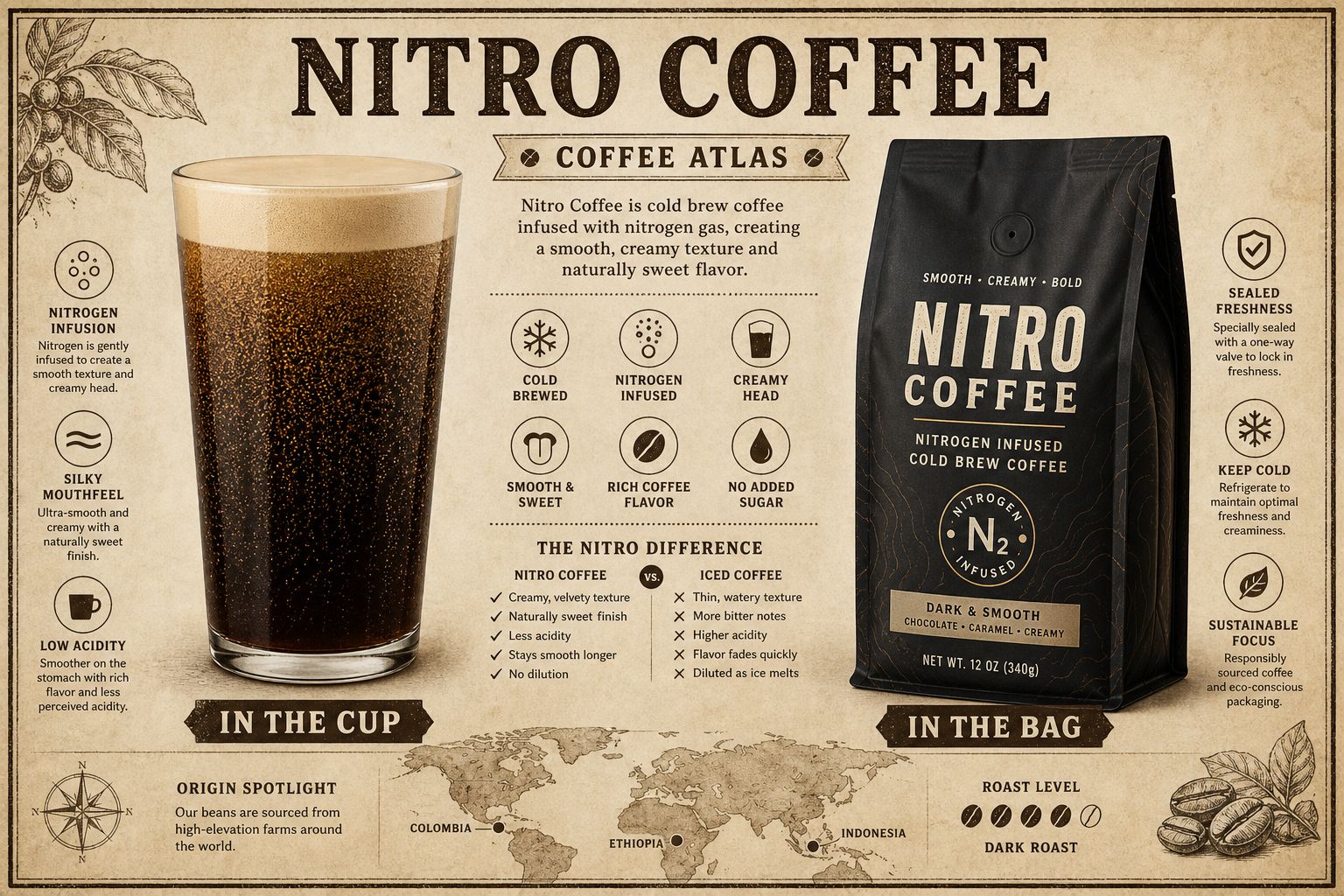
What Is Nitro Coffee—and How Is It Different From a Nitrogen-Flushed Bag?
Nitro coffee is coffee infused with nitrogen, usually cold brew poured from a stout-style tap. Tiny bubbles form in the glass and the texture is often smoother. If the bag says nitrogen flushed, that is packaging: a way of protecting roasted beans by pushing oxygen out.
Updated: Aug 21, 2026Reviewed by: Content and layout review
Nitrogen in the cup is not nitrogen in the bag
Nitro coffee means nitrogen has been forced into a finished brew. It is commonly made with cold brew and served from a stout-style tap. When it hits the glass, the tiny bubbles fall like a waterfall, then settle, leaving a denser foam on top.
If the bag says nitrogen flushed, that is packaging: nitrogen pushes oxygen out of the bag so roasted coffee stales more slowly.
Nitro coffee is a way of serving a coffee drink, not a kind of bean. The same bag of beans can go into pour-over, or into cold brew that is then charged with nitrogen. Nitrogen flushing, by contrast, is there to protect the beans.
The illustration compares a nitrogen-infused coffee drink on the left with nitrogen-flushed bean packaging on the right; it does not show a specific product.
Why it often feels smoother
Chemical & Engineering News reported in 2015 that Nate Armbrust at Stumptown first tried carbon dioxide in coffee and found the carbonic acid harsh. He switched to nitrogen after thinking about Guinness, whose nitrogen bubbles and foam feel smoother. In June 2013, nitro coffee appeared in Portland shops.
Nitrogen does not dissolve easily in water. Lee and Devereux wrote in 2011 that it is about fifty times less soluble than carbon dioxide and does not form an acid in solution. Low solubility means smaller bubbles and a longer-lasting foam. When stout comes off a tap, the liquid has to squeeze through a very fine hole before those bubbles appear. In a can, a small capsule fires gas into the liquid when you open it. Nitro coffee often uses a similar special tap to create fine foam.
The cup often feels smoother than sparkling water. Some people find the mouthfeel rounder, with a little sweetness as well; the nitrogen process does not add sugar.
The illustration compares nitrogen bubbles on the left with carbon dioxide bubbles on the right; it is not a laboratory measurement of bubble size.
Sprudge quoted Armbrust in 2015: controlled high pressure puts tiny nitrogen bubbles into cold brew so they come out of solution when poured, which is when you see the waterfall of bubbles. In a can, a small capsule streams nitrogen through the liquid when the top is popped.
How nitrogen flushing protects packaged beans
Nitrogen flushing is a different matter. MTPak describes it as pushing oxygen out of a bag before it is sealed. Nitrogen is largely inert, so the aim is slower oxidation. Once the bag is open, outside air is back in. Not every bag of roasted coffee is nitrogen-flushed, and flushing does not guarantee long freshness after opening. See storing coffee for everyday storage practices.
So nitro coffee is nitrogen in the liquid. Whether you enjoy it depends on the drink itself and your preferences. Your caffeine intake still depends on the amount of ground coffee, brewing method, and serving size. If you want to read more, see the caffeine article.
Common Misconceptions
Does a nitrogen-flushed bag mean the coffee is nitro coffee?
No. Nitrogen flushing removes oxygen during packaging to protect roasted beans, while nitro coffee is a finished brew infused with nitrogen.
Is nitro coffee sweeter?
Not necessarily. Tiny bubbles often create a smoother, rounder mouthfeel that some people perceive as slightly sweeter, but nitrogen infusion itself adds no sugar.
Is nitro coffee lower in caffeine?
Not necessarily. Nitrogen infusion does not change the caffeine content; dose, brewing method, and serving size determine how much you consume. See the caffeine article for details.
Is it the same as sparkling or carbonated coffee?
No. Carbon dioxide makes larger, sharper bubbles. Nitrogen is less soluble, so the bubbles stay smaller and the texture is usually smoother, not soda-like.
Is it always served cold?
Cafes commonly infuse cold brew with nitrogen, though recipes vary between shops.
W. T. Lee and M. G. Devereux, Foaming in stout beers, American Journal of Physics, 2011: Physics of nitrogen in water: roughly fifty times less soluble than carbon dioxide, not acidic in solution, smaller longer-lasting bubbles. Draught stout has to squeeze through a very fine hole before those bubbles appear; cans often use a small gas capsule that fires when opened. Used only as an analogy for why nitro coffee often needs a special tap.