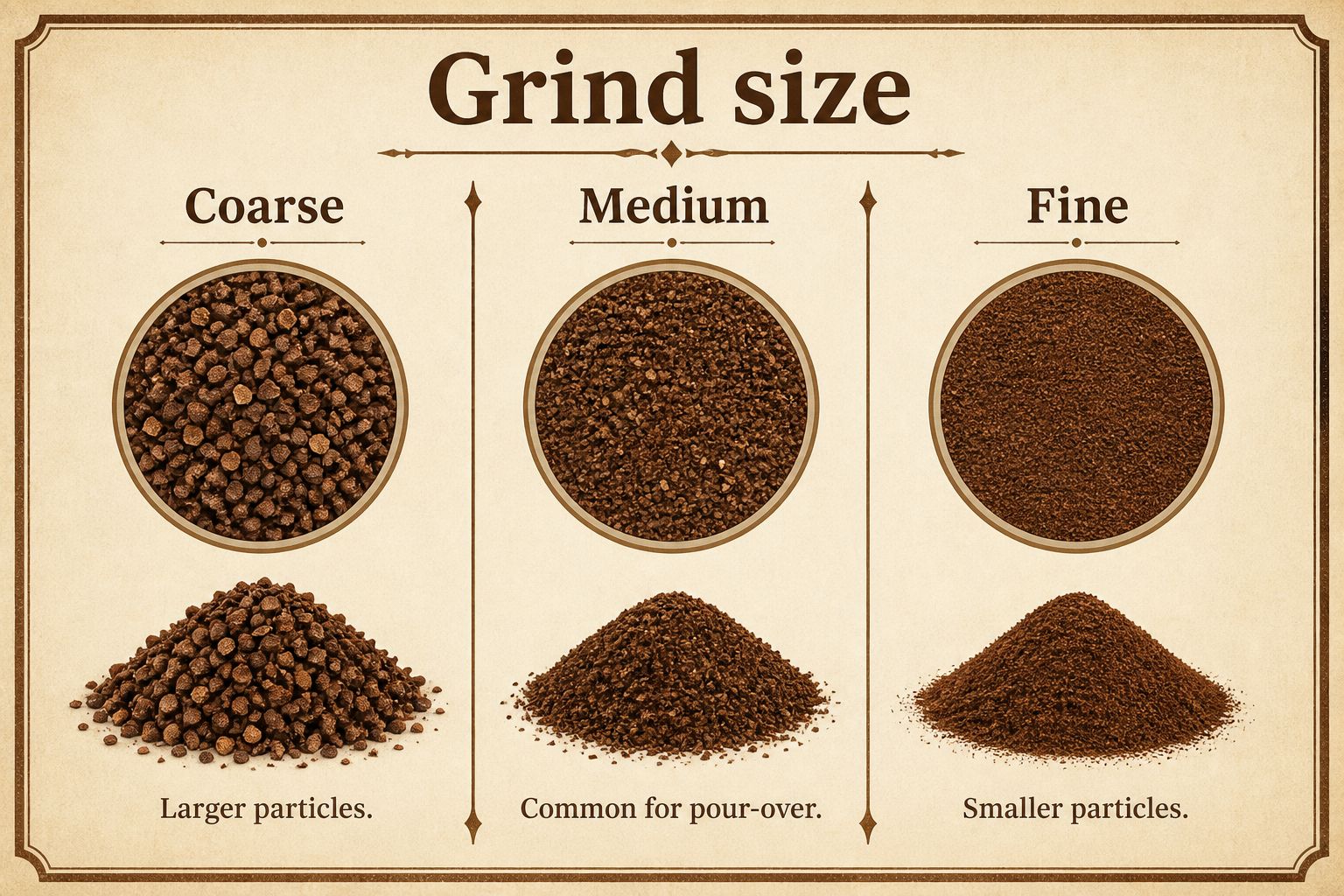
Grind size describes the average size of ground coffee particles. Finer coffee exposes more surface area and usually slows flow through a filter, increasing extraction efficiency. Coarser coffee does the opposite. Brew strength depends more directly on the coffee-to-water ratio.
Grinding breaks roasted beans into particles so water can reach far more surface area. Coarse particles are larger; fine particles are smaller. Grinder numbers are machine-specific, so a setting of 12 on one model does not equal 12 on another.
Common pairings follow the time and mechanics of the brew. Espresso usually needs a fine grind. Pour-over and automatic drip often use a medium range. Longer immersion methods such as a French press often begin coarser.
Finer and coarser coffee change extraction differently
Smaller particles provide more total surface area for water and create smaller spaces in a filter bed. Soluble material can leave the coffee more quickly, while water often flows more slowly through the compact bed. Larger particles expose less area and allow water to pass through larger gaps.
In percolation brewing, coarse particles generally leave larger pathways for water, while a fine bed creates more resistance.
Percolation methods move water through a bed of coffee. If the grind is too fine for the recipe, flow may slow and contact time may increase. If it is too coarse, water may leave before enough flavor is extracted. Immersion methods keep coffee and water together, so the brewer controls contact time more directly.
Grind and strength are related but not identical. Extraction asks how much soluble material moved out of the grounds. Strength asks how concentrated that material is in the beverage. Coffee-to-water ratio has the most direct effect on concentration; grind mainly changes the speed, evenness, and flavor of extraction.
The 2015 SCAA Golden Cup standard paired grind with contact time, listing roughly 1 to 4 minutes for fine, 4 to 6 minutes for drip, and 6 to 8 minutes for coarse grinding. It used about 55 grams of coffee per liter of water, a beverage strength of 1.15 to 1.35 percent, and an extraction-yield reference of 18 to 22 percent. These ranges were intended for filter brewing; they do not apply directly to every home brewer or guarantee that a coffee will suit your taste.
Why brewing methods start in different ranges
Espresso is extracted under pressure in a matter of seconds, so fine grinding provides both the surface area and resistance it needs. Grinding too fine, however, can restrict flow or encourage channeling, where water follows a path of lower resistance and leaves some areas overextracted and others underextracted.
Pour-over and drip commonly begin in a medium range because gravity needs a bed that offers resistance without stalling. A French press and other longer immersion methods commonly use a coarser setting to slow extraction and reduce the amount of fine sediment passing through a metal filter.
Cupping has its own repeatable preparation. The 2024 SCA standard describes a grind slightly coarser than typical paper-filter brewing, with 70 to 75 percent passing an 850-micrometer No. 20 U.S. standard sieve. That is a laboratory-style comparison reference, not a setting you need to match at home.
These are common starting ranges, not universal settings or fixed brew times.
There is no universal best setting because brewing conditions vary. Scott Rao makes this point in his Perfect Daily Grind interview; keeping other variables steady makes it easier to adjust grind by taste.
In a drip-brewer study conducted by UC Davis and SCA, a difference of about 25 percent in median particle size was not distinguishable in triangle tests when basket shape stayed the same. Differences between conical and flat-bottom baskets were easier to detect. This finding applies to the study’s conditions and does not show that grind is unimportant in every brewing method.
A practical way to adjust
Keep dose, water amount, temperature, and pouring method steady, then change only the grind. If the cup tastes thin, sharply sour, or undeveloped and the water moved quickly, try a slightly finer setting. If it tastes dry, harsh, or bitter and the brew stalled, try slightly coarser. See over-extraction and under-extraction for that distinction.
These observations offer a starting point for adjustment, but brewing water, temperature, agitation, filter shape, and the coffee itself can produce similar results. Dark-roasted coffee is generally easier to extract, so some brewers use a slightly coarser grind; light roasts sometimes benefit from a finer setting to extract more flavor.
Particle distribution also matters because large particles and very fine powder extract at different rates. A wide mix can leave the larger particles underextracted while the fines are overextracted. Grinder quality and the selected setting both affect that distribution, so compare the flavor while keeping your brewing technique consistent.
Common Misconceptions
Does finer coffee always make a stronger drink?
Finer grinding usually changes extraction rate and flavor. Beverage concentration depends more directly on how much coffee and water you use.
Can espresso and pour-over use the same grind?
Usually not. Espresso uses much finer coffee to create resistance during a short pressurized brew, while pour-over commonly uses a medium range for gravity-driven flow.
Can I copy a grinder number from a recipe?
Only as a starting point on the same grinder model. Dial numbers and burr calibration are not standardized between machines.
Does sour coffee always mean the grind is too coarse?
No. Coarse grinding and fast flow can produce a thin, sharp cup, but the coffee's natural acidity, roast, water, and temperature can also contribute.
Can I use preground coffee?
Yes, but aroma changes faster after grinding. Whole-bean coffee ground shortly before brewing generally retains aroma longer.