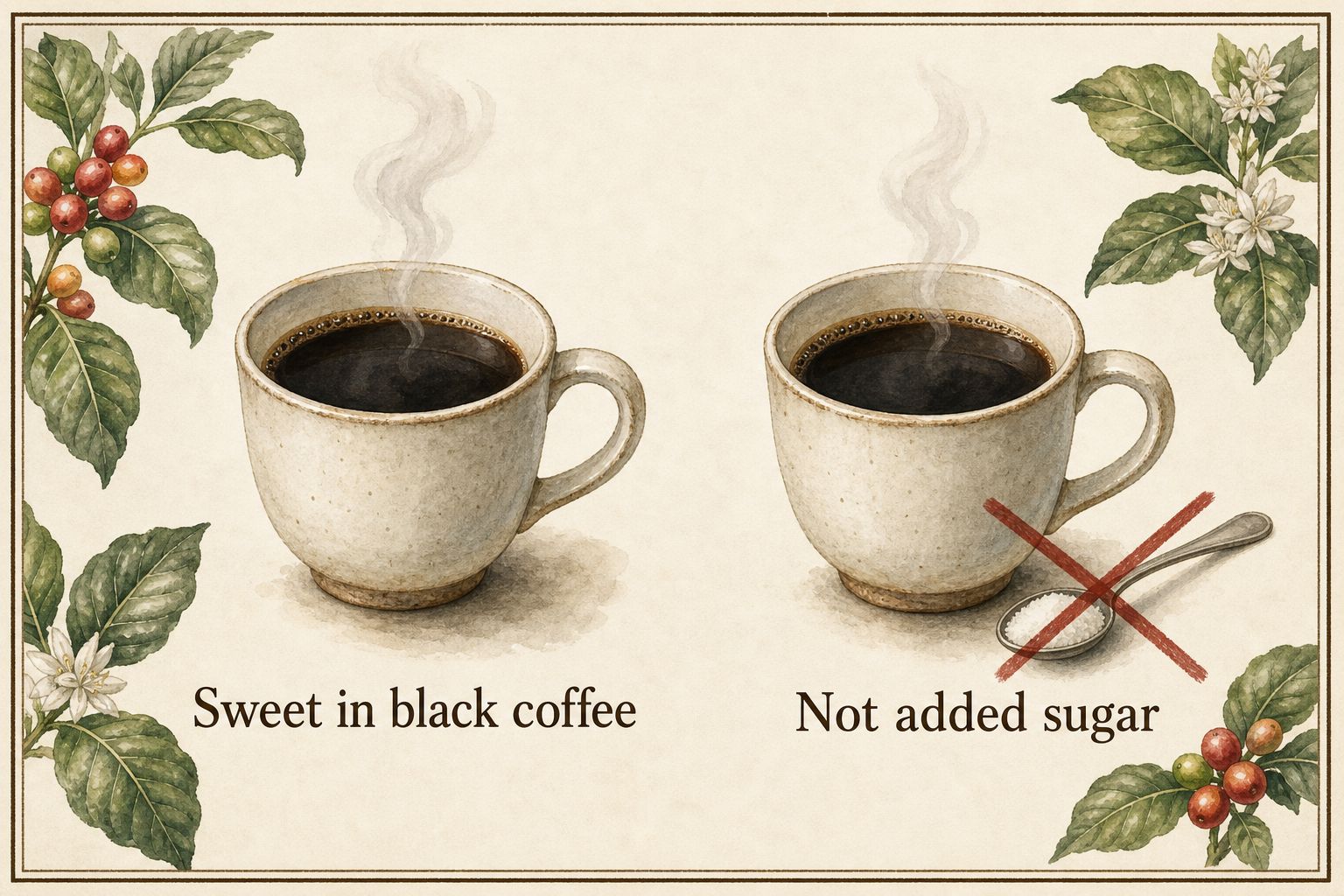
Why Does Coffee Taste Sweet—and Do You Have to Add Sugar?
Black coffee can taste sweet without added sugar. Most of the sucrose in green beans is used up in roasting, and leftover sugars in the brew sit below the tongue’s detection threshold. The sweetness you usually notice is a real perception: aroma can support it, and you can still taste it on the tongue, but leftover sucrose is not doing that work. The sweetest samples clustered with fruity and fermented aromas; the least sweet clustered with bitter, roasty, papery notes.
Updated: Aug 30, 2026Reviewed by: Content and layout review
Black coffee can taste sweet on its own
Black coffee can taste sweet without added sugar.
Specialty tasters assess sweetness as an important sensory attribute. When SCA asked cuppers in 2021 how they would change the 2004 form, a majority wanted a rating of sweetness intensity; the old sheet only ticked whether sweetness was present. The Coffee Value Assessment descriptive form now treats sweetness as a basic taste and as aroma, and rates it on a 15-point intensity scale.
The flavor wheel describes flavor as taste plus aroma. Sweetness is a basic taste perceived on the tongue, while caramel, honey, and brown sugar often describe aroma impressions. “Sweet” on a bag is not the same claim as “this brew is high in sucrose.”
For a drinker, bag notes like sweet, brown sugar, or caramel are cupping language.
What happens to sugar, and why coffee still tastes sweet
Green beans do contain sucrose. Barista Hustle, citing Farah, puts that as high as about 9%. Roasting uses those sugars in caramelization and Maillard reactions. Flament writes that more than 99% of the sugars degrade in the roast. Clarke and Macrae are more specific: a medium roast retains about 0.9% of green sucrose, a light roast about 2.9%.
Once brewed, leftover sugar is usually too low for the tongue to pick out on its own. SCA reports the Ohio State analysis: people detect sucrose around 2,000 mg/L; the coffees tested topped out around 100 mg/L. The samples with the most sugar were the least sweet to tasters.
Where does the sweetness you usually notice come from? Not leftover sucrose in the cup. The Ohio State and Coffee Science Foundation work points to two parts. Aroma can support the impression. The same tasters scoring with the nose pinched reported less sweetness overall and a narrower spread, but a similar rank order. Sweetness remains perceptible on the tongue, although the remaining sucrose does not explain it; the team was still investigating the responsible molecules.
The sweetest samples clustered with fruity and fermented aromas, and some floral vanilla. The least sweet clustered with bitter, roasty, papery notes. The study did not isolate roast or process, so it does not prove that medium roast is always sweetest, or that naturals always taste sweeter.
Sucrose in the green bean on the left; most of it used up after roasting on the right. What remains is usually too little to be the sweet taste by itself.
Aroma, bitterness, and the sweetness you actually drink
Pinching the nose weakens sweetness without erasing it. The sweet impression in black coffee is not only “it smells like sugar.”
The same SCA analysis links lower sweetness with bitter and roasty notes, and higher sweetness with fruit aromas. These interactions also help explain why coffee tastes fruity.
Under-extraction often tastes sharp, thin, and less sweet; over-extraction often lets bitterness cover the rest. Fine grinds, hotter water, and longer contact make bitterness more likely. These brewing changes can affect perceived sweetness without adding sucrose.
The left side shows normal tasting, while the right shows tasting with the nose pinched. Aroma supports perceived sweetness, but sweetness remains perceptible on the tongue even though residual sucrose does not explain it.
If a black coffee tastes sweet, start with the idea that nobody added sugar, and that leftover green-bean sucrose is not doing the tasting work. The sweetness you usually notice is helped by aroma and still present on the tongue; bitterness and roast often cover it. Sweet on the bag is cupping language.
Common Misconceptions
If black coffee tastes sweet, was sugar added?
Not necessarily. Unsweetened coffee can still taste sweet. SCA reports leftover sugars in the brew are usually below the tongue’s detection threshold.
Is that leftover sucrose from the green bean?
Mostly no. Sucrose is used up in caramelization and Maillard reactions during roasting. What remains is usually too little to be the sweet taste on its own.
Is sweetness just an aroma trick?
Aroma can support the impression. With the nose pinched, overall sweetness dropped, but the sweeter and less-sweet coffees stayed in a similar order. Sweetness remains perceptible on the tongue, although the remaining sucrose does not explain it; the study had not yet identified the responsible molecules.
Where does the sweetness in unsweetened coffee come from?
Aroma contributes to sweetness, which also remains perceptible on the tongue even though residual sucrose does not explain it. Bitterness and roasty flavors often mask that sweetness.
Are fruity coffees always sweeter?
In that sample set, the sweetest cups clustered with fruity and fermented aromas. That is an observation from those coffees, not a rule for every fruity bag.
Why does under-extraction often taste less sweet?
Low perceived sweetness is a common sign of under-extraction. Fine grinds and long contact make bitterness more likely to cover sweetness. See over-extraction and bitterness.
Nancy Córdoba, Devin Peterson, and Peter Giuliano, How Sweet Coffee Tastes! Towards an Understanding of Coffee Sweetness, SCA 25, Issue 22, 2024: 125 professional tasters could separate coffees by sweetness intensity. With nose clips, overall sweetness dropped and the spread narrowed, but rank order stayed similar and the least-sweet samples stayed least sweet. Measured fructose, mannose, sucrose, and glucose/galactose sat far below detection; sucrose threshold about 2,000 mg/L versus about 100 mg/L at most in the brews. The coffees with the most sugar were the least sweet. Sweetest samples associated with fruity and fermented aromas and some floral vanilla; least sweet with bitter, roasty, papery notes. The study did not isolate roast, ripeness, or process.