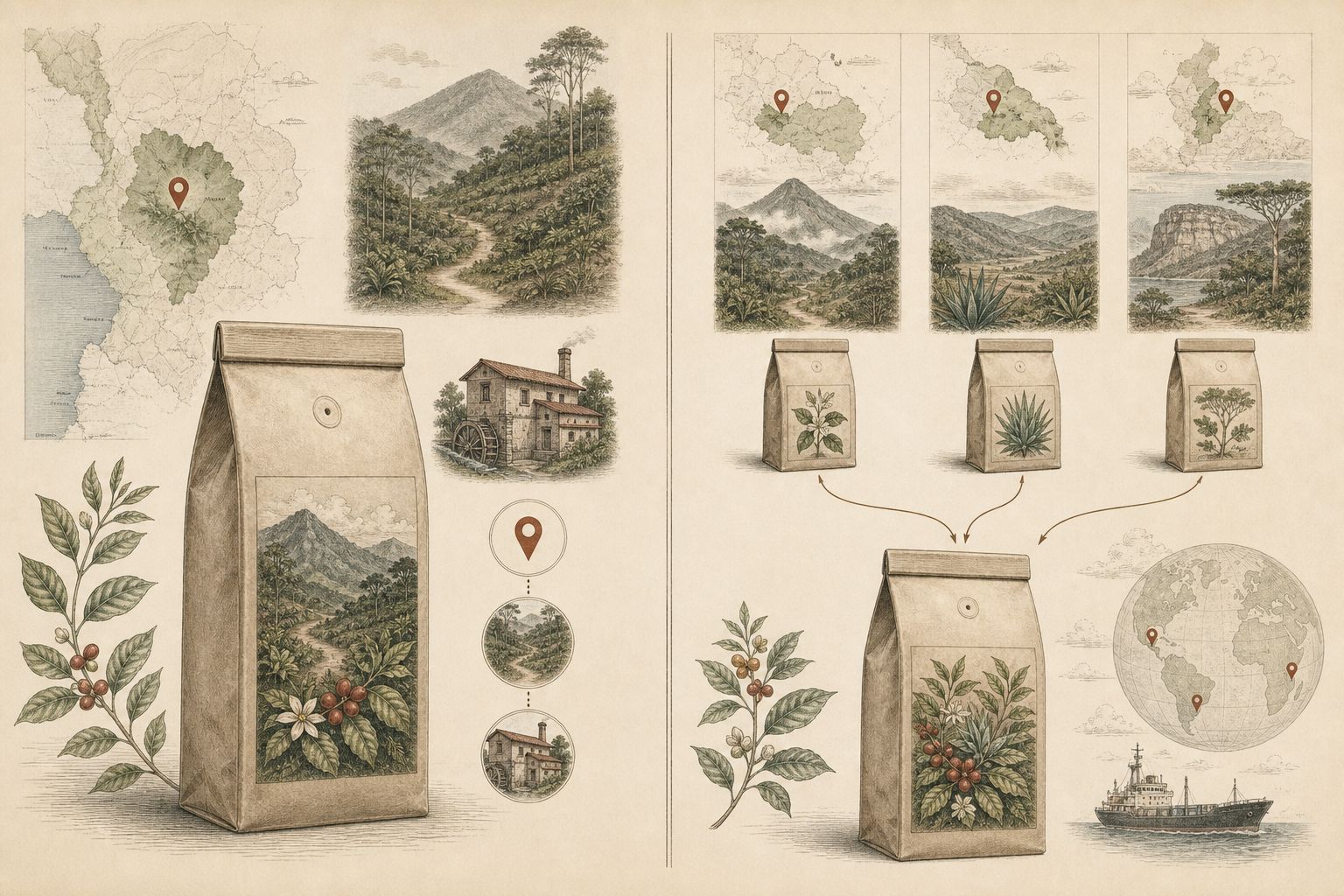
Single-origin coffee comes from one stated source rather than combining coffees from different sources as a blend does. That source may be a country, region, mill, farm, or individual lot, so the label does not describe one fixed level of traceability.
Updated: Aug 20, 2026Reviewed by: Ah-Zhu (English-site batch review)
One source can mean several different scales
On a coffee bag, “single origin” generally means the coffee comes from one stated geographic or production source instead of mixing coffees from multiple sources. There is no single formal definition that fixes how small that source must be.
At the broadest level, the source may be a country such as Ethiopia, Kenya, or Colombia. A more specific bag might name a region such as Yirgacheffe or Sidama, then a cooperative, washing station, farm, or microlot. All of these can appear under the single-origin label.
Single origin can describe a country or a very specific lot. Read the rest of the label to see how precise the source actually is.
Narrower traceability makes it easier to connect the coffee with a producer, processing method, elevation, or harvest. A country-level lot can still contain coffees from multiple regions or elevations, even though it is sold as one national origin.
Single origin and specialty answer different questions
Specialty coffee describes distinctive quality, character, and value, while single origin identifies where the coffee came from. The labels address different aspects of a coffee, so one does not establish the other.
A single-origin coffee can be ordinary or exceptional, just as a blend can combine high-value specialty lots. When a bag carries both terms, “single origin” describes its source, while “specialty” describes how the coffee is positioned and evaluated.
How it differs from a blend
A coffee blend combines at least two coffees. Those components might come from different countries or regions, or even from different varieties or processes at one farm. A product sometimes called a “single-origin blend” still combines components; the shared farm or country simply keeps the geographic scope narrow.
Blends often help roasters maintain a recognizable espresso or house profile by replacing individual components as the seasons change. Single origins are more often chosen to show a particular place or lot, whose flavor may vary from harvest to harvest.
Neither goal is automatically better. Choose a single origin when you want to compare places, processes, or harvests. Choose a blend when you want a dependable profile or a coffee designed for espresso and milk.
What to check on the bag
After the origin name, look for region, producer or station, variety, processing method, and harvest information. These details tell you how much the “single” label actually explains.
Processing and roasting still matter. A washed and a natural coffee from the same region can taste very different, and single origin does not guarantee a light roast. Use the source as a coordinate, then read the rest of the bag before predicting flavor.
Common Misconceptions
Is single-origin coffee automatically specialty coffee?
No. Single origin describes source, while specialty describes recognized attributes and value. A single-origin coffee may be specialty, and a blend may contain specialty lots.
Can an entire country count as a single origin?
It often does in market usage. A country, region, washing station, farm, or microlot may all be sold as single origin. Smaller units generally provide finer traceability.
Does single origin always taste better?
No. It can make origin character easier to explore, while a blend may be designed for consistency or balance. Quality still depends on the lot, roasting, brewing, and your preferences.
Are blends lower quality?
Not inherently. Blends combine coffees for goals such as consistency, espresso balance, or performance with milk. The category does not reveal ingredient quality by itself.
Is a bag labeled Ethiopia a single origin?
It can be. A label naming Yirgacheffe, a washing station, or a specific lot gives more precise traceability than the country name alone.