Why Does Ethiopian Coffee Taste Floral and Fruity?
Ethiopia holds exceptional arabica diversity, and many coffees combine local landrace populations with washed or natural processing. Floral citrus profiles are common in southern washed lots, while natural coffees often lean toward berries and ripe fruit.
Updated: Aug 26, 2026Reviewed by: Ah-Zhu (English-site batch review)
Arabica diversity starts here
Ethiopia is arabica coffee’s principal center of origin and genetic diversity. World Coffee Research traces Coffea arabica to Ethiopia, while later research identifies South Sudan’s Boma Plateau as another center containing a distinct wild population. The country sits in the typical coffee belt, with much production on equatorial highlands.
That history matters in the cup because Ethiopian production still includes diverse landrace populations. Much commercial arabica outside Ethiopia descends from the narrow Bourbon and Typica groups that moved through Yemen. Ethiopian farms and forests retain a much broader plant base.
The country produces overwhelmingly arabica. A 2025 USDA report described Ethiopia as the world’s fifth-largest coffee producer and third-largest arabica producer and exporter, with coffee generating about one-third of export earnings and supporting roughly 15 million people. These numbers describe economic scale; they do not make every lot taste alike.
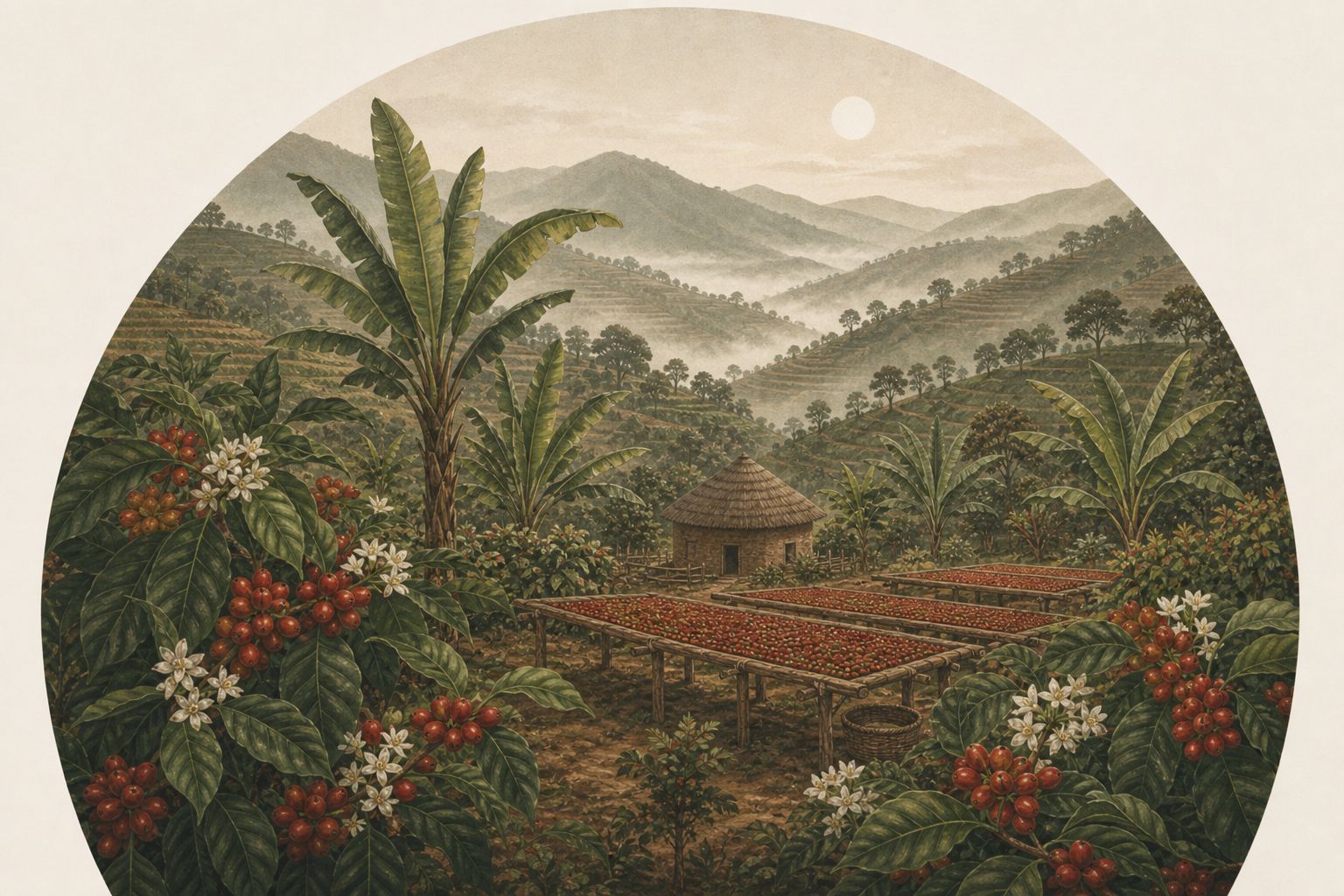
Production systems include forest, semi-forest, garden, and estate coffee. Garden coffee—trees grown near a home alongside food and shade crops—is especially common among smallholders. A literature review estimated roughly half of production in that system, though the figure is not a current census.
Why flowers and fruit appear so often
Three pieces of information help explain the familiar profile: plant material, process, and location.
Southern and southwestern lots frequently contain local landraces rather than one uniform cultivar. Their combined aromatic potential can be complex. Gesha is one famous example of Ethiopian landrace material that later became a traceable variety line, but a bag marked heirloom is usually broader and more mixed.
Processing also influences which flavors stand out. Southern washed coffees are often associated with jasmine-like flowers, bergamot, citrus, tea, and sometimes cocoa. Natural coffees commonly show blueberry, strawberry, jam, dried-fruit, or wine-like notes. Harrar in the east is especially associated with natural processing and more pronounced berry, wine, and chocolate flavors.
Processing often shifts the emphasis, but neither side is a guaranteed flavor formula.
Regional names also offer useful flavor references, though coffees within a region can taste very different. Altitude, climate, local plant populations, washing stations, drying, and lot separation differ across the country.
Reading Yirgacheffe, Sidama, Guji, and Harrar
Yirgacheffe is famous for washed coffees with delicate flowers, citrus, bergamot, peach, and tea-like structure. Natural lots from the same broader area may be far riper and more berry-driven.
Sidama—also spelled Sidamo in coffee trade—is a larger southern reference. Guji, once often grouped into broader southern descriptions, now appears frequently as its own origin name. Harrar lies to the east and is traditionally associated with natural coffee.
Coffee-region names do not always map neatly onto current administrative boundaries.
A bag may stop at a broad region or name a zone, cooperative, washing station, producer, and lot. The more precise information is usually more useful than treating Yirgacheffe or Ethiopia as a flavor brand.
When choosing a coffee, washed processing offers a useful reference for clear floral and citrus flavors, while natural processing more often emphasizes ripe fruit. These tendencies can guide your choice, but tasting the actual lot will give you a better understanding of its character.
Common Misconceptions
Does every Ethiopian coffee taste floral or fruity?
No. Those are common tendencies, especially in high-quality southern lots. Plant population, region, process, roast, and lot quality can produce a very different cup.
Is Ethiopian coffee wild coffee?
Some forest and semi-forest systems include wild or semi-wild material, but much export coffee comes from small garden farms where coffee grows near homes with other crops.
Is Ethiopian heirloom one variety?
Usually not. Heirloom is often a broad label for local landrace populations and may combine cherries from many types of trees.
Are Yirgacheffe, Sidama, and Guji coffee varieties?
No. They are regional or trade-geographic names. Variety or landrace information and processing should be read separately.
World Coffee Research, History of Arabica: Establishes Ethiopia as arabica's principal center of origin and diversity and explains landraces and the later narrow Bourbon/Typica commercial foundation.