Essential Pour-Over Coffee Equipment for Beginners
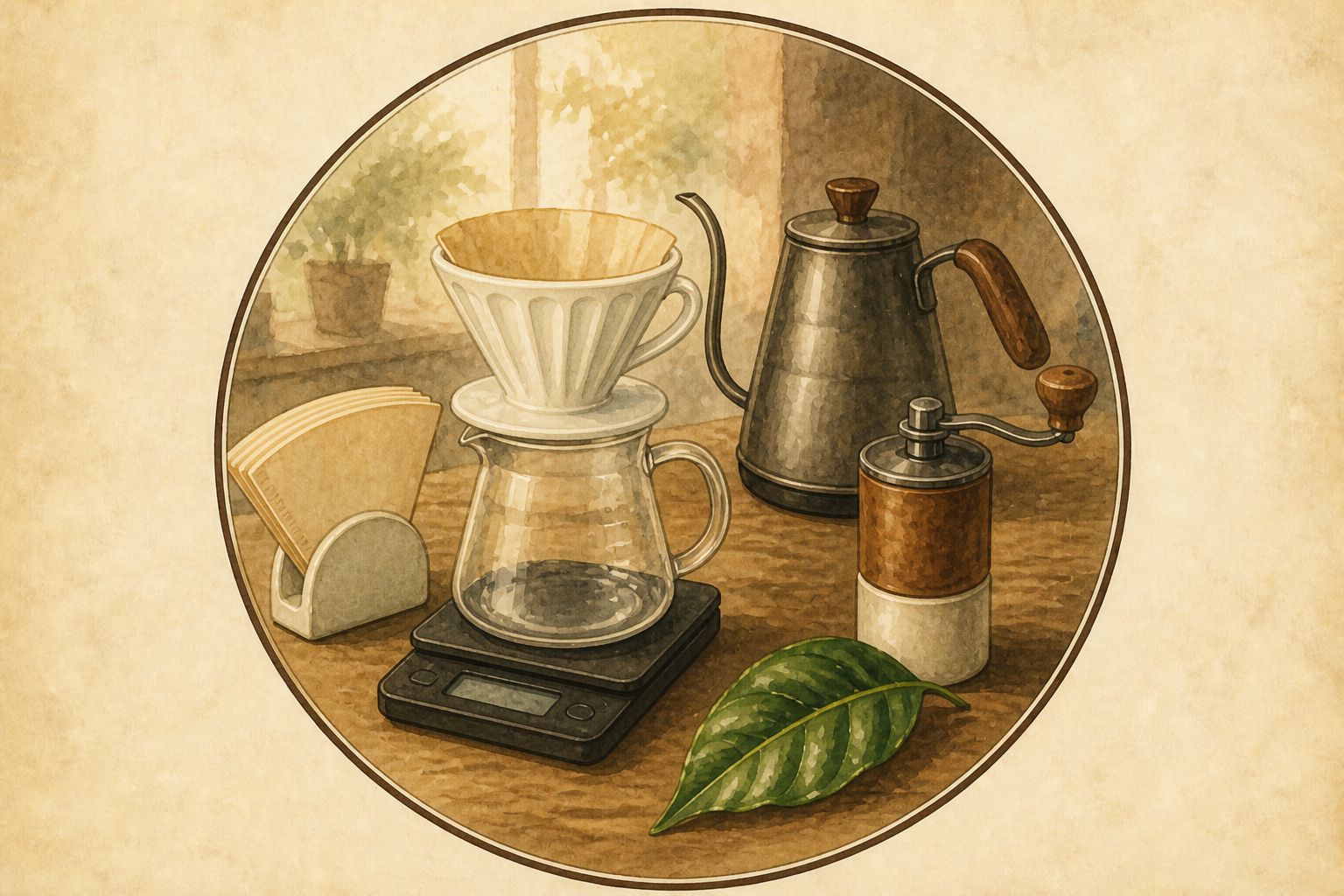
A basic pour-over setup uses a brewer and matching filters, a scale, a kettle, and a grinder. Start with equipment that makes your recipe measurable and repeatable; no single premium shopping list is required.
Updated: Aug 20, 2026Reviewed by: Ah-Zhu (English-site batch review)
What each tool controls
Pour-over uses gravity to move hot water through ground coffee and a filter. Unlike espresso, the method does not depend on pump pressure.
A common starter setup contains five categories:
Filter: separates grounds and changes flow and filtration.
Brewer: supports the filter and shapes the coffee bed and drainage path.
Scale: measures coffee and water so a recipe can be repeated.
Kettle: heats water and controls how it reaches the coffee.
Grinder: sets particle size and consistency.
These tools serve different purposes; you do not need to buy them all at once. Begin with what you already own and spend only when a tool solves a problem you can identify.
Filter and brewer must match
Paper shape and size are designed around brewer geometry. A cone brewer needs a compatible cone filter; a flat-bottom brewer needs the correct flat or basket form. Poor fit can create folds, gaps, bypass, and uneven flow.
Use the manufacturer's specified shape and size; the illustration does not represent a specific product.
Cone and flat-bottom brewers create different bed shapes and flow patterns. Neither geometry is universally better. Choose one with readily available filters and use it consistently while learning.
Material affects heat. Ceramic and glass can absorb substantial heat and often benefit from preheating. Plastic commonly loses less brew heat at the start. Rib design and manufacturing details can also affect flow, so two materials in a similar-looking line may not behave identically.
A scale turns a guess into a recipe
A scale lets you record dry coffee and poured water. Without those two numbers, “too strong,” “too weak,” or “different today” is difficult to diagnose.
The historical SCAA Golden Cup reference uses 55 grams of coffee per liter of water with ±10% tolerance and water-contact temperature around 93°C ±3°C. That is a broad brewing reference, not a command for every coffee. A ratio near 1:16–1:18 is a practical interpretation to test and adjust.
A scale that reads to 0.1 gram is convenient for small coffee doses, though a whole-gram kitchen scale is enough to begin. A timer is useful for observing flow but does not need to be built into the scale.
A controlled kettle helps repeat the pour
Water placement, flow rate, and pulse size affect agitation and how evenly the bed extracts. A gooseneck spout makes a narrow, controlled stream easier. A regular kettle can still work; pour gently, avoid flooding one spot, and learn how quickly its flow changes with tilt.
Temperature control is optional. A thermometer used with an ordinary kettle can measure water temperature, and boiling water can be allowed to cool as needed. Stable pouring and a measured recipe often matter more for a beginner than an expensive electronic kettle.
The grinder usually changes consistency the most
Uneven grounds contain many fine and coarse particles. Fines can extract rapidly and slow drainage, while boulders extract more slowly. Their combined flavors make a recipe difficult to repeat.
Blade grinders chop by time and commonly leave a wide particle range. Burr grinders pass coffee through a controlled gap and make grind changes more predictable. Hand and electric burr grinders can both work well; alignment, burr design, construction, workflow, and range matter more than the power source alone.
No grinder creates identical particles, but a narrower distribution makes adjustment more repeatable.
Grinding whole beans just before brewing also preserves aroma better than storing preground coffee. See grind size for how particle size changes extraction.
What to buy first
Start with the step that addresses a problem in your current setup:
Get a brewer and correctly fitting filters so the method can function.
Add a scale if dose and water are currently guesses.
Improve the grinder when particle inconsistency blocks repeatable results.
Add a gooseneck kettle when pouring control is the remaining problem.
If you already own a good kitchen scale or controlled kettle, keep using it. Five expensive tools do not guarantee good coffee; beans, water, roast, grind, recipe, and personal preference still determine the result. This guide compares equipment roles rather than naming a universal shopping list, so you can evaluate products available in your own market.
Common Misconceptions
Must I buy all five tools at once?
No. A brewer and matching filter create the basic method. Use an existing kettle and kitchen scale if they are workable, then upgrade the step that limits consistency most.
Can I use a blade grinder?
It can break coffee into smaller pieces, but particle size is often very uneven. A burr grinder provides more controllable and repeatable grind settings.
Can I make pour-over without a gooseneck kettle?
Yes. A gooseneck makes flow rate and placement easier to control, but a regular kettle can work with careful pouring.
Does brewer material matter?
Plastic, ceramic, glass, and metal all work. Thermal behavior differs, but matching the filter and learning one brewer's flow usually matters before chasing material.