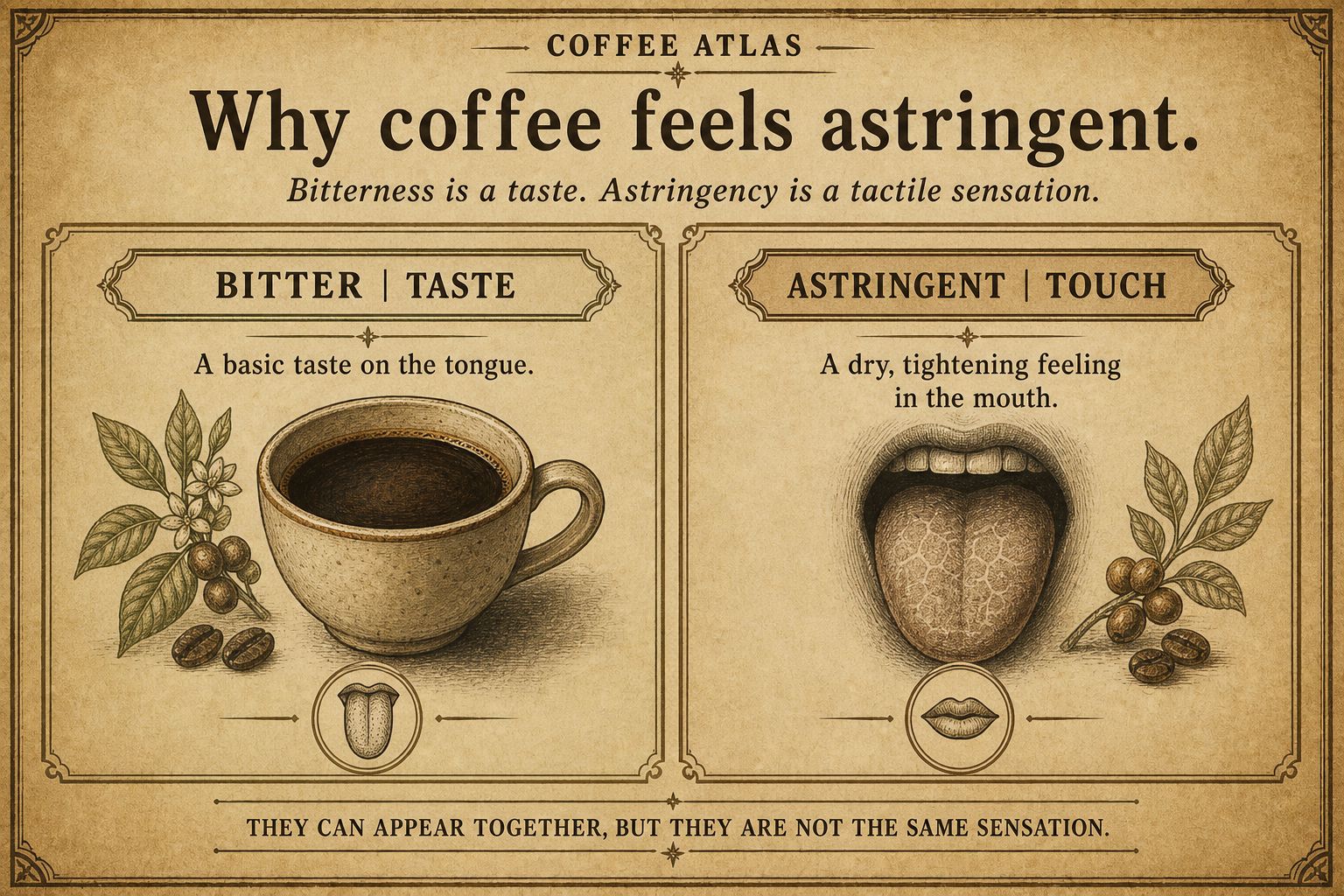
Astringency is a drying, puckering tactile sensation in the mouth, not bitterness itself. Polyphenols can bind salivary proteins and reduce lubrication, so the tongue feels dry. Over-extraction, uneven flow, and immature coffee can make that sensation more obvious; bright acidity is a taste and is not the same thing.
Updated: Sep 7, 2026Reviewed by: Content and layout review
Astringency is a tactile sensation, not a taste
After a sip of coffee, the tongue can feel dry, sandy, or tight—closer to strong black tea or an unripe banana than to a bitter taste. Sensory work calls this mouth-drying, or astringency. It is a tactile impression in the mouth, not one of the basic tastes.
The World Coffee Research Sensory Lexicon describes Mouth Drying as a drying, puckering, or tingling sensation on the surface or edge of the tongue and mouth. SCA Coffee Value Assessment places mouth-drying under mouthfeel, alongside weight and texture, and records intensity separately from whether you like it. Alum solutions are a common training reference so tasters agree on the drying concept first.
This site already treats oral drying as one texture under body and mouthfeel. This page explains why coffee can feel astringent, and how that differs from bitterness.
How it differs from bitterness and acidity
Bitterness is a basic taste on the tongue. Astringency is tactile: once lubrication drops, oral surfaces rub, and the finish feels dry, tight, or sandy. The two can appear together, especially in over-extracted coffee. A bitter cup is not automatically astringent, and a drying cup is not automatically “too bitter.”
Bright fruit acidity is also a taste. People sometimes mix a sharp acid with a drying, astringent finish, because acidity can make the mouth feel drawn. Barista Hustle notes that when a white wine is described as dry, that usually means residual sugar is low and acidity is clear—not that tannin leaves a lingering sandy film. A useful check is whether the tongue still feels dry and tight after you swallow, or whether only sourness or bitterness remains.
Why the tongue feels dry
The prevailing explanation is that polyphenols bind proteins in saliva, the proteins aggregate and precipitate, and the lubricating mechanism saliva provides in the mouth is interrupted. Friction rises, and the surface feels dry and rough. Linne and colleagues restated that mechanism in 2025, often pointing to proline-rich salivary proteins.
Coffee’s most abundant polyphenols are chlorogenic acids, not the condensed tannins that dominate stories about red wine or black tea. Barista Hustle notes that the industry often uses tannin loosely for any polyphenol that precipitates protein, even though coffee’s most common examples are not tannins in the strictest sense. This page stays with polyphenols rather than treating coffee as tea tannin.
Roasting also forms melanoidins. In 2025, Linne, Tello, Simons, and Peterson used sensory-guided fractionation on two drip coffees and isolated a phenolic-rich melanoidin or melanoidin-precursor fraction. Added back to water and coffee at brew-relevant levels, it made a drying, astringent difference that panelists could detect. The authors present this as the first evidence that melanoidins contribute directly to coffee astringency, and they describe the effect as perceptible and subtle.
The left panel shows saliva helping keep the mouth slick. The right panel shows polyphenols binding those proteins so lubrication falls. This is a concept sketch, not a lab photo.
When it is more likely to show up
Over-extracted coffee is often described as harsh, dry, and covered in bitterness. Perfect Daily Grind and this site’s page on over-extraction and under-extraction treat a dry finish as a common over-extraction tendency. Barista Hustle adds that many astringent polyphenols are poorly soluble, so they are more likely to be extracted into the brew at higher extraction yields; if water channels through the bed, local extraction yield can rise even when the overall yield looks normal, and the cup can still taste astringent.
Immature coffee is another recurring source. Hu and colleagues (2020) cite earlier work that immature beans can cause astringency and harm quality. SCA green grading lists immature beans as a Category 2 defect, and this site’s coffee defects page notes that a few immature beans do not automatically ruin a cup. Ripeness is one possible contributor, not a claim that every unripe cherry makes astringency obvious in the flavor.
Sweetness is often described as reducing perceived astringency; acidity and saltiness can make the drying feel stronger. Barista Hustle also notes that cooler temperatures can increase the perception, and that fats or oils in espresso can partly block protein binding. Those are perceptual and matrix tendencies, not a guaranteed way to remove astringency.
Also, do not treat light-roast coffee as automatically more astringent. Chlorogenic acids usually decline as roasting progresses, while melanoidins form during roasting. Both families can participate; the actual flavor still has to be tasted.
The left panel shows brewing that pulls more polyphenols. The right panel shows immature coffee as another possible source. Results vary by lot and brewing conditions.
If the same bag and roast feel especially dry and astringent after this brew, a high extraction yield—or water running unevenly through the bed—is a common first cause. Grind size, contact time, and temperature are the home variables that are easiest to change; change one at a time. Use those changes to assess whether brewing can be ruled out as the source of the dryness. If many brew attempts still come out dry and astringent, look next at ripeness, defects, or the coffee itself.
Common Misconceptions
Is astringency the same as bitterness?
No. Bitterness is a taste. Astringency is a drying, tightening tactile sensation. They often show up together in over-extracted coffee, but they are still different things to describe.
If a coffee tastes very acidic, is that astringency?
Not automatically. Bright acidity is a taste. Astringency is the dryness that can linger on the tongue after you swallow. Sharp acid can make the mouth feel tight, but that is not the same as mouth-drying. See why coffee tastes fruity.
Does astringency always mean over-extraction?
No. Over-extraction and uneven flow through the coffee bed are common brewing explanations, and immature coffee can also contribute. If this brew of the same bag feels especially dry and astringent, brewing is a reasonable first check. See over-extraction and under-extraction.
Do immature beans always make the cup dry?
Research often links immature coffee with astringency, but a few beans do not automatically ruin a cup. SCA green grading lists immature beans as a Category 2 defect. See coffee defects.
Is any astringency a defect?
Excessive drying and sandiness are usually unwanted. Mild drying can exist, and cupping forms record intensity separately from preference. The usual problem is drying that crowds out other textures and flavors, not the complete absence of dryness.
SCA Standard 103-2024, Coffee Value Assessment: Descriptive Assessment: Defines mouthfeel as the tactile sensation of liquid in the mouth, excluding temperature. It includes weight, texture, and other tactile attributes such as mouth-drying (astringency). Intensity is recorded separately from preference.
World Coffee Research, Sensory Lexicon: Defines Mouth Drying as a drying, puckering, or tingling sensation on the surface and/or edge of the tongue and mouth, with alum solutions as intensity references.
Barista Hustle, Why Can Coffee Dry Your Mouth?: Calls the sandy dry feeling astringency and compares it with strong black tea and unripe banana. It notes that the coffee industry often uses tannin loosely for polyphenols that precipitate proteins, even though coffee’s most common examples are not tannins in the strictest sense. Higher extraction and channeling are offered as common brewing explanations; sweetness is described as reducing perceived astringency, while acidity, saltiness, cooler temperature, and espresso oils are discussed as conditions that can change perception.