Coffee cupping uses a repeatable preparation to smell, taste, describe, and compare coffees. It can document sensory attributes or evaluate quality and preference. A score is an industry communication tool, not a certificate or a guarantee that you will like the coffee.
Updated: Aug 22, 2026Reviewed by: Ah-Zhu (English-site batch review)
Cupping creates a common comparison condition
Coffee cupping is a structured way to smell, taste, and compare samples. Multiple cups from the same lot can be prepared separately so an evaluator can observe both sensory character and consistency.
The 2024 SCA standard allows cupping to support descriptive assessment—what attributes are present—and affective assessment—how quality or preference is evaluated. That means cupping is both tasting and, in some settings, scoring.
Many tasting notes and quality scores on coffee bags come from cupping. The results also influence how green coffee is compared, priced, and discussed as specialty coffee.
Why the preparation is standardized
If every sample used a different pour-over recipe or espresso setting, differences in technique could overwhelm differences between coffees. Cupping reduces those variables by controlling dose, water, grind, time, and tasting sequence.
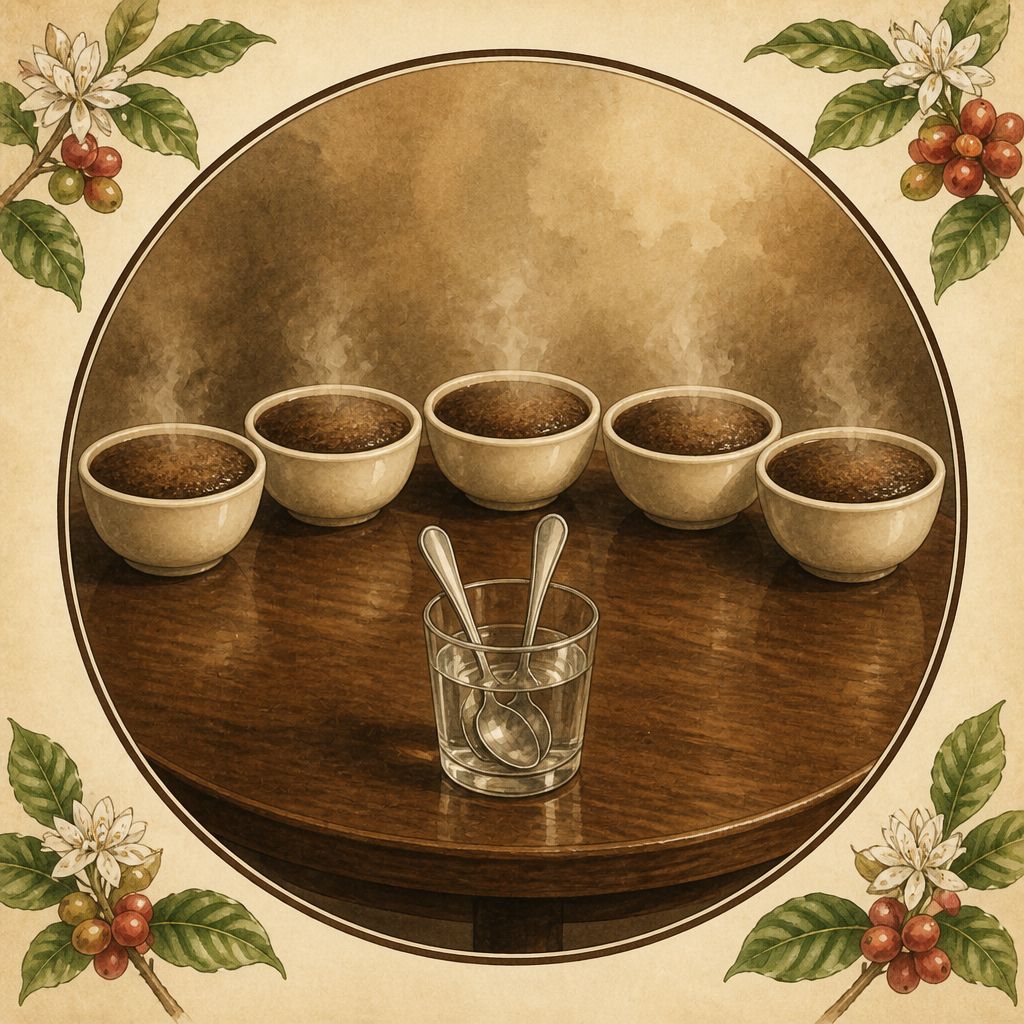
SCA Standard 102-2024 uses 8.25 grams of coffee for each 150 milliliters of bowl capacity and water near 93°C, with a tolerance of 3°C. The grind is slightly coarser than typical paper-filter brewing. Grounds float into a crust that remains undisturbed for about three to five minutes before it is broken. Affective assessment uses five cups of the same sample to reveal inconsistency.
Sample roast color is also controlled for comparison, using a medium reference that does not necessarily match the “medium roast” on a retail bag.
What happens at the table
Evaluators first smell the dry grounds for fragrance. After water is added, they smell the wet aroma and the crust, then break the crust and remove floating material.
Once the coffee cools enough to taste, a spoon carries a small amount to the mouth. A forceful slurp spreads liquid across the tongue and palate while aroma reaches the nose. Evaluators consider flavor, aftertaste, acidity, sweetness, and body.
Cupping keeps grounds in the bowl for a repeatable comparison. Pour-over passes water through a bed and filter to prepare a beverage.
The SCA permits other preparations, such as filtered coffee or French press, for some descriptive work. Affective evaluation uses the standardized five-cup method because repeatability and sample uniformity matter.
Description and preference are not the same result
In 2024, the SCA formally adopted CVA descriptive and affective assessments and sample-preparation mechanics to replace the 2004 cupping forms and protocol.
Descriptive assessment records attributes and their intensity without deciding whether they are desirable. Affective assessment records quality impressions or preferences. The full CVA framework also considers physical green-coffee information and extrinsic facts such as origin and processing. See coffee defects for more on visible faults in green coffee.
Descriptive assessment records the coffee's attributes, while affective assessment considers how the evaluator or market values them.
Many companies still use the older 100-point form, and 80 points remains common trade language, so ask which method produced a score before comparing it with others. A score provides a shared reference under specified evaluation conditions, but it also reflects the evaluator’s or market’s quality impressions and preferences. Recording sensory attributes and judging their desirability are distinct tasks.
Common Misconceptions
Is cupping tasting or scoring?
It can be both. A session may describe aroma, flavor, acidity, body, and finish, or it may evaluate quality and preference using a structured form.
Does a higher score guarantee better-tasting coffee?
No. A score communicates an evaluation under specific conditions and reflects a preference framework. It cannot guarantee your personal preference or home-brewing result.
Is pour-over the same as cupping?
No. Traditional cupping immerses grounds in the bowl for comparison, while pour-over moves water through a coffee bed and filter to prepare a drink.
Can someone cup coffee without a certification?
Yes. Training and calibration make results more comparable in trade, but anyone can use a consistent bowl method to compare coffees. A score on a bag is not itself a certificate.
Do all tasting notes on a bag come from cupping?
Many do, but a bag may not identify the evaluator or method. Use the notes as a direction rather than a guarantee.
Is 80 points a legal definition of specialty coffee?
No. It remains a common operational threshold from the older scoring system. The current SCA definition and CVA framework are broader.