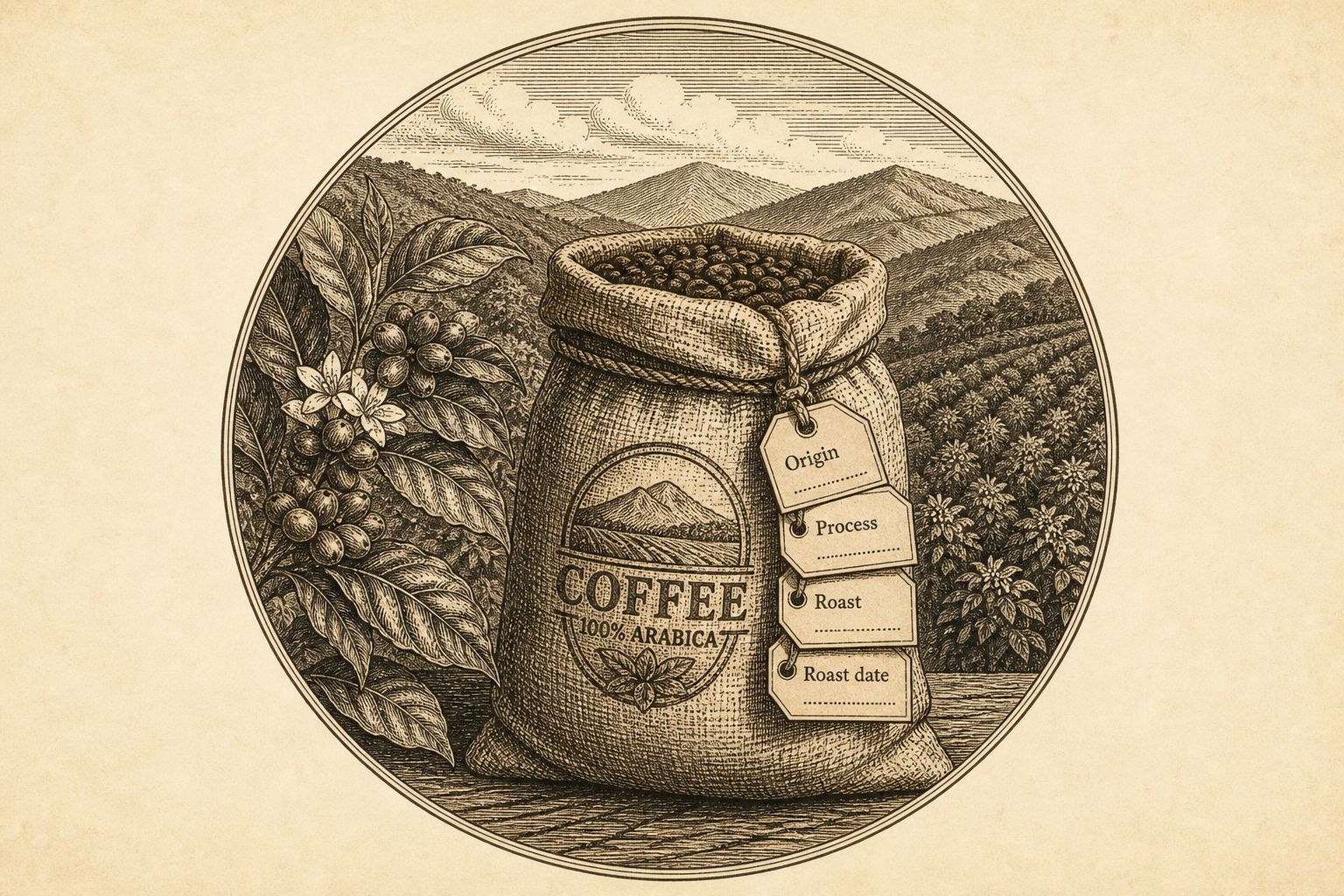
Start with origin, processing method, roast level, and roast date. Those four fields explain where the coffee came from, how the fruit became green coffee, how far it was roasted, and when it was roasted. Flavor notes are guidance, not a guarantee.
Updated: Aug 20, 2026Reviewed by: Ah-Zhu (English-site batch review)
Find four fields first
A detailed coffee label records how the coffee was produced and roasted. Start with origin, processing method, roast level, and roast date, then use flavor notes, variety, elevation, certifications, and export grades to fill in the details.
The SCA’s Coffee Value Assessment includes origin, processing, certifications, and other information outside the cup as part of coffee value. Those details do not replace sensory quality, but they help explain why a lot is distinctive and traceable.
This sample label highlights origin, variety, processing method, roast level, and roast date.
Origin tells you where the coffee was produced. A country can be sold as a single origin, while a region, station, farm, or microlot gives finer traceability. A blend combines multiple coffees.
Processing tells you how harvested fruit became dry, stable coffee. Washed coffee often has a clean, clearly defined flavor profile, while natural coffee commonly has fuller ripe-fruit character. Honey processing dries coffee with some mucilage retained. These are tendencies, not flavor guarantees.
Roast level describes how far green coffee was roasted. Light roasting often preserves more recognizable origin character, while dark roasting emphasizes roast-derived flavors. Roasters do not share exact light-medium-dark boundaries.
Variety names the plant material, such as Typica, Bourbon, or Gesha. Variety can influence the cup, but farming, environment, processing, roasting, and brewing remain important.
Roast date is different from a best-by date
Roasting creates carbon dioxide and volatile aroma compounds. Gas leaves whole beans over time, and grinding accelerates the change by exposing far more surface area.
Peter Giuliano’s SCA article uses retained carbon dioxide as one freshness reference and describes whole beans within roughly three weeks of roasting as fresh by that measure. That is not a universal peak-flavor deadline. Different coffees, roasts, packages, and brewing methods age at different rates.
Very fresh coffee can also be difficult to brew because abundant gas interferes with even wetting and extraction. Some brewers wait several days, and espresso may benefit from a longer rest. A best-by date usually reaches much farther into the future and cannot tell you when roasting occurred.
A roast date identifies when the beans were roasted. A best-by date alone does not provide that information.
Treat tasting notes as a direction
Blueberry, jasmine, chocolate, or black currant usually describe an evaluator’s sensory association. They are not added ingredients unless the package separately says the coffee is flavored.
Your result can differ because of water, grind, extraction, roast, freshness, and sensory vocabulary. Use the notes to choose a direction and compare your experience, not to decide that you brewed incorrectly when one word does not appear.
Elevation, certifications, and grades add context. Higher elevation can be associated with slower development and denser seeds under some conditions, but it is not a universal quality rule. Certifications describe production or trade requirements. Export grades vary by country and may focus on size rather than taste.
When choosing a bag, match the information to your goal. For clear acidity, look at origin, processing, and a not-too-dark roast. For ripe fruit character, explore natural processing. For a stable daily espresso, a transparent blend plus a useful roast date may matter more than a long list of tasting notes.
Common Misconceptions
Should I avoid coffee without a roast date?
Treat it as missing information. A distant best-by date does not reveal when the coffee was roasted or how much aroma may already have changed.
Will I taste every flavor note on the bag?
Not necessarily. Notes describe a sensory impression under particular conditions. Your water, grinder, recipe, roast development, and preferences can produce a different result.
Can a country name count as a single origin?
Yes in common market usage, but a region, station, farm, or lot provides more precise traceability.
Does a specialty label guarantee 80 points?
No. Eighty points is a long-used industry reference, but the bag may not identify the evaluator or protocol.
Do grades such as AA or SHG guarantee better flavor?
No. They may describe screen size or an export classification. For example, Kenya AA primarily identifies bean size, not a flavor score.