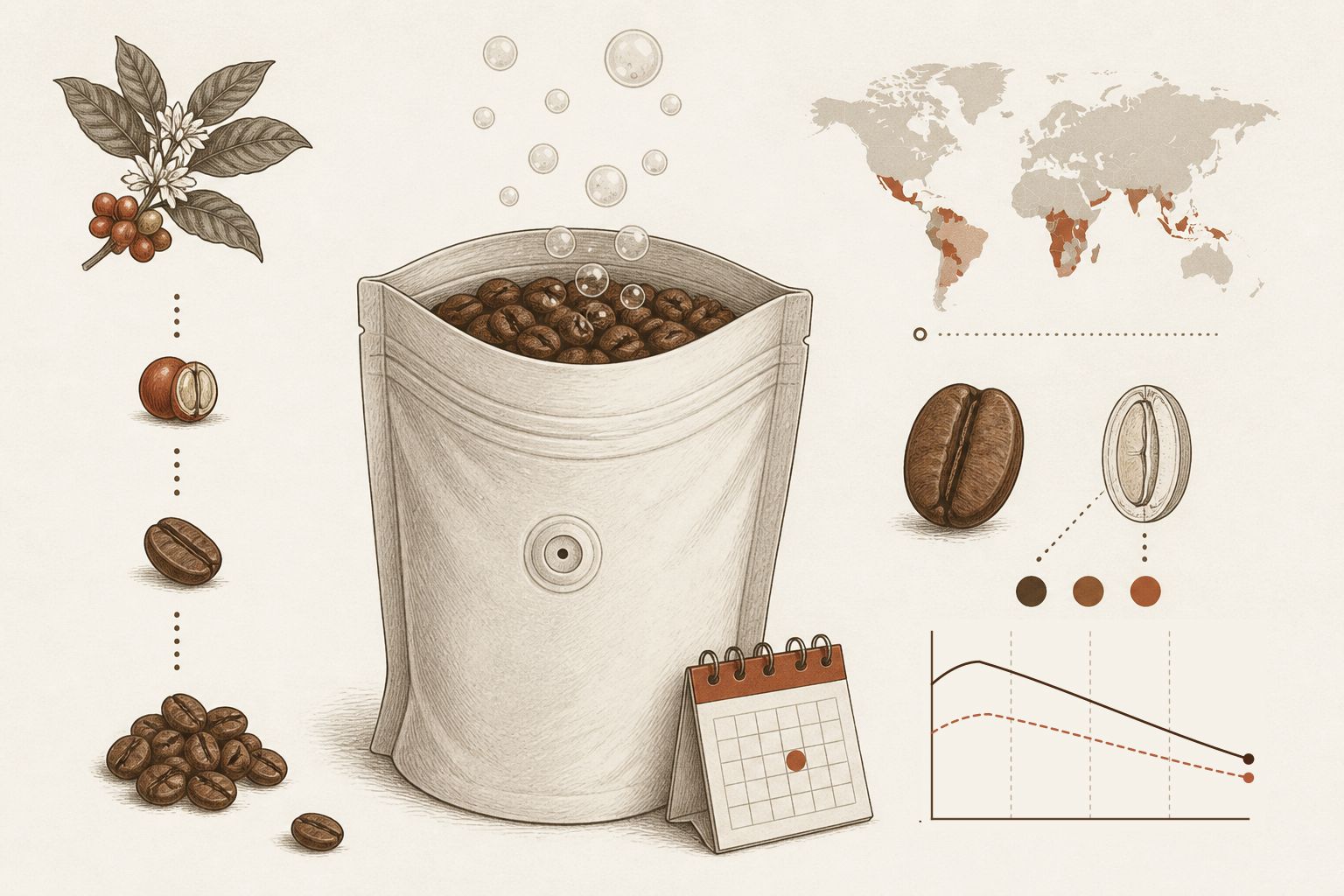
Roasted coffee releases trapped carbon dioxide over time. Brewing immediately can create gas bubbles that interfere with even wetting and extraction, so filter coffee often benefits from a few days of rest and espresso commonly benefits from longer.
Roasting creates carbon dioxide and traps part of it within the porous coffee structure. The gradual release of that gas is called degassing. Allowing the coffee to move through some of that process before brewing is commonly called resting.
The roast date is therefore not a countdown to instant decline. A coffee can be too gas-rich for consistent brewing on day zero and easier to extract several days later. See how to read a coffee bag for the difference between roast date and a best-by claim.
What carbon dioxide changes
Carbon dioxide is generated during reactions that also create coffee aroma. Some leaves during roasting, while some remains in the bean and escapes during storage, grinding, and brewing.
When very fresh grounds meet water, rapidly escaping gas creates bubbles and resists even contact between water and coffee particles. In pour-over, this appears as a large bloom. In espresso, gas contributes to crema. Neither a dramatic bloom nor thick crema guarantees a balanced extraction.
Resting can reduce gas interference and make brewing more repeatable.
Carbon dioxide also interacts with storage. While abundant gas escapes outward, it can slow oxygen entry. As degassing diminishes, oxygen-driven staling becomes a larger concern. Resting and freshness therefore overlap rather than forming a simple “new is good, old is bad” line.
How long should coffee rest?
There is no universal schedule. Industry interviews commonly place an initial usable range from a few days to two or three weeks after roasting. Filter coffee may become workable after one or several days. Espresso’s short, pressurized extraction is often more sensitive to gas and may benefit from five to seven days or longer.
Roast and processing can change the pace. Darker coffee has a more fractured structure and commonly degasses faster. Lighter coffee may retain gas longer. Some natural coffees are rested longer than washed coffees in particular roastery workflows. These are tendencies, not rules.
SCA freshness material shows rapid degassing during approximately the first 20 days and a slower rate afterward. Using carbon dioxide as one freshness marker, whole beans can be considered fresh for roughly the first three weeks; ground coffee changes much faster. Sensory peak and carbon-dioxide level are not identical, so some coffees remain expressive for a month or more.
The curve is conceptual. It is not a fixed calendar for every coffee.
Find the window by tasting
Use the roast date as a starting coordinate. Brew the same coffee with a repeatable recipe on different days. If the grounds repel water, espresso runs unpredictably, or flavor feels disjointed, wait another day or two. If aroma and definition begin to fade, the peak may be passing.
Resting should make coffee easier to enjoy, not create a rigid ritual. Store the bag well throughout the comparison; otherwise oxygen, moisture, heat, and light can obscure the change you are trying to observe.
Common Misconceptions
Is coffee best immediately after roasting?
Not always. Very fresh coffee can release enough gas during brewing to interfere with even wetting and extraction. A few days of rest often helps.
Must every coffee rest exactly seven days?
No. Coffee, roast, process, package, grinder, and brew method all change the useful window.
Does a large pour-over bloom prove the coffee tastes better?
No. A large bloom shows that substantial gas is escaping. It is a freshness clue, not a quality score. See [why coffee blooms](/en/knowledge/bloom/).
Is resting the same as storage?
No. Resting describes the post-roast degassing period. Storage describes how you limit oxygen, moisture, light, and heat throughout the coffee's life.