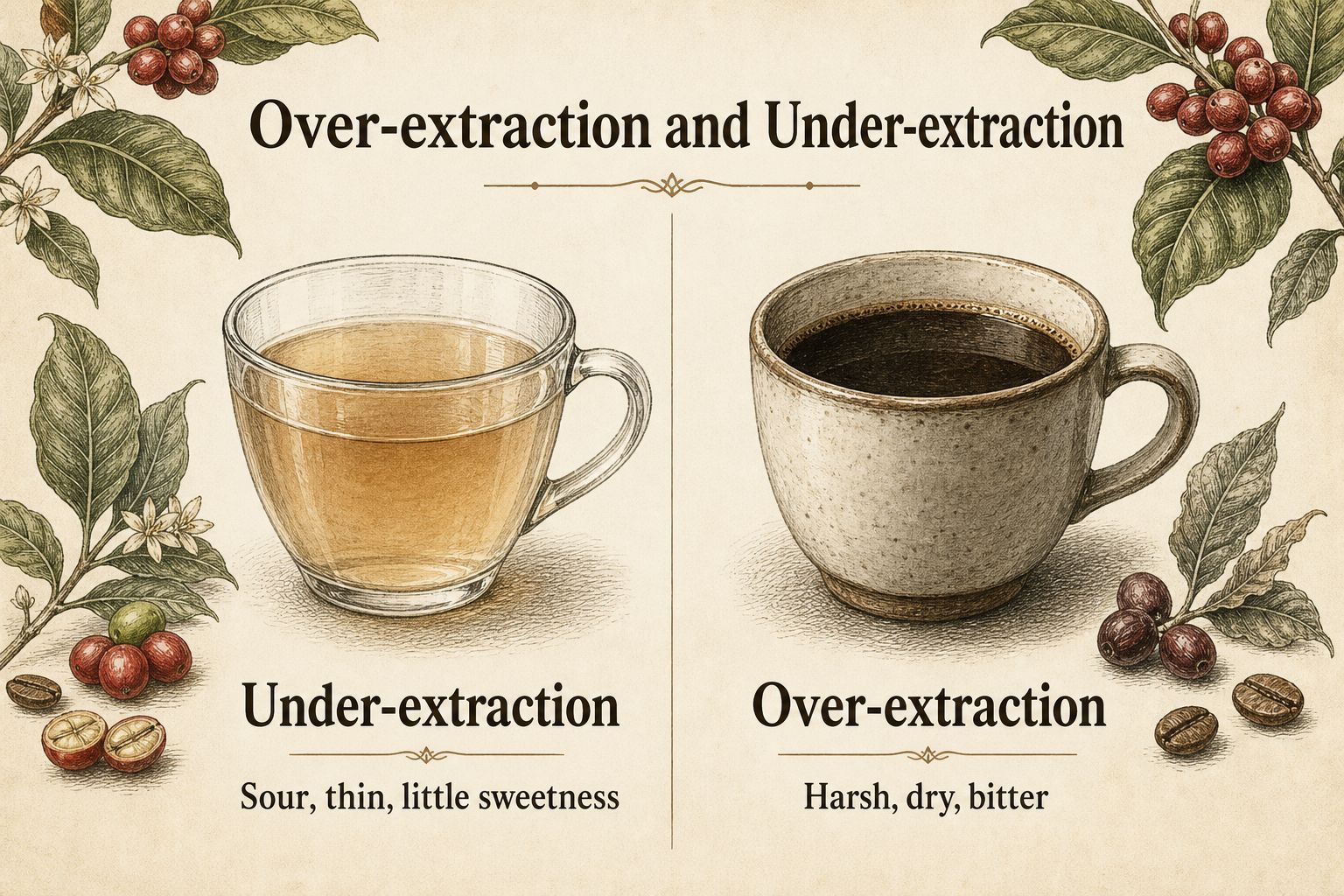
Extraction is the process of water drawing soluble material out of the coffee. Under-extraction often tastes sharp, thin, and short on sweetness. Over-extraction often tastes harsh, dry, and bitter. Strength is how concentrated the cup is, which is not the same as extraction yield. Bright fruit acidity and roast bitterness are not automatically extraction problems.
Updated: Oct 2, 2026Reviewed by: Content and layout review
What to check before your next brew
Note the beans, coffee dose, water amount, grind setting, water temperature, and brew time. For pour-over and other filter coffee, choose the closest situation below and change just one setting, keeping the rest as consistent as you can. Taste gives you a clue, not a measurement of extraction yield.
You like the flavor, but the strength is wrong
Check first: Is the whole drink too concentrated or dilute, or are sharp sourness and dryness the real problem? Weigh the coffee and water to confirm your brew ratio.
Try one change: Keep the coffee dose fixed and change only the brew-water amount slightly: less for a weak cup, more for a strong one. Use the brew-ratio calculator to work out the amounts. Changing brew water can also change extraction, so this is not a strength-only adjustment.
Understand why: Adding water after the brewed coffee has been separated from the grounds lowers its concentration without returning extracted material to the grounds. That differs from changing brew water; see strength versus extraction yield below.
The cup is sharply sour and thin
Check first: Does the roast level or flavor description suggest bright acidity? If the cup is also bitter, or results vary widely, use the unevenness check below first.
Try one change: If your brewing is consistent, try a slightly finer grind while keeping the ratio, temperature, and pouring pattern unchanged. Treat it as a flavor comparison, not proof that the previous cup was under-extracted.
Understand why:Fruit acidity is not automatically under-extraction. Grind size also affects water flow, so finer is not always better.
Bitterness dominates and the finish is dry
Check first: Dark roasting can contribute bitterness. Consider whether you changed the beans, water, or brewing method; if results are erratic, work on consistency first.
Try one change: With a repeatable brew, try a slightly coarser grind. Keep the ratio, temperature, and pouring pattern the same and compare your preference. If it does not help, do not keep moving in the same direction automatically.
Understand why:Bitterness and astringency have several possible sources. This trial cannot prove that the last cup was over-extracted.
The cup is both sour and bitter, or changes every time
Check first: Compare the measured coffee and water amounts, the distribution of the grounds, and whether you keep pouring into one spot. These are things to investigate, not confirmation of channeling from taste alone.
Try one change: Choose one visible inconsistency. For example, if the dry grounds are sloping in your pour-over brewer, level them before the next brew and keep the other settings unchanged. If nothing stands out, repeat and record the current setup before choosing finer or coarser.
When the cup in your hand tastes especially sour or bitter, people sometimes blame extraction.
Extraction is the process of water drawing soluble material out of the coffee. Under-extraction means too little material was taken from the grounds. Over-extraction means too much was taken. Perfect Daily Grind describes it as dissolving: acids, sugars, caffeine, and lipids moving into the water are why you can taste the coffee.
During brewing, a coarse grind, cooler water, or a short contact time more often leads to under-extraction. A fine grind, hotter water, or a long contact time more often over-extracts. See grind size for that relationship.
Strength is not extraction yield
Everyday “strong coffee” mixes up roast color, body, and how much actually dissolved.
Strength is how concentrated the drink is—the proportion of dissolved material in the beverage—often measured as total dissolved solids (TDS). Extraction yield is how much material was taken from the grounds. Coffee-to-water ratio affects strength more directly, while grind size, temperature, and contact time more often affect extraction yield. A concentrated coffee can still be under-extracted, while a dilute coffee can be over-extracted.
The 2015 SCAA Golden Cup reference for filter coffee is about 1.15% to 1.35% TDS from an 18% to 22% extraction yield.
A later UC Davis consumer study also found that one reference range cannot account for everyone’s preferences. Among 118 black-coffee drinkers, liking varied widely across strength and yield, even splitting into two preference clusters. That is also a reminder that the classic brewing-control-chart “ideal” extraction window is not a flavor everyone will like.
Strength is how concentrated the cup is. Extraction yield is how much material was taken from the grounds. The drawing is a concept, not a brewing control chart and not measured data.
How different extraction yields change the cup
Under-extracted coffee often tastes relatively sharp, acidic, thin, and short on sweetness, sometimes even a little grassy and incomplete. A common teaching sequence is that acidic notes dissolve earlier, sweetness follows, and bitterness shows up later. If too little material has been extracted from the grounds, acidity may be more noticeable than sweetness. That is the extraction order often used in teaching, but it is not a precise chemical clock; many compounds are actually extracted in overlapping waves.
Over-extraction’s bitterness often covers the other flavors, with a dry, harsh finish. Perfect Daily Grind notes that bitter material is more likely to dominate later in extraction. A very fine grind, high water temperature, or long contact time can make bitterness mask sweetness and acidity. See why coffee tastes bitter.
Both particle-size distribution and even water flow affect extraction. Channeling concentrates flow in lower-resistance areas, so water does not reach every part of the bed equally. Alongside grind size, check how evenly you distribute the grounds or pour the water; sourness or bitterness alone does not tell you which direction to adjust.
Sour and bitter are not always extraction
Bright fruit acidity is not the same as the sharp, hollow sourness of under-extraction.
Citrus or berry notes on a bag are often that clean acidity showing up in the cup. Specialty tasting treats acidity as something to describe, not automatically as a fault. Under-extraction is more about thinness, missing sweetness, and a cup that never fully developed. Vinegar, harsh fermentation, and mold belong with processing or storage. See why coffee tastes fruity or acidic.
Bitterness splits the same way. Light-to-medium roasts often have a cocoa-like bitterness. Darker roasting more often creates a harsher, throat-catching bitterness that lingers, the result of chlorogenic acids turning into lactones and then phenylindanes. Over-extraction can push bitterness forward, especially late in the brew, but a bitter cup is not a diagnosis by itself.
Fruit acidity and roast bitterness can show up without an extraction error. The drawing is a concept, not a diagnosis of any one cup.
How you can adjust at home
Use the checks at the top to choose one comparison, then record whether you preferred the result. Grind, contact time, and water temperature are all possible variables for later trials; change one at a time rather than combining adjustments. A useful change should be repeatable with the same coffee and method.
Keep the coffee’s inherent acidity and roast bitterness in mind. Brewing water also affects flavor, so an unsatisfying result does not have to come from over-extraction or under-extraction.
Common Misconceptions
Does sour coffee always mean under-extraction?
No. Under-extraction often tastes sharp, thin, and short on sweetness. Bright fruit acidity on a light roast is a different thing. Vinegar, harsh fermentation, and mold belong with processing or storage problems.
Does bitter coffee always mean over-extraction?
No. Over-extraction often tastes harsh, dry, and bitter. Darker roasting also creates harsher bitterness that lingers. See the bitterness page for the roast chemistry.
Is a strong cup over-extracted, and a weak cup under-extracted?
Those are different measurements. Strength is mostly about the coffee-to-water ratio. Extraction yield is how much material was taken from the grounds. A cup can be strong and still under-extracted, or weak and already over-extracted.
Is 18% to 22% extraction the only good range?
That is the SCAA Golden Cup reference for filter coffee, not a proof of quality. Later consumer work found two preference clusters across a wider range of strength and yield.
Why can one cup taste both sour and bitter?
Uneven grind or channeling can over-extract some particles and under-extract others in the same brew. Fix evenness before chasing a finer or coarser grind in one direction.
Barista Hustle, B1 3.02 – Channelling: Explains how espresso water follows lower-resistance areas and how uneven distribution or tamping can cause channeling.
SCAA Standard, Golden Cup, revised 23 December 2015: Provides filter-coffee reference ranges: brew strength of 11.5 to 13.5 g/L TDS (about 1.15% to 1.35%) from an 18% to 22% extraction yield, with a recommended 55 g coffee per liter of water plus or minus 10%. These industry reference ranges do not guarantee that the result will suit every drinker.
Perfect Daily Grind, Coffee 101: Extraction & The “Strong Coffee” Myth, 2017: Distinguishes colloquial strength from extraction. Brew ratio changes concentration in the cup more directly; grind, temperature, and contact time are the variables most people can use to change how thoroughly the dose is extracted.
Hazel, Coffee Extraction & How It Helps Create The Perfect Cup, Perfect Daily Grind, 2018: Defines extraction as dissolving flavor compounds into water. Common industry teaching is that acidic notes come out earlier, sweetness next, and bitterness later; under-extraction often lacks sweetness, over-extraction lets bitterness dominate. Uneven grind or channeling can mix both in one cup. The article also warns against chasing a single perfect percentage.