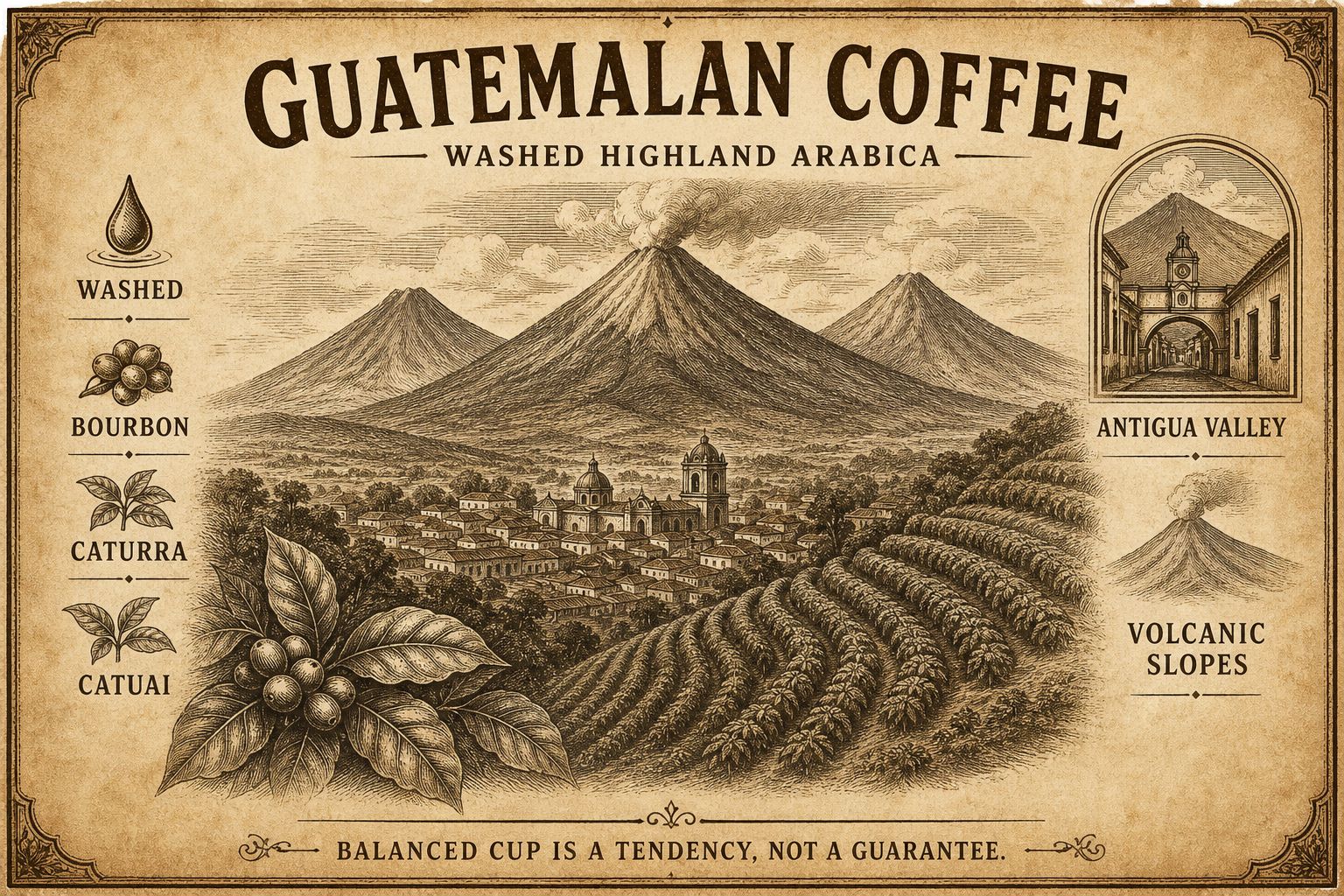
What Does Guatemalan Coffee Taste Like—and What Is Antigua?
Guatemalan specialty coffee is often high-grown washed arabica with balanced acidity, sweet citrus, flowers, cocoa, or nuts. Antigua is a volcanic-valley region, while SHB is a high-elevation hard-bean classification—not a cup score.
Updated: Aug 20, 2026Reviewed by: Ah-Zhu (English-site batch review)
Three different labels on one bag
A bag marked Guatemala Antigua SHB identifies the country, the volcanic-valley growing region of Antigua, and a trade classification. SHB stands for Strictly Hard Bean and is associated with high-elevation, dense coffee.
Guatemala’s 2025/26 production was listed by USDA at about 3.16 million 60-kilogram bags, roughly 2% of world output. Arabica covers about 98% of planted area. A 2025 report counted approximately 125,000 smallholders; they represented most producers but less than half of output. Anacafé is the national coffee association.
For a specialty buyer, the common baseline is high-grown washed arabica. Region, farm, variety, and lot still create substantial differences.
Why the profile is often called balanced
Washed processing, elevation, and traditional arabica varieties commonly produce a clean cup with moderate-to-rounded acidity. Tasting reports frequently mention sweet citrus closer to orange than lemon, flowers, nut-toned chocolate or cocoa, and a smooth texture that can range from light to full.
Blind tasters may not always distinguish Guatemala from neighboring Central American origins. Its classic profile often emphasizes balance, with no single flavor dominating the cup.
Farms still grow Bourbon, Caturra, Catuai, Typica, and other material, sometimes harvested together. Variety and processing can outweigh a broad regional expectation.
Regional tendencies overlap and do not replace producer, variety, process, or lot information.
Antigua is a region, not a quality adjective
Antigua surrounds the historic city in a valley framed by Fuego, Agua, and Acatenango volcanoes. Its long production history, fertile volcanic landscape, distinct wet and dry seasons, established estates, and proximity to the capital helped make its name internationally familiar.
Common descriptions emphasize sweetness, aroma, and balance. That does not mean every coffee sold as Guatemala comes from Antigua, nor that the region automatically outperforms the rest of the country.
Huehuetenango and SHB
Huehuetenango lies toward the Mexican border. It is high, relatively dry during harvest, remote, and associated with limestone landscapes. Some buyers describe its coffees as more acidic, full-bodied, or occasionally wine-like than the Antigua reference.
The illustration shows relative position, not precise administrative boundaries.
Anacafé promotes eight regional identities, including Antigua, Highland Huehue, Acatenango, and Atitlán. Geography gives the categories some meaning, but Coffee Review cautions that cup profiles align only loosely and can be overtaken by variety and processing.
SHB describes coffee grown under conditions associated with slower development and harder, denser beans. USDA reported roughly 83% of exports in that class in 2025. It is valuable physical and trade information, but it does not guarantee careful harvesting, defect-free processing, or a high cup score.
Common Misconceptions
Is all Guatemalan coffee from Antigua?
No. Antigua is one region. Huehuetenango, Acatenango, Atitlán, and other Anacafé regions also appear frequently in specialty coffee.
Is Antigua automatically better?
No. Its history and recognizable valley make the name prominent, but many buyers value Huehuetenango and other regions just as highly.
Does SHB guarantee better flavor?
No. Strictly Hard Bean is an elevation- and density-related trade classification, not a cupping score or quality guarantee.
Is all Guatemalan coffee washed?
Most exports are washed, but natural, honey, and experimental processes also exist. Read the process on the bag.