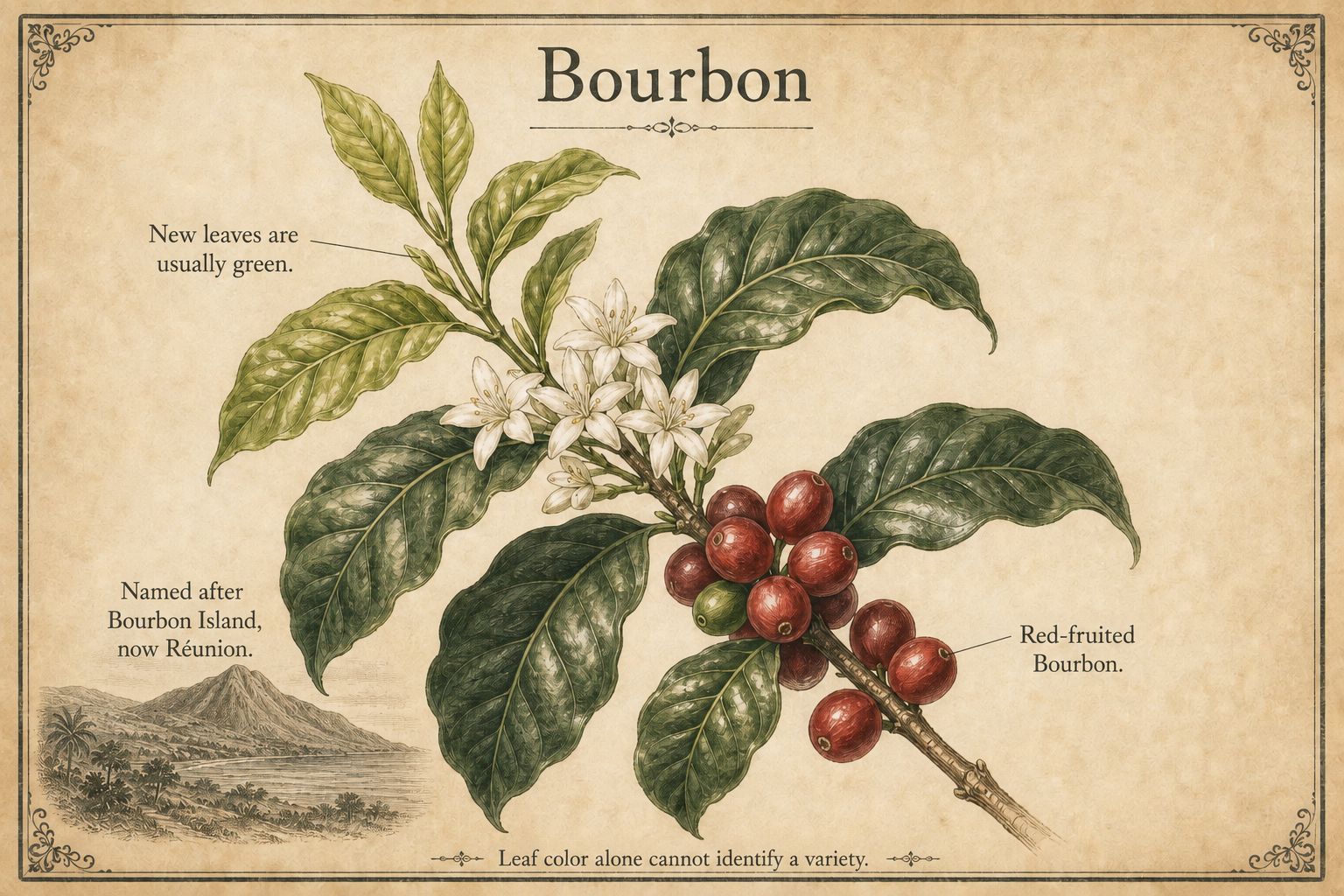
Bourbon is a foundational arabica variety named for Bourbon Island, now Réunion. It can have excellent quality potential at elevation, but its tall plants, modest yields, and disease susceptibility led many farms to replace it with descendants such as Caturra.
Updated: Aug 22, 2026Reviewed by: Ah-Zhu (English-site batch review)
The coffee variety named for an island
Bourbon is a variety of Coffea arabica named after Bourbon Island, now Réunion, east of Madagascar.
World Coffee Research describes Bourbon as the best-known variety in the broader Bourbon genetic group. The plant is tall, often shows green new leaf tips, and has moderate-to-low yield. It is susceptible to coffee leaf rust, nematodes, and coffee berry disease. At suitable elevation, its quality potential is very good.
The variety name identifies plant ancestry; origin, processing, elevation, and roasting provide further context for understanding an individual coffee’s flavor.
Bourbon and Typica took different routes
Genetic evidence connects much of the arabica population moved from Ethiopia to Yemen with the Bourbon and Typica groups. French introductions brought Yemeni coffee to Réunion in the early 1700s, with documented attempts in 1708, 1715, and 1718. The island population became the variety now known as Bourbon.
Typica followed a different route through India, Java, and Amsterdam. Both plants are tall, relatively low-yielding, disease-susceptible, and capable of high cup quality. Green new leaves are commonly associated with Bourbon, while bronze tips are common in Typica, but field identification requires more than one visible trait.
Leaf-tip color is a common tendency, not enough evidence to identify a plant by itself.
Several distinct varieties are related to Bourbon. SL28 is Bourbon-related but was selected from East African material. Caturra is a natural mutation of Bourbon. Laurina, also called Bourbon Pointu, is another Bourbon mutation: a smaller tree that is often lower in caffeine. Each remains a distinct variety name.
How Bourbon spread
Bourbon stayed largely on Réunion until the mid-1800s. French missionary networks then moved seed into East Africa, including Zanzibar and sites in present-day Tanzania and Kenya. This history contributed to the term French Mission coffee.
Around 1860, Bourbon reached the Campinas area of southern Brazil and spread north through Latin America. Many farms later replaced it with more compact or productive descendants and hybrids, including Caturra, Catuai, and Mundo Novo. Bourbon itself still appears in El Salvador, Guatemala, Honduras, Peru, Brazil, and specialty lots elsewhere.
Bourbon became established on Réunion before its nineteenth-century expansion into the Americas and East Africa.
How Bourbon often tastes
World Coffee Research emphasizes quality potential at elevation rather than one sensory formula. Coffee Review tastings have associated some single-variety Bourbons with fine, sweet acidity, dried berries, and cocoa-toned fruit. Those observations describe samples, not a botanical guarantee.
Yellow Bourbon is especially visible in Brazilian specialty coffee. It refers to Bourbon-derived plants with yellow ripe fruit, not an automatic sweetness grade. Controlled comparisons are still needed before attributing a cup difference to cherry color alone.
Bourbon provides information about lineage and farming characteristics, while origin, ripeness, processing, roasting, and tasting help establish the quality of an individual lot.
Common Misconceptions
Is Bourbon coffee related to bourbon whiskey?
No. The coffee is named after Bourbon Island, the former name of Réunion in the Indian Ocean.
How is Bourbon different from Typica?
Both belong to foundational arabica genetic groups, but their named varieties followed different histories. Bourbon developed on Réunion; Typica emerged along the India–Java line and spread through Amsterdam.
What is Yellow Bourbon?
Yellow Bourbon refers to Bourbon-derived plants whose ripe cherries are yellow. Brazilian specialty coffees may be sold as separate Yellow Bourbon lots, but fruit color alone does not guarantee a particular flavor.
Does Bourbon coffee always taste sweet?
No. Fine, sweet acidity and dried-berry character appear in some tasting reports, but origin, processing, roasting, and the quality of the individual lot remain decisive.
World Coffee Research, Bourbon: Describes Bourbon’s farming characteristics and quality potential, its introduction from Yemen to Réunion, and its later spread to other growing regions.