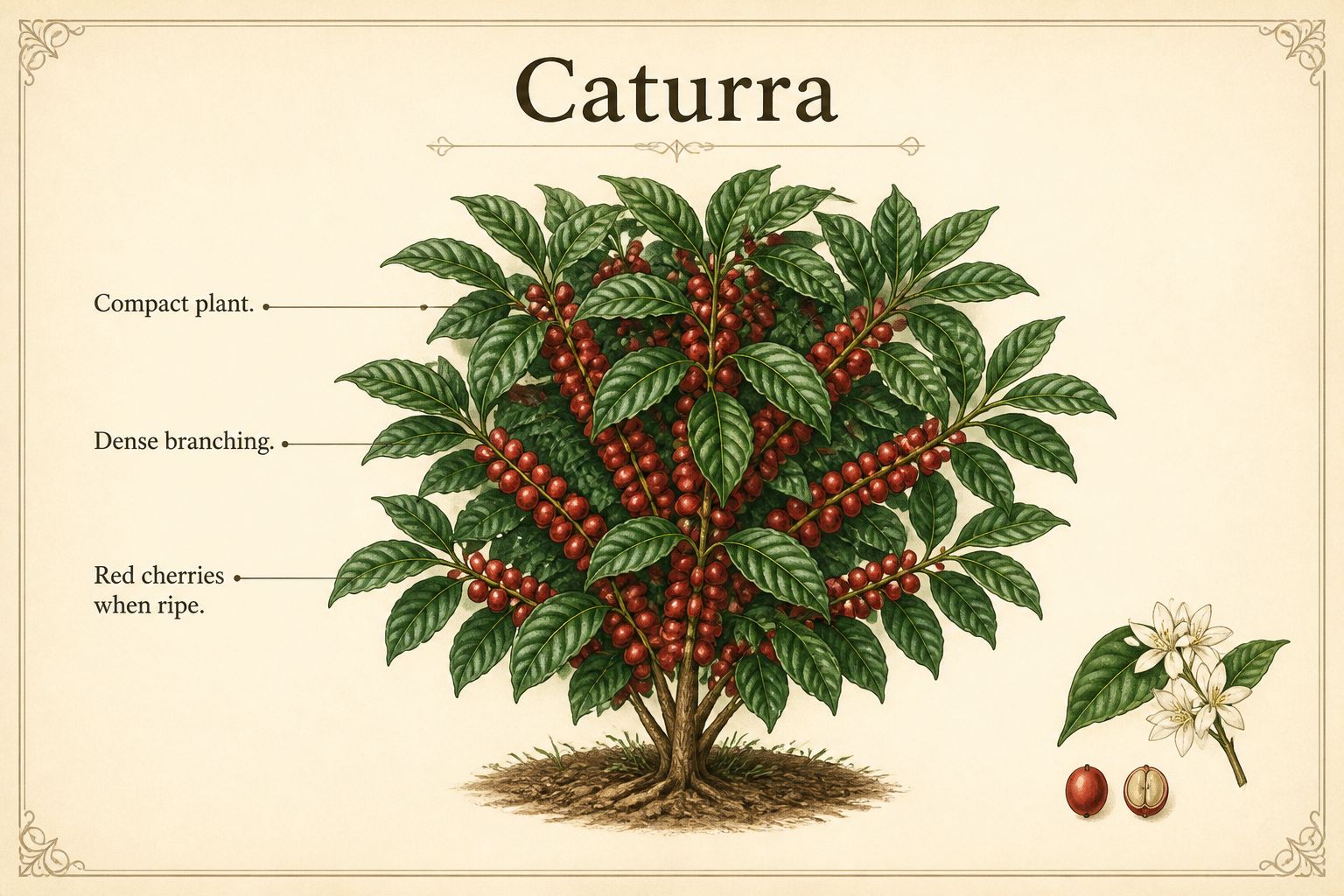
Caturra is a compact natural mutation of Bourbon discovered in Brazil in the early twentieth century. Its short internodes support dense planting and easier harvest, but it remains highly susceptible to coffee leaf rust.
Caturra is a variety of Coffea arabica, a species in the Rubiaceae family. It was discovered on a farm in Minas Gerais, Brazil, around 1915–1918. It arose as a natural mutation of Bourbon. A single-gene change shortened the distance between branch nodes, creating a lower, denser plant.
The name is linked to a Guaraní word meaning small, and the variety has also been called Nanico. Plants commonly show green new leaves and medium-sized beans. They can produce at moderate levels under good nutrition, but they are highly susceptible to coffee leaf rust, nematodes, and coffee berry disease.
World Coffee Research rates its cup-quality potential at high elevation as good, though the variety alone cannot establish the quality of an individual lot.
Why compact growth changed farming
Brazil’s Instituto Agronômico began selecting Caturra material in 1937. Compact plants can be spaced more densely than tall Bourbon, place more fruiting points into a given area, and simplify field work and harvest.
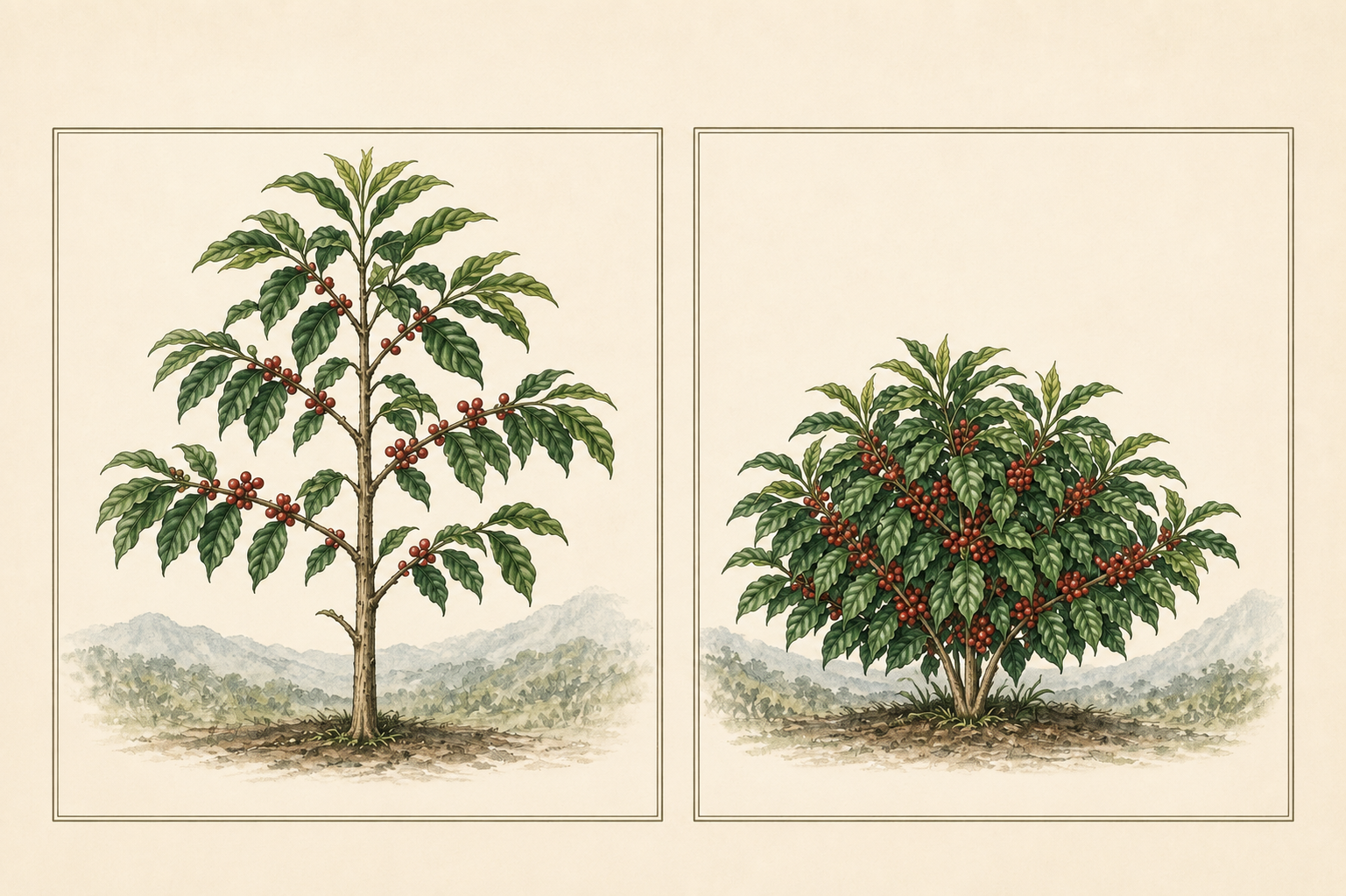
Bourbon (left) grows taller, while Caturra (right) has shorter internodes and a more compact form. This illustration shows a general comparison and cannot identify an individual plant.
Caturra’s compact form comes with substantial nutrient needs and vulnerability to major diseases, so its productivity advantage depends on farm management and environment.
From Brazil to Central America and Colombia
Caturra was never officially released in Brazil, but it spread widely through Central America. It reached Guatemala in the 1940s, expanded commercially about three decades later, and became important in Costa Rica, Honduras, Panama, and other countries. Its architecture supported the denser, more sun-exposed systems that expanded during the late twentieth century.
In Colombia, Caturra once approached half of national production. Beginning in 2008, national programs promoted rust-resistant Castillo, which includes Caturra in its breeding background. A 2025 USDA report citing Fedecafé placed rust-resistant improved varieties at roughly 87% of planted area, though single-variety Caturra still appears in specialty lots.
Caturra also became breeding material. Varieties in the Catimor family combine it with Timor Hybrid, while Catuai crosses Caturra with Mundo Novo.
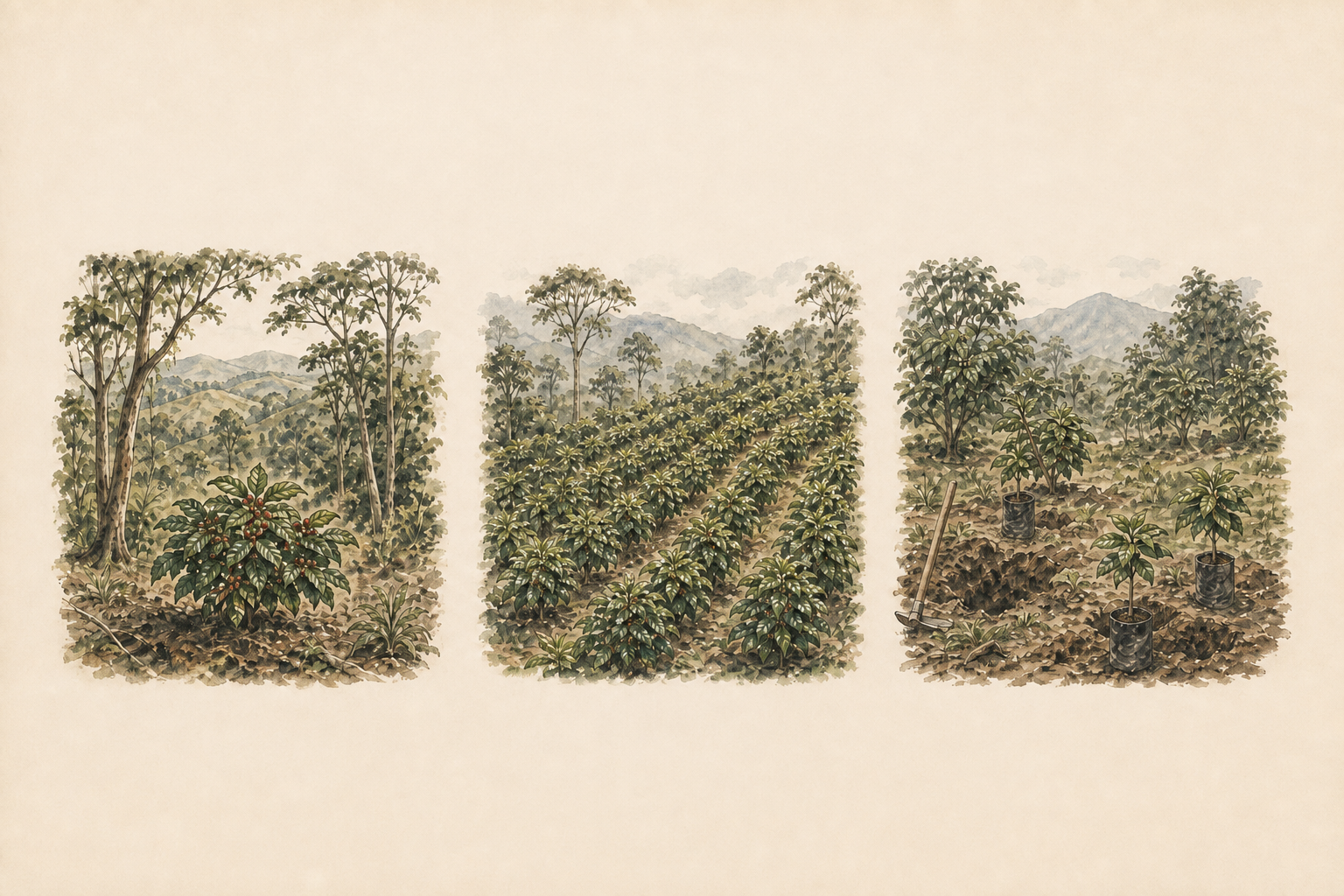
From left to right: Caturra was discovered in Minas Gerais, Brazil; it spread through Central America, where its compact growth supported dense planting; Colombia later promoted replacement with rust-resistant varieties.
How Caturra often tastes
Caturra is often described as structured, balanced, direct, and dependable rather than intensely variety-specific. Coffee Review has noted that the mutation may lack some of the recognizable dried-berry character attributed to certain Bourbons, while still producing strong cups.
Processing can easily dominate that subtle distinction. A natural Caturra may show wine-like fruit, while a washed high-elevation lot can be crisp and clearly defined. Use the variety name as agronomic and lineage information, not as a flavor guarantee or a ranking above or below Bourbon.
Common Misconceptions
Is Caturra the same variety as Bourbon?
No. Caturra is a natural mutation of Bourbon. A single-gene change shortened the plant's internodes and produced a more compact growth habit.
Is Caturra the same as Catuai?
No. Catuai is a cross between Mundo Novo and Caturra. Both are compact, but they have different origins and plant architecture.
Why do farmers plant compact Caturra?
Shorter, denser plants can be spaced more closely and are easier to manage and harvest. They still need substantial nutrition and disease control.
Does Caturra guarantee better coffee?
No. It has good quality potential at elevation, but origin, farming practices, cherry selection, processing, roasting, and brewing all influence its flavor.
World Coffee Research, Caturra: Describes the discovery of the mutation, its compact growth, selection for agricultural use, and spread across growing regions. It also records quality potential, disease susceptibility, and its role in later breeding.
World Coffee Research, Catuai: Establishes Catuai as a Mundo Novo × Caturra cross rather than another name for Caturra.