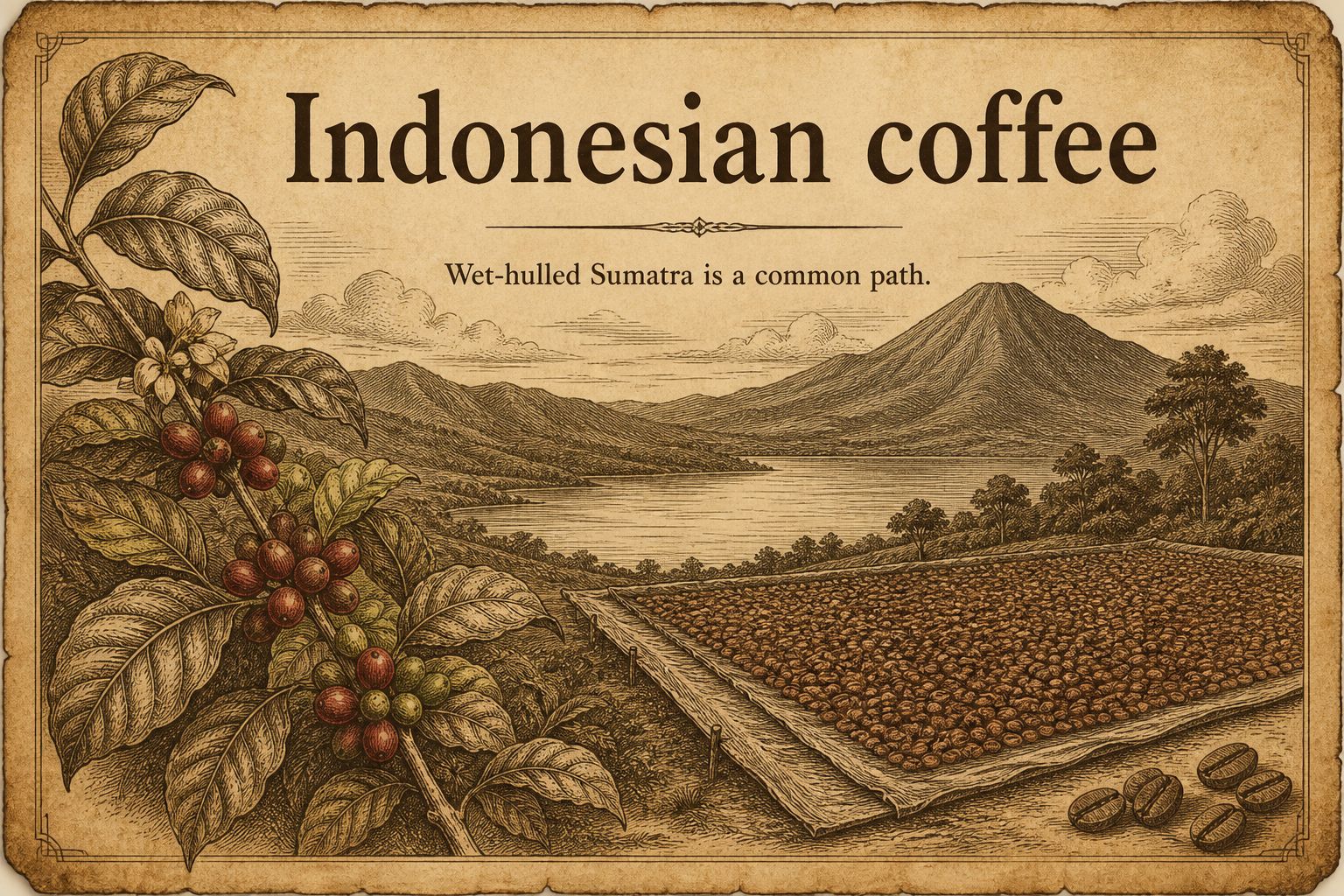
Why Does Indonesian Coffee Often Taste Full-Bodied?
The full body and restrained acidity associated with Indonesian specialty coffee usually refer to wet-hulled Sumatran arabica—not the entire country's production. Indonesia grows far more robusta, and Java or Sulawesi coffees may follow different processes.
Indonesia is the country; Sumatra, Java, and Sulawesi are islands within it. Mandheling is often a broad trade identity rather than one precise administrative region. Wet-hulled describes a process.
These labels are often compressed into one flavor expectation, but they answer different questions. USDA listed Indonesia at about 12.37 million 60-kilogram bags for 2025/26, roughly 7% of global production. About 11 million bags were robusta and 1.37 million arabica. National output is mostly robusta, as in Vietnam; the specialty shelf is usually a different story.
Sumatra accounts for around 60% of national coffee acreage. Southern Sumatra, Lampung, and Bengkulu dominate robusta output. The Indonesian bag on a specialty single-origin shelf, however, is more likely to be highland arabica from northern Sumatra or another carefully separated area.
Why Sumatran arabica often feels heavy
The familiar profile is closely connected to wet hulling. The early steps resemble washed processing: cherries are depulped, mucilage is removed, and parchment coffee begins drying. Before it reaches normal export moisture, the still-moist parchment is mechanically hulled away. The exposed seeds then finish drying.
That sequence helps produce the full texture and restrained acidity associated with many Sumatran coffees. Well-managed lots may combine chocolate, spicy fruit, earth, cedar, herbs, or tobacco. Actual mold or stagnant-water defects are not a required part of the style.
The contrast is primarily about common processing choices, not an unavoidable difference between islands.
Supply-chain control can outweigh the regional name. Smallholder collection, moist parchment trading, hulling, final drying, sorting, and storage all affect whether a lot shows complex earthiness or unwanted mustiness.
Lintong, Mandheling, and Gayo
Lintong refers more specifically to the area southwest of Lake Toba around Lintongnihuta. Mandheling is used much more broadly and may cover Lintong, similar Lake Toba coffees, or wet-hulled coffee from Aceh. A bag marked only Mandheling does not establish one county or farm.
Aceh/Gayo coffee grows around Lake Tawar and Takengon, often at higher elevations and under shade. Some lots are perceived as brighter than the classic Lintong reference, and cooperative, organic, and fair-trade structures are common.
Java and Sulawesi are not Sumatra
Java has an important estate and washed-coffee history. Conventionally washed Java can be finer and more restrained than wet-hulled Sumatra, though an earthy finish may still appear.
Specialty Sulawesi is often associated with the Toraja highlands. Toarco-program coffees commonly follow washed methods, while smallholder lots may be wet-hulled. Historical bag names include Celebes for the island and Kalossi for a trade area.
The illustration provides island-level orientation, not precise administrative boundaries.
When buying, start with species and process. Sumatra wet-hulled arabica supports a much more useful expectation than Indonesia alone.
Common Misconceptions
Is every Indonesian coffee full-bodied and low in acidity?
No. That expectation fits many wet-hulled Sumatran arabicas. Washed Java can be more delicate, and Indonesia's much larger robusta sector belongs to another market context.
Is Mandheling a precise coffee region?
Not consistently. It is often a broad trade name that may include coffee from around Lake Toba, Lintong, or even Aceh.
Is all Indonesian coffee wet-hulled?
No. Wet hulling is common in Sumatran arabica and parts of Sulawesi, while Java and other islands also produce conventionally washed, natural, honey, and experimental coffees.
Does Indonesia mostly grow arabica?
No. USDA's 2025/26 estimate was about 11 million bags of robusta and 1.37 million bags of arabica.