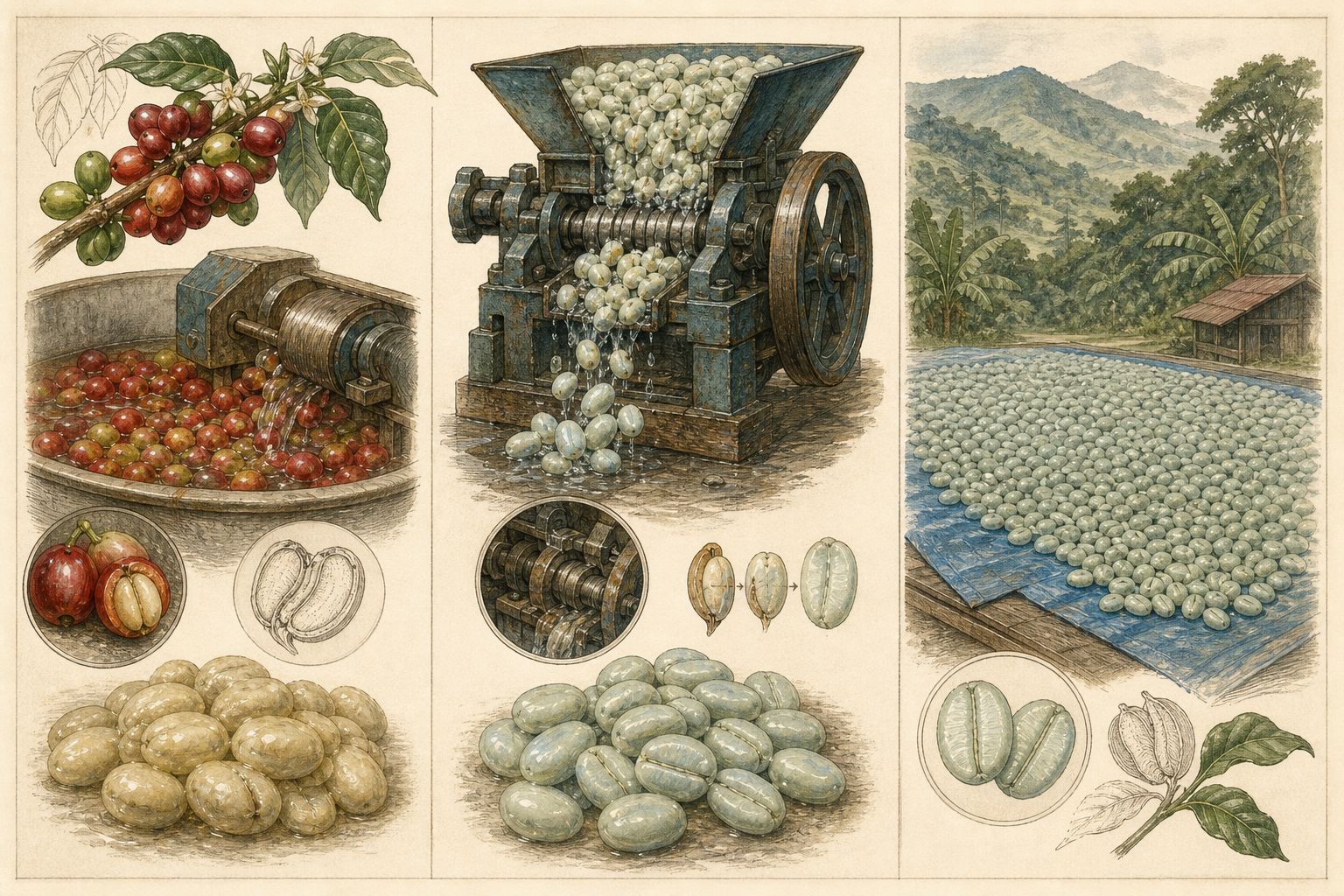
In wet hulling, producers remove parchment while the coffee still contains much more moisture than export-ready green coffee, then dry the exposed seeds. The method is closely associated with Indonesia's humid climate and supply chain.
Updated: Aug 31, 2026Reviewed by: Ah-Zhu (English-site batch review)
Washed Process
Pick ripe coffee cherries
Remove the skin and pulp
Break down the mucilage through fermentation
Wash the coffee
Dry the parchment coffee
Natural Process
Pick ripe coffee cherries
Dry the whole cherries
Turn them regularly
Remove the dried fruit and parchment
Prepare the green coffee
Honey Process
Pick ripe coffee cherries
Remove the skin while retaining some mucilage
Dry the coffee with mucilage attached
Remove the parchment after drying
Prepare the green coffee
Wet-Hulled Process
Pick ripe coffee cherries
Depulp, then briefly ferment or wash
Remove the parchment while moisture remains high
Continue drying
Prepare the green coffee
Anaerobic Fermentation
Pick ripe coffee cherries
Place the coffee in a sealed or low-oxygen vessel
Control fermentation time and temperature
Finish with a washed, natural, or honey process
Dry the coffee
The defining step in wet hulling
Wet hulling—giling basah in Indonesian—begins somewhat like washed processing. Producers depulp cherries, ferment or hold the parchment coffee, remove the mucilage, and begin drying. The crucial difference comes next: the parchment is hulled away while the coffee is still unusually moist.
Industry references describe hulling at roughly 20–40% moisture, with some accounts narrowing the common working range to about 25–35%. The exposed seeds then continue drying toward approximately 12–13%. Exact numbers vary by operator and measurement, but the sequence is consistent: parchment comes off well before export-ready moisture.
That makes wet hulling different from honey processing, where mucilage remains during drying, and from conventional washed processing, where the seed usually finishes drying inside its parchment.
Why the parchment comes off early
Much of Indonesia is humid and rainy. Keeping wet parchment around the seed can slow drying at a stage when producers and collectors need to stabilize and sell coffee. Early hulling exposes the seed directly to air and speeds the next drying phase.
The supply chain also matters. Smallholders may depulp coffee, remove mucilage, partially dry the parchment coffee, and sell it to a collector. A larger facility performs the wet hulling and finishes drying. Earlier sale can mean faster payment to a farmer, while centralized equipment handles the difficult hulling step.
Moist seeds are swollen and soft, and the parchment clings tightly. Mechanical friction can bruise or nick the green coffee. Once the protective parchment is gone, the seed is also more exposed to its drying environment. These physical conditions help explain the distinctive appearance and sensory reputation of wet-hulled lots, but good sorting and drying remain essential.
How wet-hulled coffee often tastes
The covered seeds on the left represent washed coffee drying inside parchment; the exposed seeds on the right represent drying after wet hulling. Citrus, wood, and leaves suggest flavor associations rather than flavors guaranteed in every lot.
Wet-hulled coffees are often associated with full body and restrained acidity. Well-produced Sumatran examples may combine chocolate and spicy fruit with earth, tobacco, cedar, herbs, or forest-like notes. These descriptions can be part of the style rather than defects.
Quality still matters. Appealing earthy complexity is not the same as obvious mold or mustiness. A poorly dried or stored lot can develop defects, while a carefully selected wet-hulled coffee can be clean and structured. Use the process label to set a broad expectation, then evaluate the producer, lot, roast, and cup on their own merits.
Coffee Review also reported floral, citrus, and orange notes in particular wet-hulled Sumatran samples. Citrus flavor alone therefore does not establish that a lot was washed instead; check the producer’s processing description.
Common Misconceptions
Is wet-hulled coffee the same as semi-washed coffee?
Semi-washed is sometimes used as a loose translation, but it is ambiguous. Wet hulling specifically means removing parchment before the coffee has finished drying.
Is the earthy character of wet-hulled coffee just mold?
No. Well-managed lots can show appealing earth, tobacco, cedar, herbal, fruit, and chocolate notes. Actual mold or mustiness is a defect, not the definition of the process.
Is all Indonesian coffee wet-hulled?
No. The method is especially common in Sumatra and also appears elsewhere, but Indonesian producers use washed, natural, honey, and experimental methods too.
Is wet-hulled coffee always heavy and low in acidity?
Those are common tendencies, not guarantees. Origin, variety, lot selection, roast, and brewing can all change the cup.