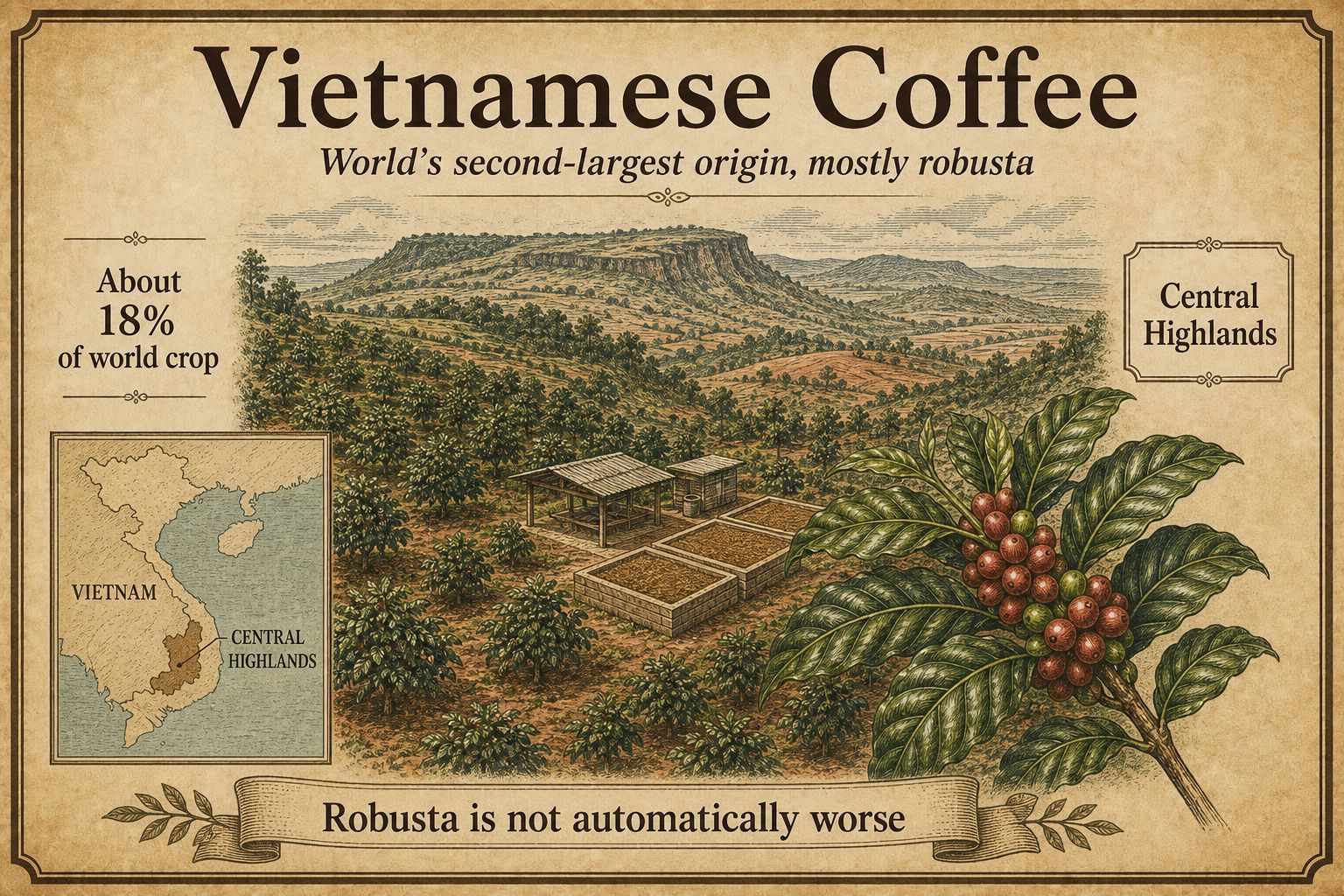
Why Is Vietnamese Coffee Usually Robusta—and Is It Worse?
Vietnam is the world's second-largest coffee origin, and nearly all of that crop is robusta. Commodity-grade green coffee often goes into blends and soluble coffee, while carefully harvested and processed lots can also achieve good quality. On a Vietnamese bag, check whether the coffee is labeled robusta or arabica.
Updated: Sep 4, 2026Reviewed by: Content and layout review
What Vietnam on a bag is telling you
A label that reads Vietnam usually does not point to a highland washed arabica like Kenya or Ethiopia. Among the origins on this site, Vietnam is a high-volume country: the world’s second-largest producer, and nearly all of that crop is robusta.
USDA places Vietnam near 18% of world coffee. For 2025/26 it estimates about 31.7 million sixty-kilogram bags, including roughly 30.5 million robusta and 1.2 million arabica. World Coffee Research calls Vietnam the world’s largest robusta origin, over 40% of global robusta. The International Coffee Organization’s 2022–2024 mean export rank is second.
The country name provides this broad production context; the label gives more specific information about the coffee you are buying.
Why the crop is usually robusta
The usual reasons are the growing environment, yield, and how well the plants adapt.
The International Coffee Organization’s 2019 country profile records arabica arriving with French missionaries in 1857, and robusta in 1908. The Central Highlands (Tây Nguyên), a basalt plateau under monsoon weather, later became the place where robusta grows most readily. World Coffee Research uses Western Highlands for the same region. The main provinces in that snapshot are Dak Lak, Lam Dong, Dak Nong, Gia Lai, and Kon Tum.
World Coffee Research describes robusta as more heat-tolerant, often planted where arabica is a poorer fit, and typically higher yielding. The Western Highlands Agriculture and Forestry Science Institute (WASI) selected TR vegetative clones and the seed-propagated polyclonal TRS1 line for yield, disease resistance, and local adaptation. These factors helped Vietnam become a major robusta producer.
Area expanded quickly after the late 1980s. The ICO profile puts national coffee area near 50,000 hectares in 1986; the Central Highlands later became one of the world’s most important robusta regions. World Coffee Research cites about 640,000 farms, roughly 97% smallholders.
Vietnam does grow arabica too. USDA still lists about 1.0 to 1.2 million bags a year. The ICO profile said almost all of that arabica was Catimor. Coffee Review describes a push for arabica volume, but harvest, processing, and drying were often rough, so those lots seldom showed up on specialty lists. More carefully produced lots have since emerged, though they remain a small share of production.
Robusta accounts for most Vietnamese coffee production, with arabica making up a much smaller share. This illustration shows national output; check the label to identify an individual coffee.
How to read Central Highlands names
Bags may add Buon Ma Thuot, Dak Lak, Lam Dong, or Da Lat. Those are place names in or near the highlands, not flavor guarantees.
The ICO profile also notes a common Central Highlands habit of strip-picking unripe and overripe fruit together, which tends to pull quality down. Those lots become commercial-grade green coffee, and they are more likely to go into cost-sensitive soluble coffee and blends.
An illustration of the Central Highlands, Vietnam’s main coffee-growing belt, rather than an exact administrative map or a photograph of a specific mill.
Both Vietnam and Indonesia grow mostly robusta by volume, but Indonesian specialty coffee is often wet-hulled arabica from Sumatra. Vietnamese coffee more commonly appears as robusta sold on its own or used in blends and soluble coffee.
Is it worse?
Robusta and arabica are two species, not two roast levels. For plant differences, caffeine ranges, and common cupping tendencies, see arabica versus robusta. If you watch caffeine, note that robusta green coffee usually has a higher caffeine fraction.
The Coffee Quality Institute and Uganda Coffee Development Authority wrote a Fine Robusta protocol with its own green-grading and cupping rules. The point is that carefully produced robusta can be evaluated on its own terms, not only as cheap filler. A 2025 study of Vietnamese farms treats this specialty path as something that became more visible from the mid-2010s and still accounts for a small share of national output.
Commodity Vietnamese robusta is often used in blends and soluble coffee, and commonly has more bitterness, less acidity, and heavier body. If the bag says arabica or Fine Robusta, look into the lot’s processing and quality controls. The label alone does not establish a specialty score.
Common Misconceptions
Is Vietnamese coffee always robusta?
Almost all of the crop is. USDA puts 2025/26 near 30.5 million bags of robusta and 1.2 million of arabica. Vietnam also produces arabica, though it accounts for a much smaller share of the national crop.
Is robusta automatically worse?
No. Commodity lots often taste harsher because of strip-picking and looser drying and sorting. The Coffee Quality Institute set a separate Fine Robusta standard. Quality still depends on how that lot was processed, and on the cup you want. See arabica versus robusta.
Is Vietnamese arabica specialty coffee?
Not by default. Coffee Review recorded volume growth that often outran harvest and processing care, so those lots seldom reached specialty lists. More carefully produced lots have since emerged, but remain a minority. The species name alone does not establish a quality score.
Does Vietnamese coffee always have more caffeine?
If you watch caffeine, note that robusta green coffee usually has a higher caffeine fraction than arabica. Your caffeine intake still depends on the amount of ground coffee, brewing method, and serving size. See the caffeine page.
Is Vietnam just another robusta origin like Indonesia?
Both countries grow mostly robusta by volume, but Indonesian specialty coffee is often wet-hulled arabica from Sumatra. Vietnamese coffee more commonly appears as robusta sold on its own or used in blends and soluble coffee. Check the packaging for the specific coffee.
USDA Foreign Agricultural Service, Coffee Annual, Vietnam, VM2026-0016, 2026: Reports production of 31.7 million bags for marketing year 2025/26, including about 30.5 million bags of robusta and 1.2 million of arabica. For 2024/25, production was about 29 million bags, comprising 28 million of robusta and 1 million of arabica. Exports remain mostly green beans, while instant coffee and roasted, ground coffee account for smaller shares.
World Coffee Research, Vietnam: World's largest robusta producer, over 40% of global robusta. About 640,000 farms, mostly in the Western Highlands. More than US$5 billion in export revenue in the 2023–2024 crop year, over 12% of agricultural GDP. ICO 2022–2024 mean export rank 2nd. Enveritas 2018: about 97% smallholders. WASI is the main breeding institute.
Kenneth Davids, Vietnam Coffee, Coffee Review, excerpted from 21st Century Coffee: A Guide: Vietnam as the largest robusta origin and the second-largest coffee producer. Authorities pushed arabica volume, but at the time of writing northern arabicas were often handicapped by careless harvest, processing, and drying, and seldom appeared on specialty lists. Whether volume would convert into quality arabica or robusta was still open.
International Coffee Organization, Country Coffee Profile: Vietnam, ICC-124-9, 2019: French missionaries introduced arabica in 1857; robusta arrived in 1908. About 50,000 hectares in 1986, then rapid expansion in the Central Highlands. Robusta concentrated in Dak Lak, Lam Dong, Dak Nong, Gia Lai, and Kon Tum. Arabica was almost all Catimor in that profile. Strip-picking mixed ripe and unripe cherry is listed as one reason quality often lagged. Treat area figures as a 2019 snapshot.
World Coffee Research, History of Robusta: Robusta as more heat-tolerant, often planted where arabica is a poorer fit, typically higher yielding, with a higher caffeine fraction. Cups often less acidic, more bitter, heavier in body. Well-processed lots can enter specialty markets. See arabica versus robusta for a fuller comparison.
Coffee Quality Institute / UCDA, Fine Robusta Standards and Protocols: Fine Robusta has its own green-grading and cupping protocol, not a copy of arabica scoring. Lots that meet the standard can receive Q Robusta verification. A quality path, not a picture of Vietnam's national crop.