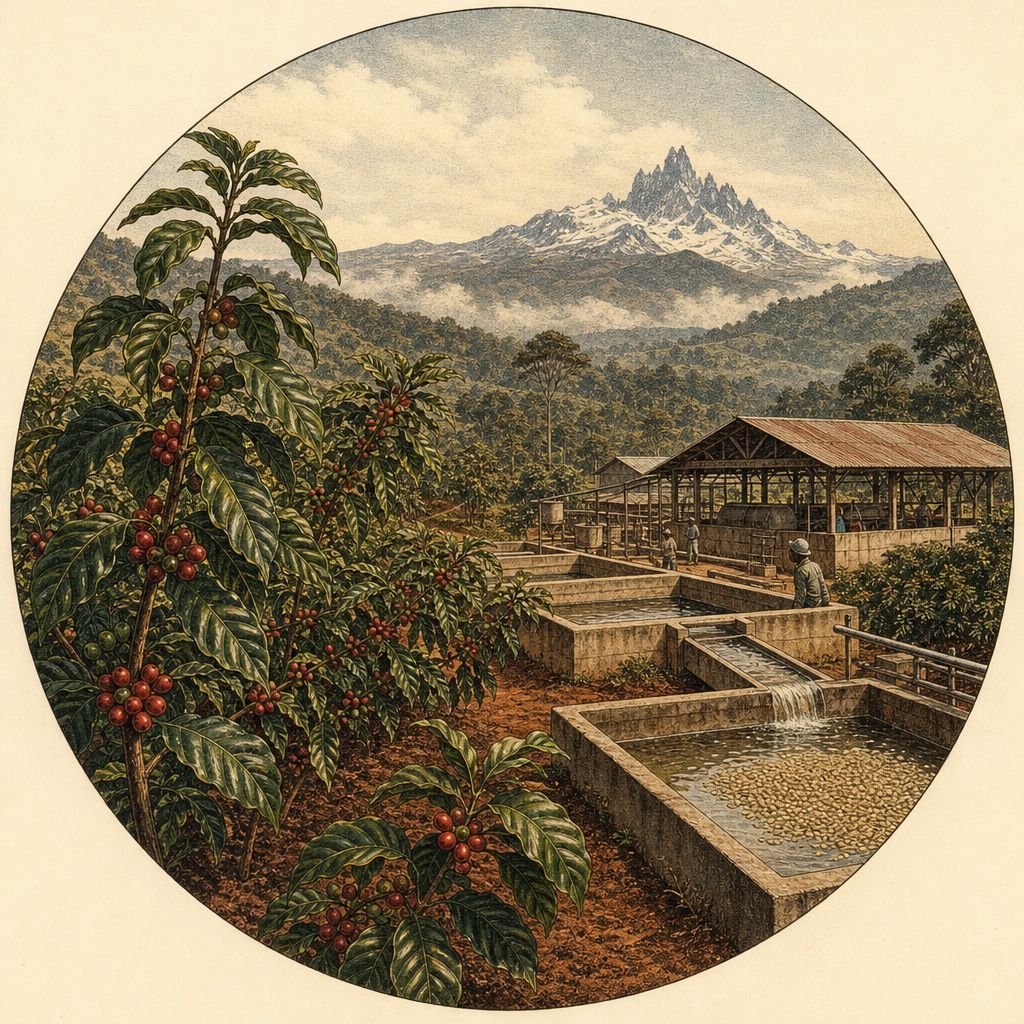
High-elevation growing areas, washed processing, and varieties such as SL28 and SL34 contribute to Kenya's reputation for vivid acidity and black-currant or citrus notes. AA and AB describe screen size, not cup quality.
Updated: Aug 20, 2026Reviewed by: Ah-Zhu (English-site batch review)
What Kenya signals on a coffee bag
Kenyan specialty coffee is strongly associated with highland production around Mount Kenya and the Aberdare Range. Coffee Review places much of the classic growing belt around 1,400–2,000 meters, where cooler nights can slow seed development and contribute to dense green coffee.
Country does not define one cup. The bag may also name a county, cooperative, factory or washing station, variety mixture, process, auction lot, and screen grade. Those details are more useful than assuming every Kenyan coffee will be aggressively acidic.
AA and AB are especially easy to misread. AA generally refers to larger beans around screen 18, while AB contains a common combination around screen 16. The letters do not represent cupping scores. Size sorting can help roast consistency, but an AB lot can taste better than an AA lot.
Three reasons for the bright reputation
The first is plant material. SL28 and SL34 were selected through Scott Agricultural Laboratories in the 1930s. SL28 is Bourbon-related, drought-tolerant, and capable of excellent quality at elevation, but susceptible to leaf rust and coffee berry disease. SL34 is Typica-related, also has high quality potential, and is associated with wetter highlands.
Later disease-resistant hybrids such as Ruiru 11 and Batian became important. Deliveries to a washing station may combine several varieties, so the classic profile cannot be assigned to one plant in every bag.
The second is washed processing. A common Kenyan sequence depulps the cherries, ferments the parchment coffee, washes it, and may soak it again in clean water before drying. The practice is sometimes called the Kenya process or double soak. It is often credited with clarity, but the independent sensory effect of the extra soak has not been established as a universal rule.
The third is the highland environment. Elevation, cool nights, volcanic landscapes, and regional climate interact with variety and process. Together they often produce clearly structured acidity rather than the softer impression associated with many lower-elevation coffees.
Dark berries and citrus are recurring tasting associations, not requirements for Kenyan coffee.
Nyeri, Kirinyaga, and Kiambu
Many recognizable specialty lots come from counties around Mount Kenya. Nyeri is often associated with vivid sweet acidity and clear fruit. Kirinyaga frequently appears in floral, berry, citrus, and sometimes savory descriptions. Kiambu covers a broader range, including rounded cocoa-toned coffees and brighter berry or citrus lots.
Trade-region impressions overlap; producer, station, variety mixture, and processing can outweigh the county name.
Kenya’s auction system, established in the 1930s, uses cup evaluation to support lot trading through the Nairobi Coffee Exchange. Direct-sale channels have also been available since 2006, so a specialty bag may come through either route.
What to expect in the cup
Classic washed Kenya can suggest black currant, blackberry, raspberry, citrus, juicy acidity, and sometimes a savory ripe-tomato character. SL34 is often associated with citrus and substantial body, but mixed lots blur any variety-level distinction.
If you enjoy clean, unmistakable acidity, Kenya is a useful reference origin. If a coffee tastes sharply vinegary, harshly sour, or unpleasantly fermented, that is different from the controlled fruit-like acidity the origin is known for. See why coffee tastes fruity and acidic for the sensory distinction.
Common Misconceptions
Does every Kenyan coffee taste sharply acidic or like black currant?
No. Those are recurring specialty-coffee profiles. Variety mixture, elevation, processing, roast, and brewing can make a lot softer, heavier, or less fruit-driven.
Is Kenya AA always better than Kenya AB?
No. AA and AB primarily sort beans by screen size. A larger bean is not automatically a higher-scoring or better-tasting bean.
Is every Kenyan lot pure SL28?
No. SL28 and SL34 are often mixed, and modern farms also grow Ruiru 11, Batian, and other varieties.
Is bright acidity a sign that coffee has spoiled?
Not by itself. Clean citrus- or berry-like acidity is different from an unpleasant vinegar smell, harsh sourness, or fermentation defect.
World Coffee Research, SL28: Describes SL28’s selection at Scott Labs and its relationship to Bourbon. It also records drought tolerance, disease susceptibility, and quality potential at high elevation.
World Coffee Research, SL34: Describes SL34’s history at Scott Labs and its relationship to Typica, along with disease susceptibility and quality potential.
Coffee Review, The Joy of Kenya: Classic Coffee-Producing Origin: Discusses flavor tendencies associated with coffee varieties, Kenya’s washing and soaking practices, and screen-size grades. It also covers growing elevations, regional tasting impressions, auctions, and direct trade.