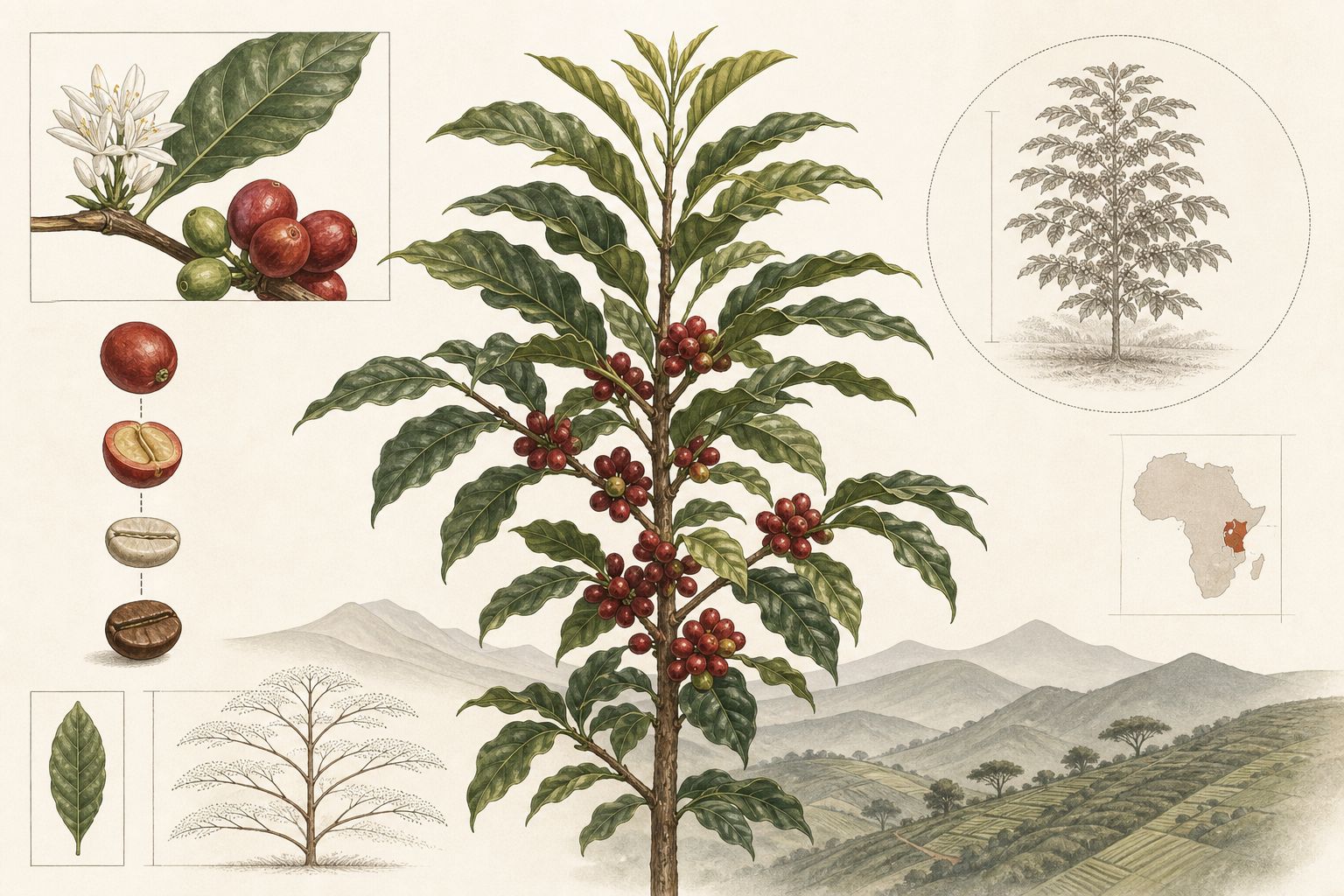
SL28 is an arabica variety selected by Kenya's Scott Agricultural Laboratories in 1935 from drought-tolerant Tanzanian material. It is Bourbon-related, valued for high-elevation quality and drought tolerance, and often associated with Kenya's black-currant-like cup profile.
Updated: Aug 20, 2026Reviewed by: Ah-Zhu (English-site batch review)
What the letters and number mean
SL28 is an arabica variety closely associated with Kenya. SL refers to Scott Agricultural Laboratories, the research institution established by the British colonial government in Kenya in 1922. Numbered selections from the laboratory’s 1930s program retained the prefix.
World Coffee Research describes SL28 as tall, large-seeded, generally green-tipped, and low-yielding. It has very good high-elevation quality potential and notable drought tolerance, but it is susceptible to coffee leaf rust, nematodes, and coffee berry disease.
Selection from drought-tolerant East African material
The line traces to a population known as Tanganyika Drought Resistant. Coffee officer A. D. Trench observed promising material in present-day Tanzania in the early 1930s. Scott Labs selected the plant that became SL28 in 1935.
The variety became important in Kenya because it could tolerate dry conditions while producing valuable cup quality at medium and high elevations. World Coffee Research notes that plants left untended for years can return to productive cultivation and that some Kenyan SL28 trees have remained productive for 60–80 years.
SL28 remains vulnerable to disease despite its longevity. Kenya later released hybrids such as Ruiru 11 and Batian with disease resistance as a breeding priority. Commercial lots can contain several varieties delivered together, so Kenya does not automatically mean pure SL28.
SL28, Bourbon, and SL34
Genetic testing places SL28 in Bourbon-related material, but it is not the named Bourbon variety. Bourbon followed a documented route through Réunion; SL28 was selected from East African material for its own traits.
SL34 came from the same laboratory era but is Typica-related. It also has high quality potential at elevation and is susceptible to coffee berry disease. It is commonly associated with well-watered highland conditions rather than SL28’s drought-tolerance reputation.
SL28 (left) is known for drought tolerance, while SL34 (right) is suited to highlands with good rainfall. These general growing characteristics cannot identify an individual plant.
SL28 also grows in Malawi, Uganda, Zimbabwe, and parts of Latin America. The variety name does not guarantee Kenyan origin.
How SL28 often tastes
Classic washed Kenyan coffees involving SL28 are frequently associated with black currant, blackberry, raspberry, jam-like dark fruit, and bright, juicy acidity. Some tasting descriptions include a savory ripe-tomato quality. SL34 is often linked with citrus acidity and substantial body.
Black currant and dark berries (left) represent flavors often associated with SL28; citrus (right) represents a common description of SL34. These tasting associations do not guarantee the flavor of an individual lot.
Variety composition, region, washed processing, drying, roasting, and brewing all affect flavor. SL28 provides genetic and agronomic context, while tasting helps establish the character of the individual lot.
Common Misconceptions
Is SL28 another name for Bourbon?
No. Genetic work places SL28 in Bourbon-related material, but it is a distinct selection with its own history.
How is SL28 different from SL34?
Both came from Scott Labs in the 1930s. SL28 is Bourbon-related and noted for drought tolerance; SL34 is Typica-related and associated with wetter highland conditions.
Is every Kenyan coffee SL28?
No. Lots may include SL34, Ruiru 11, Batian, and other varieties, and deliveries to a washing station can be mixed.
Does SL28 always taste like black currant?
No. Black currant and dark berries are recurring descriptions for classic Kenyan examples, but origin, lot composition, processing, roasting, and brewing affect the resulting flavor.
World Coffee Research, SL28: Describes SL28’s selection history, relationship to Bourbon, drought tolerance, plant characteristics, disease susceptibility, growing regions, longevity, and quality potential.
World Coffee Research, SL34: Describes SL34’s relationship to Typica, its cultivation in Kenya, quality potential at high elevation, and susceptibility to disease.