What Does Peruvian Coffee Taste Like—and Does Organic Mean Better?
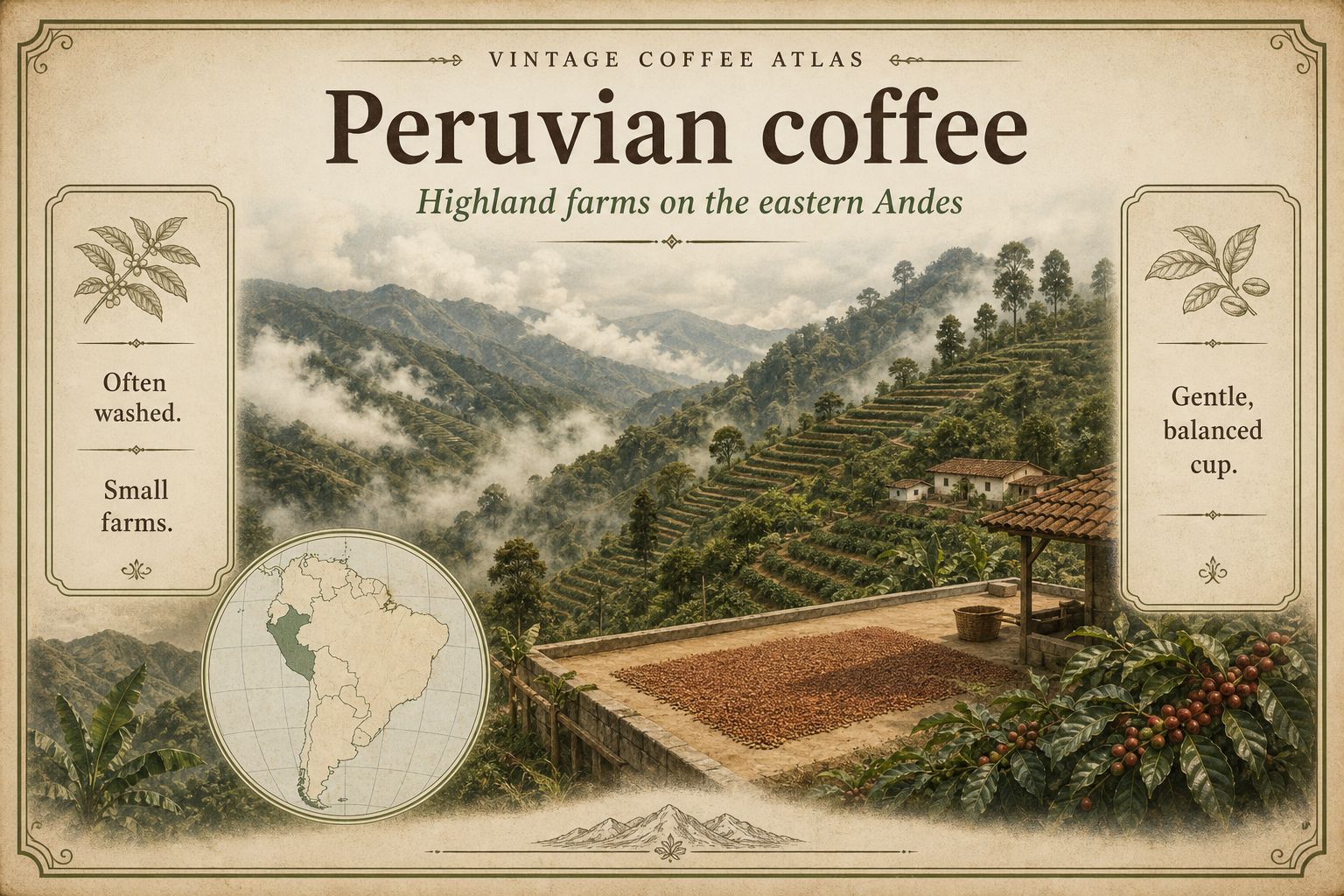
Peruvian coffee commonly comes from small shaded farms on the eastern Andes and is washed, hand-picked arabica with gentle fruit, flowers, nuts, or chocolate. Organic certification governs production practices; it does not guarantee cup quality.
Updated: Aug 20, 2026Reviewed by: Ah-Zhu (English-site batch review)
A smallholder origin on the eastern Andes
Coffee grows across the eastern slopes of Peru’s Andes. USDA reported production in 16 of the country’s 25 administrative regions and about 223,000 households relying on the crop. More than 90% of producers farm fewer than five hectares.
For 2025/26, USDA listed approximately 4.76 million 60-kilogram bags, around 3% of global production. About three-quarters of coffee area lies between 1,000 and 1,800 meters. Farms commonly use shade, hand picking, and sun drying.
Most coffee is arabica and washed. Smallholders often depulp, ferment, wash, and dry coffee themselves with simple equipment. Careful work can produce very clean lots; difficult roads, limited infrastructure, or uneven drying can also introduce fermentation or mold defects before coffee reaches a cooperative or exporter.
Why the profile is often gentle and balanced
Classic Peruvian specialty coffee is often described as soft, bright but not sharp, and balanced. Common impressions include stone fruit, ripe citrus, subtle floral notes, nuts, and light chocolate.
Traditional plant material contributes to that identity. USDA estimated Typica at more than 70% of plantings and Caturra around 20%, with the remainder including other varieties. Coffee Review also identifies Bourbon and the compact Typica mutation Pache Común.
The country-level profile remains only a starting point. Elevation, region, farm, variety, fermentation, drying, and roast can produce a more floral, intensely fruity, earthy, or chocolate-driven cup.
Cajamarca and other major regions
USDA placed Cajamarca at roughly 22% of production, followed by San Martín at 20%, Junín at 19%, and Amazonas at 15%. Cajamarca appears frequently on specialty bags, but a bag marked only Peru does not establish that origin.
Peruvian coffee is concentrated along the eastern Andes; the illustration is not a precise administrative map.
Region helps with traceability, but a cooperative, producer, community, elevation, and lot code provide a stronger buying signal than a department name by itself.
Organic certification and cup quality are different
Peru is a leading exporter of certified organic coffee. A 2025 USDA report counted about 90,000 certified organic hectares and described the country as the world’s largest organic coffee exporter.
Organic certification applies rules to farm inputs, production, handling, and chain of custody. It does not assign a cup score. A certified lot can be excellent or flawed, just as a conventional lot can be excellent or flawed.
Some smallholders use few synthetic inputs because they cannot afford them. That situation does not create certification by itself; inspection, records, separation, and compliance are part of the certified claim.
Certification answers how coffee was produced and handled; cupping answers how a sample tastes.
Coffee leaf rust has remained a serious constraint since the 2012–2013 crisis. The 2025 USDA report still described impacts near 40% of the crop. Disease pressure, farm renewal, market access, and processing infrastructure all shape the future of Peruvian quality more directly than the word organic alone.
Common Misconceptions
Is all Peruvian coffee organic?
No. Peru has extensive certified organic production, but a bag must carry the relevant certification to make that claim. Low chemical input is not the same as certified organic status.
Does organic coffee automatically taste better?
No. Organic standards govern production and handling. Cup quality still depends on plant material, ripeness, processing, drying, storage, roasting, and brewing.
Is all Peruvian coffee from Cajamarca?
No. Cajamarca is the largest producing region, while San Martín, Junín, and Amazonas are also major origins.
Is Peruvian coffee always washed?
Washed processing is dominant, but natural and other methods also exist. Check the processing method on the packaging.