Typica is one of arabica coffee's most influential varieties. A lineage that passed through India and Java eventually spread from one Amsterdam plant into the Americas. It can produce excellent coffee at elevation, but its trees are tall, low-yielding, and disease-susceptible.
Typica identifies a variety of Coffea arabica, while origin, processing, and roasting provide further information about the coffee. World Coffee Research describes it as the best-known variety within the broader Typica genetic group and one of coffee’s most important varieties culturally and genetically.
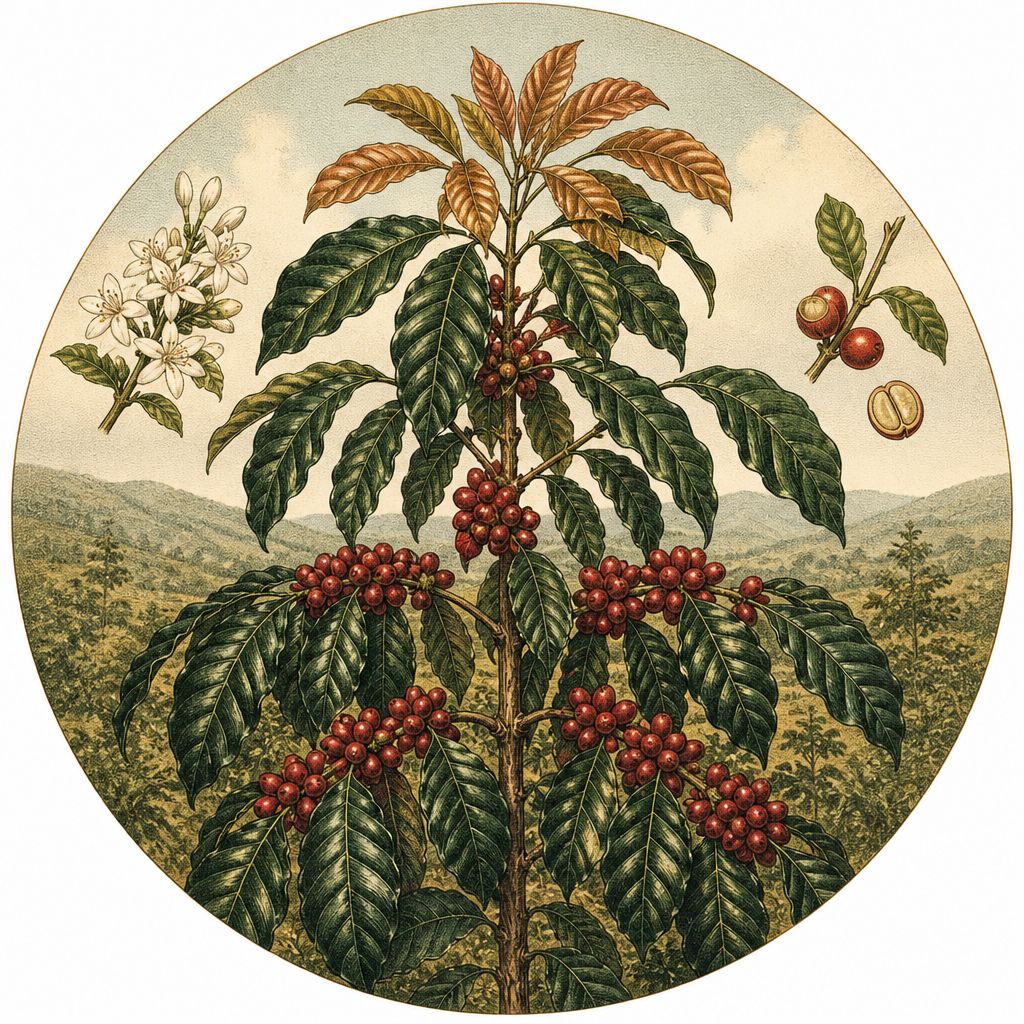
The plant is tall, often produces bronze-colored new leaf tips, and has relatively large seeds. Its yield is low, and it is highly susceptible to coffee leaf rust, nematodes, and coffee berry disease. Under suitable high-elevation conditions, however, it has very good quality potential.
Names such as Criollo, Indio, Arábigo, Blue Mountain, and Sumatra have been associated with Typica in different places. Local naming can be imprecise, so these names need to be interpreted alongside information about the source of the plants.
Typica’s place in arabica history
The broader Typica genetic group includes several distinct varieties. For example, World Coffee Research places SL34, grown in Kenya, in the Typica-related group. This relationship does not make SL34 another name for the Typica variety.
Arabica originated in Ethiopia, where much of the species’ diversity remains. A much narrower population moved to Yemen. Genetic work connects those exported plants mainly to the Bourbon and Typica groups, which later became the foundation of most commercial arabica.
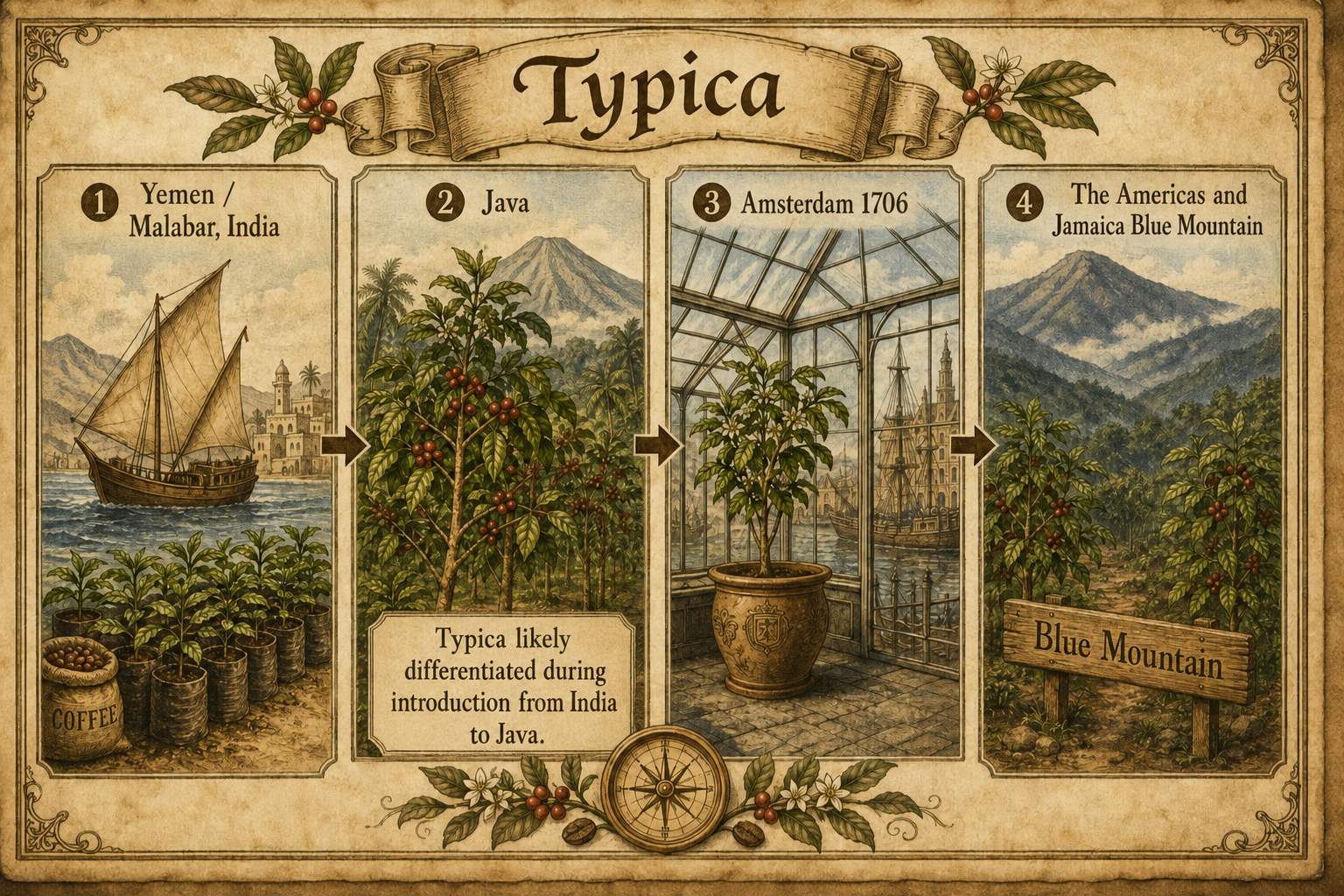
The familiar historical story often jumps directly from Yemen to Java. World Coffee Research offers a more specific interpretation: the named Typica line likely differentiated when Dutch traders moved seed from India’s Malabar Coast to Java in 1696 and 1699.
In 1706, one plant traveled from Java to Amsterdam’s botanical garden. Descendants of that plant became the source for later introductions into the Americas. Plants moved through European colonial networks to Suriname, French Guiana, Brazil, Martinique, Jamaica, the Caribbean, and Central America.
The named Typica variety likely emerged along the India-to-Java route before one Amsterdam plant seeded much of its American expansion.
Before the 1940s, many Central and South American estates relied heavily on Typica. Farms later replaced it with higher-yielding or more disease-resistant material. It remains especially visible in Peru, the Dominican Republic, and Jamaica, where Typica is associated with Jamaica Blue Mountain production.
How Typica often tastes
There is no single Typica flavor. World Coffee Research assigns strong quality potential at elevation rather than a required sensory note. Origin, climate, soil, cherry selection, processing, roasting, and brewing all influence the resulting flavor.
Classic Jamaica Blue Mountain descriptions often emphasize roundness, gentle but lively acidity, and substantial mouthfeel. That is a regional profile, not a template for Typica in Peru or Central America.
Typica provides information about one of arabica’s historically important commercial lineages. Detailed origin and processing information help explain how an individual lot might taste.
Common Misconceptions
Is SL34 the same variety as Typica?
No. World Coffee Research places SL34 in the Typica-related genetic group, but it remains a distinct variety. The Kenya article explains more about SL28 and SL34.
Is Typica the same thing as arabica?
No. Arabica is the species; Typica is one variety within it.
How is Typica different from Bourbon?
They belong to two foundational arabica genetic groups that left Yemen by different routes. The named Typica variety likely developed during its introduction from India to Java, while Bourbon became established on Réunion, formerly Bourbon Island.
Is every Jamaican Typica coffee Blue Mountain coffee?
No. Blue Mountain is a protected geographic identity, while Typica is a plant variety. Typica also grows in Peru, the Dominican Republic, and other countries. See [What Is Jamaica Blue Mountain Coffee?](/en/origins/jamaica/).
Why did many farms replace Typica?
The plants are tall, yields are low, and susceptibility to leaf rust and other major diseases makes production risky.
World Coffee Research, Typica: Describes Typica’s plant characteristics, susceptibility to disease, quality potential, local names, historical spread, and regions where it remains in production.
World Coffee Research, History of Arabica: Clarifies arabica's Ethiopian origin, Bourbon/Typica genetic groups, the likely India-to-Java differentiation, and Amsterdam founder history.