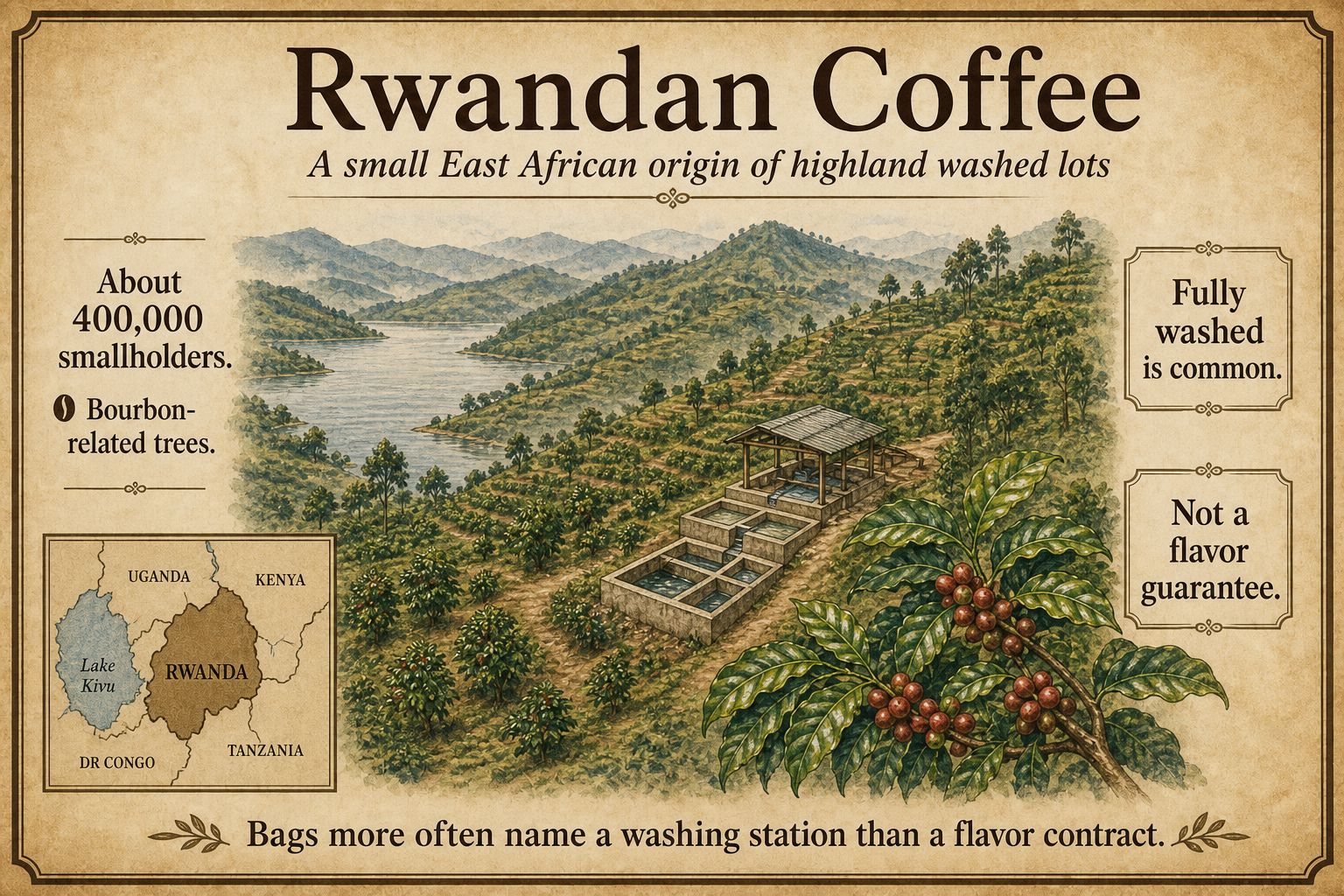
Specialty Rwanda is usually highland washed arabica from Bourbon-related trees. Coffee Review describes a sweet, balanced cup—flowers, honey, stone fruit, cocoa—sometimes with tart berry. Compared with Kenya, the acidity is usually less sharp.
Updated: Sep 3, 2026Reviewed by: Content and layout review
What Rwanda on a bag is telling you
A label that reads Rwanda usually points to highland washed arabica from smallholder plots, often delivered to a coffee washing station rather than processed as a named estate. Among the origins on this site, Rwanda is a smaller producer by volume, but it still shows up often on specialty shelves. The usual flavor profile is sweet and balanced, with bright acidity that is not automatically as sharp as Kenya.
Rwanda’s National Agricultural Export Development Board (NAEB) records about 400,000 smallholder families, coffee introduced by Germans in the early 1900s, and mainly Bourbon-type arabica. Its industry overview lists annual production of about 267,000 to 420,000 bags without specifying bag weight. World Coffee Research, citing NAEB, records about US$150 million in coffee export revenue in 2025. The International Coffee Organization’s 2022–2024 mean export rank is about 21st. USDA places Rwanda near 0.16% of world production.
A Rwanda label commonly points to washed coffee grown by smallholders in the East African highlands.
Why the cup is often sweet, balanced, and floral
Variety, washing stations, and growing conditions help explain this common flavor profile.
Variety is one factor. NAEB and World Coffee Research describe traditional plantings as Bourbon- and Typica-type arabica. Coffee Review names older local lines such as Jackson, Mibirizi, and Mayaguez. World Coffee Research’s Bourbon Mayaguez 71 came from the Mulungu collection in the DRC into Rwanda in the early 1950s and remains important there and in Burundi. Bourbon on a Rwandan bag usually names that genetic line. It may differ from Bourbon selections grown in Central America.
Coffee Review suggests that the savory-sweet, floral, cocoa-leaning Great Lakes cup may be tied to that Bourbon lineage.
Processing is another influence. Rwandan specialty coffee commonly passes through centralized washing stations, where smallholders deliver cherries for processing. NAEB’s 2023/24 annual report counted 313 operational stations that year. World Coffee Research puts fully washed coffee around 62% of exports, after processing investment from the 2000s onward. Coffee Review describes Rwanda’s visibility as a specialty origin from the mid-1990s, when aid programs and specialty buyers helped build those stations and the quality practices around them.
Many Great Lakes stations dry-ferment mucilage after depulping, rinse, then ferment again in water. Coffee Review is explicit that the sensory effect of that sequence has not been systematically studied. It is fair to treat that sequence as a common Rwandan practice.
Growing conditions also influence the coffee. Rwanda is compact, with a high average elevation. NAEB says coffee grows in most provinces, below 1,900 meters. Along Lake Kivu in the west, harvest starts earlier, around late February. Coffee Review’s point may also be that similar varieties and processing make regional differences in Rwandan coffee less obvious than differences between washing stations named on the bag.
Sweetness, floral notes, and cocoa are recurring impressions, with acidity often milder than Kenya’s. This illustration summarizes common tasting impressions; individual lots can differ.
How to read a washing-station name
Bags more often print a washing station, cooperative, or exporter than a large administrative region. Coffee Review has discussed names such as Bufcafe and COOPAC Kabirizi: a station receives cherries from nearby farms, so the name carries place information. Some tasters describe more intense fruit flavors in lots from near Lake Kivu. The same writing also notes that importer selection, plus similar varieties and process, often flattens those regional claims.
Station names show up on bags more often than province names. This is a sketch, not a cadastral map or a photograph of any mill.
World Coffee Research notes that many Rwandan coffee trees are old—about 39% older than 30 years—and that a rust- and coffee-berry-disease-resistant release, RAB C15, from 2015 is still not widely planted. Yield can swing from year to year, and older trees do not all cup the same way, so two bags labeled Rwanda can still taste quite different.
Common flavors and mouthfeel
A washed Rwanda lot is a fair place to expect sweetness, clear structure, and acidity that is bright without always being sharp. Coffee Review describes good specialty Rwanda as almost always sweet and balanced, with a satiny or lightly syrupy mouthfeel. Floral notes are usually subtle, sometimes accompanied by honey, stone fruit, ripe citrus, and cacao nib or cocoa. Some lots also show tart red- or black-currant flavors.
If you are looking for black currant and especially sharp East African acidity, Kenya is named more often. Coffee Review describes a sweet versus pungent-tart contrast associated with Kenyan SL28 that can appear in Rwanda, usually at lower intensity. For a sharper, more currant-like cup, start with Kenya. For sweetness, flowers, cocoa, and a little East African brightness, Rwanda is a common choice.
Naturals and honeys exist, and Coffee Review has cupped successful lots. Check the packaging for the actual processing method.
Potato taste defect is a separate, origin-linked risk. After roast and grind it can smell like raw potato. World Coffee Research places it mainly in the Great Lakes and links it to damage from Antestia bugs. It is not a health hazard, but one bean can spoil a brew. Coffee Review’s 2021 cupping set did not turn up potato taste, which may also mean mills have started sorting more carefully in recent years. It is not Rwanda’s flavor signature, and it is not a reason to write off the bag in advance.
Common Misconceptions
Does Rwandan coffee always taste like Kenya?
No. Both are often East African highland washed lots. Coffee Review notes that Rwanda can show a sweet versus pungent-tart contrast, but usually with less intensity than Kenya. More common descriptions emphasize balanced sweetness, floral notes, and cocoa.
If the bag says Bourbon, is that one cultivar?
It usually points to Rwanda's Bourbon-related lines. World Coffee Research names lines such as Bourbon Mayaguez 71 there. The term covers several traditional lines, which may differ from Bourbon selections grown in Central America.
Is a washing-station name a region?
A station mostly receives cherries from nearby smallholders, so the name still carries place information. Coffee Review argues that similar varieties and washed processing often shrink regional differences. Check the details of the individual lot to understand its origin and flavor.
Is Rwandan coffee always washed?
Specialty lots are usually washed. World Coffee Research puts fully washed coffee around 62% of exports. Naturals and honeys exist in smaller numbers. Trust the process printed on the bag.
Is potato taste a defect in Rwandan coffee?
It is a known Great Lakes defect, not a normal flavor. World Coffee Research links it to Antestia damage. One bean can affect a whole brew. It is not a reason to dismiss the origin, and it is not in every bag.
Kenneth Davids, Rwanda Coffee, Coffee Review, excerpted from 21st Century Coffee: A Guide: Places Rwanda in the African Great Lakes highlands. Traditional trees are mostly Bourbon-related. Specialty lots more often name a washing station or cooperative than a large estate. Recurring cup: sweet and balanced, satiny or lightly syrupy; subtle floral notes that can suggest honey; stone fruit, ripe citrus, cacao nib or cocoa; sometimes tart red or black currant. A Kenya-like sweet versus pungent-tart contrast can appear, usually at lower intensity. Notes potato taste defect, and woody or flat cups from drying or landlocked transport delays.
Kenneth Davids, African Great Lakes Coffees: Quality in the Face of Adversity, Coffee Review, 2021: Thirty-six Rwanda samples averaged 90.6. Classic Great Lakes washed cups often read savory-sweet, cocoa, flowers, and dried fruit. Many stations dry-ferment mucilage, rinse, then wet-ferment; the sensory effect is not systematically proven. Potato taste is linked to Antestia damage and Pantoea coffeiphila. After the mid-1990s, aid programs and specialty buyers helped build centralized washing stations, which is when Rwanda became more visible as a specialty origin.
National Agricultural Export Development Board, About Rwanda coffee: About 400,000 smallholder families. Germans introduced coffee in the early 1900s. Mainly Bourbon-type arabica. The page lists annual production of about 267,000–420,000 bags without stating bag weight. Its separate range of 16,000–21,000 metric tons is not an equivalent conversion at 60 kilograms per bag. About 42,000 hectares, grown in most provinces, at altitudes below 1,900 meters. Harvest starts late February along Lake Kivu in the west; some northern areas continue into August.
National Agricultural Export Development Board, Annual Report 2023-2024: 313 coffee washing stations were operational in FY 2023/24. Fully washed coffee was 76.33% of that year's export grades; natural and honey lots existed at smaller shares. A one-year snapshot, not the same statistic as World Coffee Research's roughly 62% fully washed export figure.
World Coffee Research, Rwanda: Small origin, central to rural livelihoods. NAEB recorded about US$150 million in coffee export revenue in 2025, 16.8% of agricultural export value. Up to 400,000 farmers, about 600 trees per plot. Almost all arabica, predominantly traditional Bourbon and Typica. About 62% of exports fully washed after post-2000 processing investment. About 39% of trees older than 30 years. ICO 2022–2024 mean export rank about 21st. Enveritas 2018: about 99% smallholders. RAB C15, rust- and CBD-resistant, released in 2015, still not widely planted.
USDA Foreign Agricultural Service, Production, Rwanda, Coffee: Reports that Rwanda accounts for about 0.16% of world coffee production, with a ten-year average of about 278,500 60-kg bags. Production was 250,000 bags in 2023/24 and 275,000 in 2024/25.
World Coffee Research, Bourbon Mayaguez 71: Describes a Bourbon-related line important in Rwanda and Burundi, introduced to Rwanda from the Mulungu collection in the DRC in the early 1950s. It has high quality potential but is susceptible to major diseases. A Bourbon label does not necessarily identify the same line as a Latin American Bourbon selection.
World Coffee Research, Potato taste defect: Describes potato taste defect in coffees from the Great Lakes region, including Rwanda, Burundi, the DRC, and Uganda. Affected beans can smell like raw potato after roasting and grinding. WCR states that the defect itself poses no health risk, although even one affected bean can spoil the flavor of a brew. It links the defect to damage from Antestia bugs in the genus Antestiopsis.