What Catimor and Timor Hybrid Are—and How They Relate to Castillo
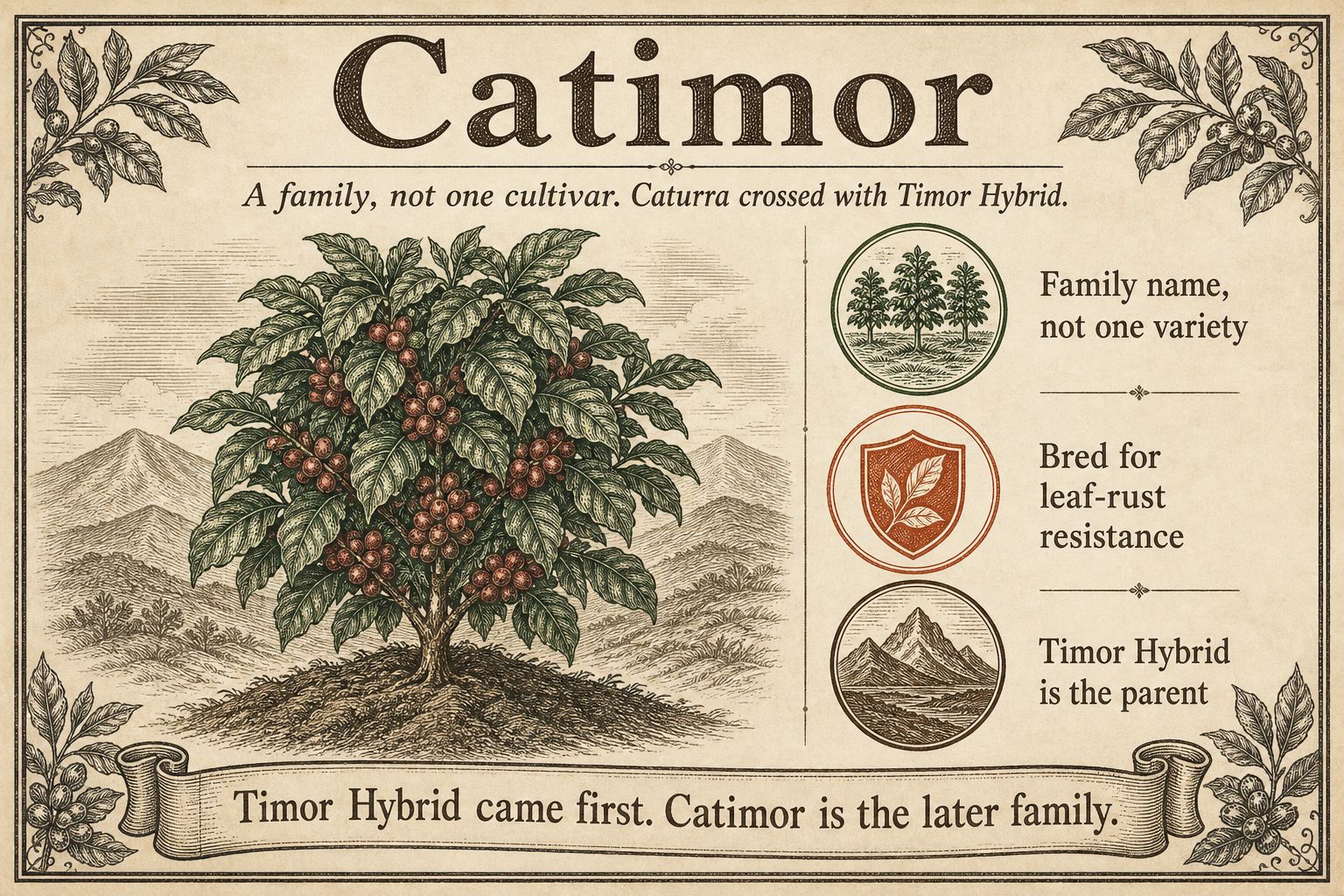
Timor Hybrid is a natural arabica–robusta cross that appeared on Timor in the 1920s. Catimor is a family of varieties subsequently bred from Caturra and Timor Hybrid for compact growth and rust resistance, rather than one cultivar.
Updated: Sep 3, 2026Reviewed by: Content and layout review
What Catimor and Timor Hybrid mean on a bag
Catimor and Timor Hybrid (Híbrido de Timor) provide information about varieties and ancestry rather than origin or a specific flavor.
Timor Hybrid appeared first, as a natural arabica–robusta hybrid on the island of Timor in the 1920s. Catimor emerged from later breeding: in the 1960s, researchers in Portugal crossed Caturra with Timor Hybrid and sent the offspring to other countries for local selection. World Coffee Research describes Catimor as a group of varieties with similar parentage rather than a single cultivar.
A bag labeled only Catimor identifies this breeding family without specifying whether the coffee is Costa Rica 95, Lempira, Castillo, or another member of the group.
Where Timor Hybrid comes from
Because arabica and robusta do not hybridize easily, Timor Hybrid is considered a rare natural hybrid.
World Coffee Research traces Timor Hybrid to the island of Timor in the 1920s and attributes its leaf-rust resistance to its robusta ancestry. Portugal’s coffee-rust research center, CIFC, received Timor seed in 1958 or 1959 and selected especially resistant plants, including HDT CIFC 832/1 and 832/2—the two lines later breeding programs used most.
Cytogenetic research identifies HT CIFC 4106, discovered in 1927, as one of the earliest recorded Timor Hybrid plants. It arose through natural hybridization rather than genetic engineering.
Rust resistance and high yield made Timor Hybrid valuable breeding material. Specialty coffee bags more often identify varieties bred from it than Timor Hybrid itself.
Timor Hybrid arose naturally; crossing it with Caturra later produced the Catimor family. This illustration explains parentage and cannot be used to identify a plant.
How the Catimor family was bred
By the 1960s, Latin America was bracing for leaf rust. CIFC’s 1967 breeding program aimed to combine rust resistance with compact plants suitable for dense planting.
Red Caturra CIFC 19/1 was crossed with both Timor Hybrid plants: 832/1 produced HW26, and 832/2 produced H46. The material went to Brazil’s agronomy institute, IAC, for testing. At the same time, this group of descendants took the name Catimor. The hybrids were developed just as leaf rust reached the Americas, and their descendants were later distributed for further selection under local conditions.
One Central American line that later drew a lot of attention is CIFC’s H26 (832/1 × Caturra), reselected in Brazil, then sent to CATIE in Turrialba, Costa Rica as T-8667. Further selection produced named cultivars such as Costa Rica 95 in Costa Rica and Catisic in El Salvador. A related line, T5175, was never officially released by ICAFE. Breeders in Honduras later selected varieties such as Lempira and IHCAFE 90.
These names identify individual cultivars within the Catimor family, while Catimor remains the name for the group.
How Castillo and Sarchimor fit
Castillo also descends from Caturra × Timor Hybrid. Colombia’s Cenicafé bred it and released it to growers in 2005. Under Cenicafé’s definition of Catimor as a family name, Castillo belongs to that group, although a correctly identified lot is usually labeled with the more specific name Castillo.
Sarchimor is often discussed alongside Catimor, but has a different parent. World Coffee Research records that CIFC crossed Timor Hybrid 832/2 with Villa Sarchi to produce H361, called Sarchimor. Both families inherit rust resistance from Timor Hybrid; their other parent is Villa Sarchi for Sarchimor and Caturra for Catimor.
Both families descend from Timor Hybrid, crossed with Caturra to develop Catimor and with Villa Sarchi to develop Sarchimor. Castillo is a Colombian composite variety within Catimor. This diagram explains the names and relationships rather than verifying a plant's identity.
Resistance is not the same as how it tastes
Rust resistance, compact growth, and better yields drove the Catimor family’s adoption. These growing advantages do not guarantee cup quality.
Some buyers assume that Timor Hybrid’s robusta ancestry leads to poorer flavor. Cenicafé’s position is that if poor-cupping lines are discarded, descendants like these need not cup differently from other arabicas. Perfect Daily Grind has also documented buyers’ continuing concerns about flavor quality.
Rust resistance can become ineffective as the pathogen evolves. World Coffee Research reports that scientific evaluation has confirmed Costa Rica 95’s susceptibility to leaf rust in Costa Rica, with susceptibility also possible elsewhere in Central America.
Catimor or a named descendant on a green-coffee bag identifies breeding ancestry without guaranteeing consistent performance across lots. Origin, processing, and roasting still influence the flavor.
Common Misconceptions
Is Catimor one variety?
No. World Coffee Research treats it as a group of distinct varieties with similar parentage. A bag that only says Catimor is naming the family, not one official cultivar.
Is Timor Hybrid the same as Catimor?
No. Timor Hybrid is the earlier natural hybrid. Catimor is the later family from Caturra crossed with Timor Hybrid, then selected in different countries.
Does robusta ancestry make it robusta coffee?
No. Robusta ancestry in Timor Hybrid contributes rust resistance, but Catimor-family varieties are still grown and sold as arabica. That ancestry alone does not make the resulting coffee robusta.
Is Castillo a Catimor?
Cenicafé uses Catimor as the generic name for this Caturra × Timor Hybrid family, and Castillo belongs to this family. A correctly identified lot is still labeled Castillo. Do not treat the two names as interchangeable.
Is Sarchimor the same as Catimor?
No. Sarchimor comes from Timor Hybrid crossed with Villa Sarchi. Catimor comes from Timor Hybrid crossed with Caturra. Both inherit rust resistance from Timor Hybrid, but their other parent differs.
World Coffee Research, T8667: Timor Hybrid arose spontaneously on Timor in the 1920s as a natural arabica × robusta hybrid; robusta ancestry conferred rust resistance. CIFC received seed in 1958 or 1959 and selected resistant plants, including HDT CIFC 832/1 and 832/2. In 1967, Red Caturra CIFC 19/1 was crossed with 832/1 (HW26) and 832/2 (H46). After IAC testing in Brazil the hybrids were called Catimor. Catimor is not a distinct variety but a group with similar parentage. T8667 comes from CIFC’s H26 (832/1 × Caturra), selected in Brazil, then sent to CATIE; later selections include Costa Rica 95, Lempira, and Catisic.
World Coffee Research, Costa Rica 95: Describes Costa Rica 95 as a member of the Catimor family, developed by ICAFE through pedigree selection from Timor Hybrid 832/1 × Caturra. The page records that Costa Rica 95 is confirmed susceptible to leaf rust in Costa Rica after scientific evaluation, and possibly elsewhere in Central America. The findings show that resistance may lose effectiveness over time.
World Coffee Research, T5175: The same CIFC H26 (832/1 × Caturra) line also produced T5175 in Central America. Honduras later selected IHCAFE 90 and Lempira from it. ICAFE never officially released T5175.
World Coffee Research, Villa Sarchi: Explains that Sarchimor and Catimor have different parentage. In 1967, CIFC crossed HDT CIFC 832/2 with Villa Sarchi to produce H361, known as Sarchimor. Catimor refers to descendants of crosses between Caturra and Timor Hybrid.