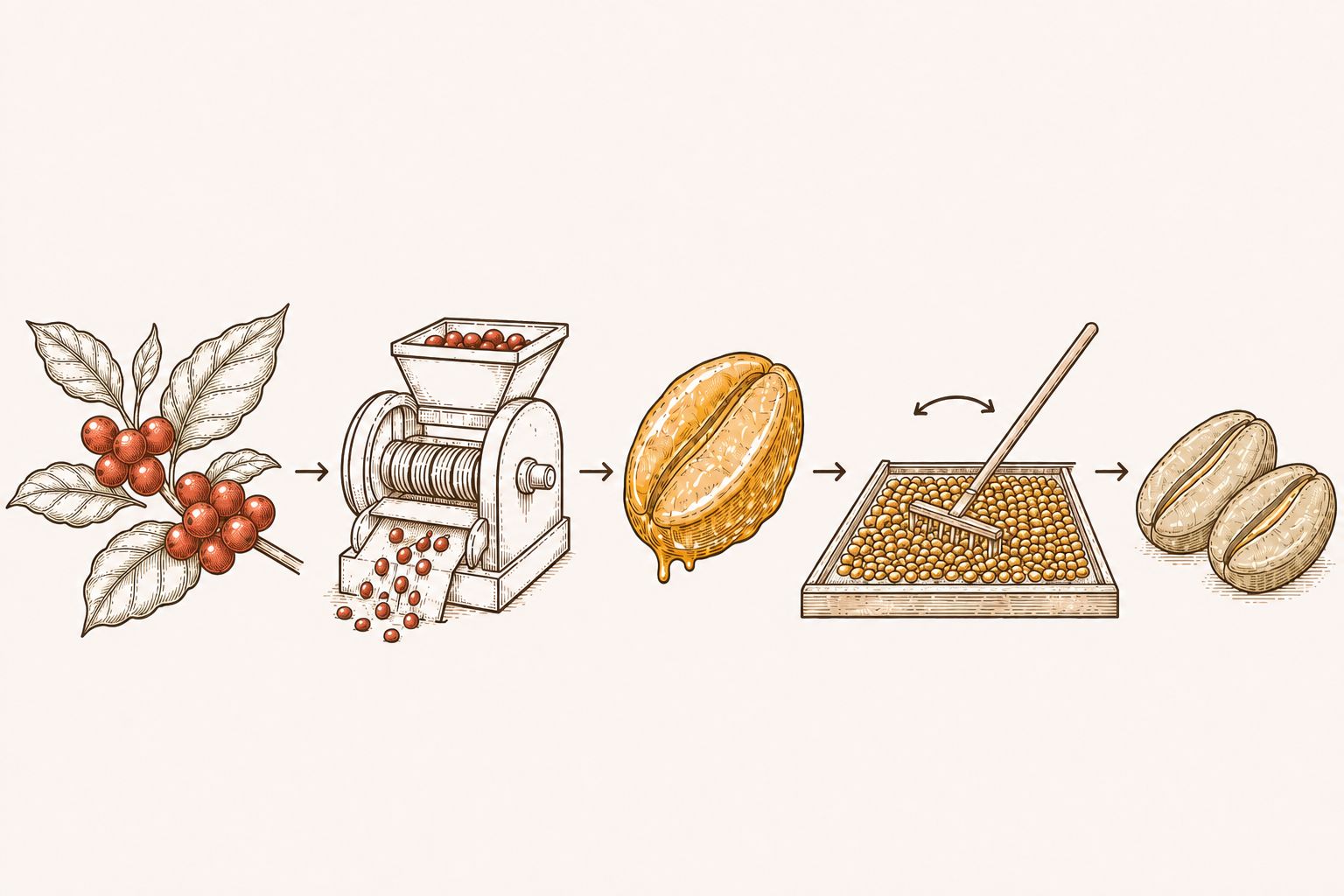
Pulped natural is a term strongly associated with Brazil for coffee that is depulped and then dried with mucilage still attached. Its mechanics overlap with honey processing, but the names carry different regional histories and expectations.
Updated: Aug 20, 2026Reviewed by: Ah-Zhu (English-site batch review)
Washed Process
Pick ripe coffee cherries
Remove the skin and pulp
Break down the mucilage through fermentation
Wash the coffee
Dry the parchment coffee
Natural Process
Pick ripe coffee cherries
Dry the whole cherries
Turn them regularly
Remove the dried fruit and parchment
Prepare the green coffee
Honey Process
Pick ripe coffee cherries
Remove the skin while retaining some mucilage
Dry the coffee with mucilage attached
Remove the parchment after drying
Prepare the green coffee
Wet-Hulled Process
Pick ripe coffee cherries
Depulp, then briefly ferment or wash
Remove the parchment while moisture remains high
Continue drying
Prepare the green coffee
Anaerobic Fermentation
Pick ripe coffee cherries
Place the coffee in a sealed or low-oxygen vessel
Control fermentation time and temperature
Finish with a washed, natural, or honey process
Dry the coffee
The basic pulped-natural process
In pulped-natural processing, ripe coffee cherries are depulped, leaving sticky mucilage around the parchment-covered seeds. The coffee is then dried with that mucilage in place instead of being fermented and washed until the surface is clean.
Brazilian producers commonly call the approach pulped natural or Cereja Descascada. Removing the skin reduces the material that needs to dry compared with a whole cherry, allowing faster drying than a natural process. The retained, sugar-rich mucilage still requires careful spreading and turning.
Natural dries in the whole fruit, pulped natural dries with mucilage attached, and washed coffee dries after the mucilage is removed.
One trade reference describes depulping within about 24 hours, drying for roughly 10–15 days, and finishing near 11% moisture. Those figures describe a working example, not a universal specification. Weather, layer depth, equipment, and producer practice all matter.
How it differs from honey process
Mechanically, honey processing and pulped natural can be nearly identical: depulp first, retain some or all mucilage, then dry. The distinction is most useful as regional and commercial context.
Pulped natural is strongly tied to Brazilian production and was adopted in part to shorten the long drying period of intact cherries. Honey and miel labels became especially common in Central America, where producers also use color categories and may emphasize flavor design through mucilage retention, shade, and drying speed.
Producers may use either term, so two lots with different names can follow more similar procedures than two lots with the same label. To understand a particular coffee, check what remained around the seed during drying and how drying was managed.
How pulped-natural coffee often tastes
Compared with a whole-fruit natural from a similar setting, pulped-natural coffee is often described as lighter, more clearly defined, and less fermentation-driven. Brazilian examples are frequently associated with nuts, chocolate, soft fruit, and rounded sweetness.
These are regional and market tendencies, not built-in flavors. A particular variety or fermentation design can produce floral or vivid fruit notes, while roast development can emphasize chocolate and body. Read pulped natural as a process clue and use the rest of the bag’s information to predict the cup.
Common Misconceptions
Is pulped natural the same as honey process?
Their core steps often overlap—remove the skin and dry the coffee with mucilage attached. Pulped natural is closely associated with Brazil, while honey or miel is common in Central America, and regional goals and subcategories differ.
What do CD and Cereja Descascada mean on a bag?
They usually indicate pulped-natural coffee. The Portuguese phrase means depulped or peeled cherry and is widely used in Brazil.
Does pulped-natural coffee always taste nutty or chocolaty?
No. Those are common descriptions for some Brazilian lots, not a process guarantee. Variety, region, drying, roast, and brewing can all lead to different flavors.
Is semi-washed another name for pulped natural?
Sometimes, but not reliably. Semi-washed can mean partial mechanical mucilage removal, a honey-like process, or even an imprecise translation of Indonesian wet hulling.
Cafe Imports, Pulped Natural Process: Describes prompt depulping followed by drying with mucilage attached, provides typical drying references, and discusses the process’s development in Brazil.