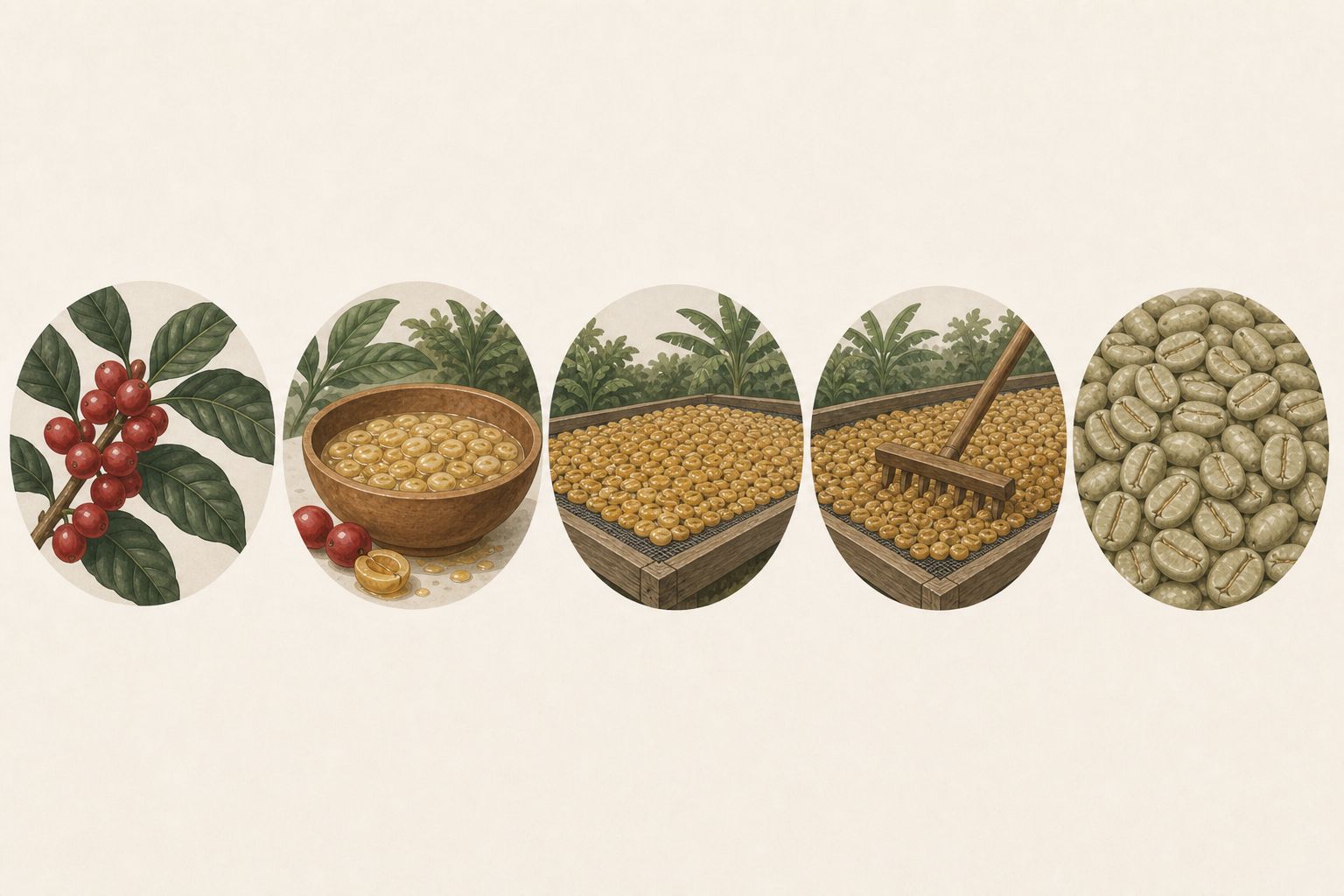
Honey processing removes the coffee cherry's skin but dries the seeds with some or all of the sticky mucilage still attached. Yellow, red, and black honey labels are useful local clues, not globally standardized recipes.
Updated: Aug 31, 2026Reviewed by: Ah-Zhu (English-site batch review)
Washed Process
Pick ripe coffee cherries
Remove the skin and pulp
Break down the mucilage through fermentation
Wash the coffee
Dry the parchment coffee
Natural Process
Pick ripe coffee cherries
Dry the whole cherries
Turn them regularly
Remove the dried fruit and parchment
Prepare the green coffee
Honey Process
Pick ripe coffee cherries
Remove the skin while retaining some mucilage
Dry the coffee with mucilage attached
Remove the parchment after drying
Prepare the green coffee
Wet-Hulled Process
Pick ripe coffee cherries
Depulp, then briefly ferment or wash
Remove the parchment while moisture remains high
Continue drying
Prepare the green coffee
Anaerobic Fermentation
Pick ripe coffee cherries
Place the coffee in a sealed or low-oxygen vessel
Control fermentation time and temperature
Finish with a washed, natural, or honey process
Dry the coffee
Why it is called honey process
Honey-process coffee contains no honey or added sugar. After depulping, a sticky layer called mucilage remains around the parchment-covered seeds. Its tacky texture and amber appearance as it dries helped give the process its name.
Instead of fermenting and washing all of that mucilage away, producers dry the coffee with some or all of it attached. This places honey processing between the broad mechanics of washed coffee and natural coffee: the skin and most pulp are gone, but the seed still dries with fruit material around it.
The retained layer raises the need for careful turning, airflow, layer depth, and weather management. Mucilage can encourage desirable fermentation, but uneven drying can also create defects. See drying.
What yellow, red, and black honey mean
Some Central American mills label lots yellow, red, or black honey, but these colors do not follow one fixed scale of mucilage retention. Industry references describe several systems based on retained mucilage, shade, drying speed, or the parchment’s appearance.
Color names can reflect mucilage, shade, drying speed, or appearance. Ask how the producer defines them.
Lighter-colored labels often suggest faster drying and a more washed-like approach, while darker labels often suggest more mucilage or slower drying under shade. These are broad tendencies, and one mill’s red honey may follow a different process from another’s.
How honey-process coffee often tastes
Honey coffees are often described as rounded, sweet, or layered, with more fruit influence than a typical washed lot and less whole-fruit fermentation character than a typical natural. A lighter honey may feel crisp and clearly defined; a darker honey may feel fuller or more fruit-forward.
Those are not fixed outcomes. A carefully processed yellow honey can be intensely fruity, and a black honey can be clean and restrained. The variety, growing environment, cherry ripeness, fermentation, drying, storage, roast, and brew method remain essential.
When a bag provides only the word honey, use it as a starting clue. A more informative description will explain how much mucilage remained, whether the coffee dried in sun or shade, how it was turned, and how the producer defines the color—if a color is used at all.
Common Misconceptions
Is honey added to honey-process coffee?
No. The name refers to the sticky, sugar-rich mucilage that remains around the seed after the cherry skin is removed.
Are yellow, red, and black honey standardized grades?
No. A producer may classify them by retained mucilage, shade, drying speed, or the dried coffee's appearance. The same color can mean different procedures at different mills.
Is honey-process coffee always sweet?
No. Rounded sweetness is a common impression, but variety, ripeness, fermentation, drying, roast, and brewing all affect the cup.
Is honey process the same as pulped natural?
Their basic mechanics often overlap—depulp, retain mucilage, then dry. Pulped natural is especially associated with Brazil, while honey terminology is common in Central America, and local goals and labels differ.
Kenneth Davids, Honey Coffees and Pulped Natural Coffees, Coffee Review: Describes drying depulped coffee with all or part of its mucilage and gives historical context for pulped natural and Central American honey terminology. Its tasting observations come from Central American samples reviewed in 2012, not a universal flavor standard.