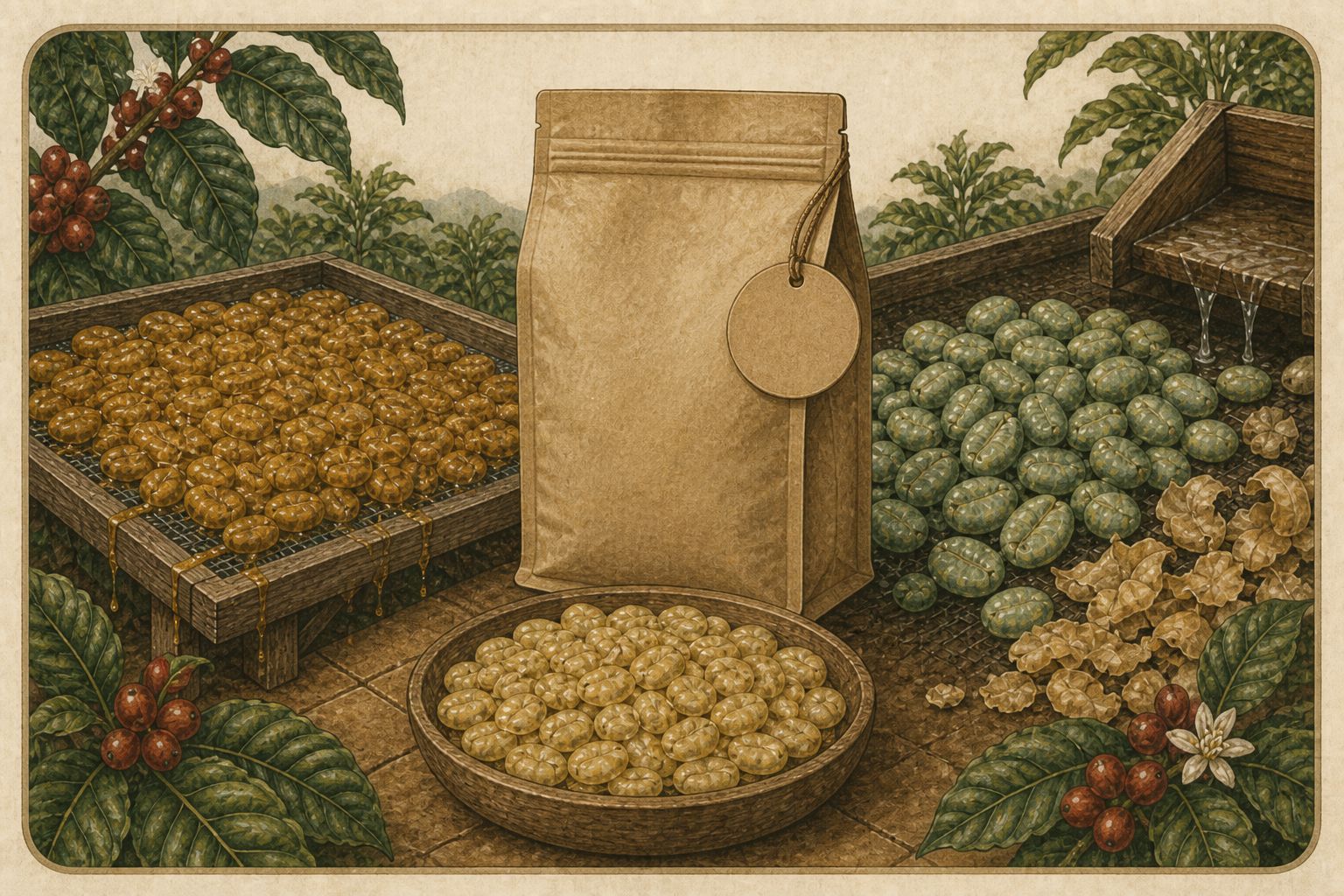
Semi-washed is not one standardized coffee process. It may refer to partially removed mucilage, a honey or pulped-natural method, or an imprecise label for Indonesian wet hulling. The production details matter more than the name.
Updated: Aug 20, 2026Reviewed by: Ah-Zhu (English-site batch review)
Washed Process
Pick ripe coffee cherries
Remove the skin and pulp
Break down the mucilage through fermentation
Wash the coffee
Dry the parchment coffee
Natural Process
Pick ripe coffee cherries
Dry the whole cherries
Turn them regularly
Remove the dried fruit and parchment
Prepare the green coffee
Honey Process
Pick ripe coffee cherries
Remove the skin while retaining some mucilage
Dry the coffee with mucilage attached
Remove the parchment after drying
Prepare the green coffee
Wet-Hulled Process
Pick ripe coffee cherries
Depulp, then briefly ferment or wash
Remove the parchment while moisture remains high
Continue drying
Prepare the green coffee
Anaerobic Fermentation
Pick ripe coffee cherries
Place the coffee in a sealed or low-oxygen vessel
Control fermentation time and temperature
Finish with a washed, natural, or honey process
Dry the coffee
Why the label is ambiguous
The coffee industry does not share one precise definition of semi-washed. Depending on the producer, country, exporter, or translator, the term can point to at least three different ideas:
A mechanical demucilager removes part—but not all—of the mucilage before drying.
The label is used loosely for Indonesian wet hulling, where the defining difference involves parchment rather than mucilage.
The same label may describe different layers being removed at different times.
Understanding the label requires the producer’s description of what happened to the actual lot.
Two questions reveal more than the name
First ask: How much mucilage remained during drying? If the skin was removed and sticky mucilage stayed around the parchment, the process belongs near the honey or pulped-natural family. Some Brazilian usage calls coffee semi-washed when machinery removes only part of the mucilage before drying.
Second ask: When was the parchment removed? In most washed and honey processes, coffee finishes drying inside parchment. In wet hulling, producers remove parchment while the coffee still has high moisture, then dry the exposed seed. Calling both approaches semi-washed hides the most important physical difference.
Mucilage-on drying and early parchment removal are not the same process, even when both are called semi-washed.
What the label can—and cannot—predict
If semi-washed means partial mucilage removal, the cup may be described as more rounded than a conventional washed coffee and more restrained than a fruit-forward natural. If it means wet-hulled Indonesian coffee, a heavier texture, softer acidity, and earthy, herbal, or tobacco-like notes are more common expectations.
These patterns are only tendencies because the label covers several processes. Look for the country, the producer’s description, mucilage retention, parchment-removal stage, drying method, and roast before predicting flavor. Without those details, semi-washed provides only a broad starting point.
Common Misconceptions
Is semi-washed the same as honey process?
Sometimes people use the terms for overlapping methods, but not consistently. Ask whether the coffee dried with all, some, or none of its mucilage attached.
Is semi-washed the same as wet-hulled coffee?
It can appear as a loose translation, but wet hulling has a different defining step—the parchment is removed while the coffee is still unusually moist.
Does semi-washed coffee have one typical flavor?
No. A honey-like version may fall between common washed and natural profiles, while a wet-hulled version may show the heavier body and restrained acidity associated with that process.
What does semi-lavado mean?
It is a Spanish label sometimes associated with hybrid depulping and washing practices. It still does not identify one globally standardized sequence.