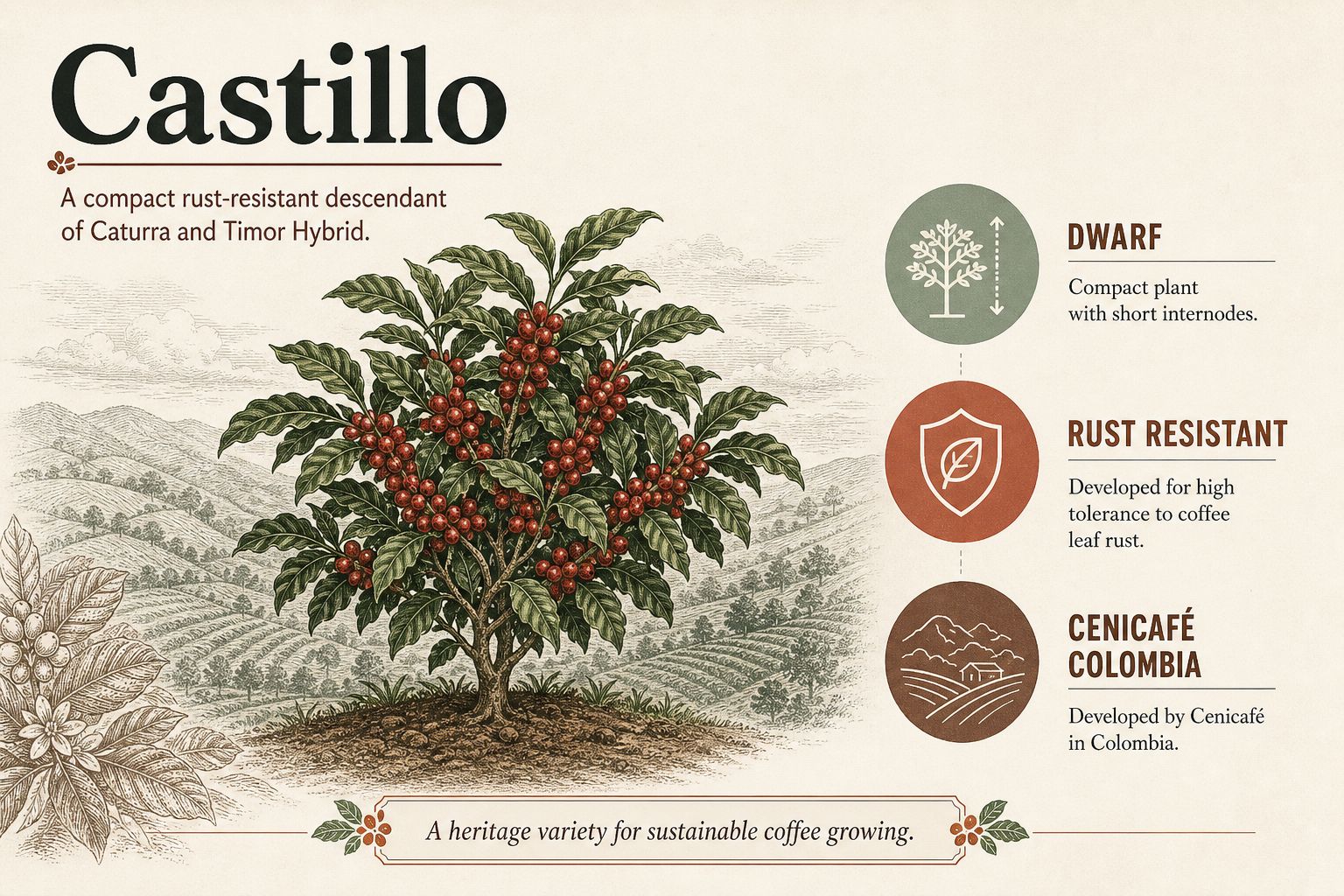
What Is Castillo Coffee—and How Is It Different From Caturra?
Castillo is a composite variety bred by Colombia’s Cenicafé from Caturra and Timor Hybrid. Released by the National Federation of Coffee Growers in 2005, it combines compact growth, high yields, and resistance to coffee leaf rust.
Updated: Sep 3, 2026Reviewed by: Content and layout review
What Castillo means on a coffee bag
Castillo is a variety name, distinct from Colombia as an origin and from the Caturra variety.
Castillo was bred by Colombia’s national coffee research center, Cenicafé, and released to farmers by the National Federation of Coffee Growers on 13 May 2005 under Resolution 03. Its name honors researcher Jaime Castillo Zapata.
Its parents are Caturra and Timor Hybrid (Híbrido de Timor). Caturra is compact but highly susceptible to coffee leaf rust, while Timor Hybrid, a natural arabica–robusta hybrid, contributes resistance genes. Castillo combines compact growth with rust resistance through this breeding.
On a bag of Colombian coffee, Castillo identifies the variety grown, without guaranteeing a particular flavor.
How it differs from Caturra
Both varieties are compact, so height alone cannot distinguish them.
Caturra is a natural mutation of Bourbon. World Coffee Research notes its rust susceptibility and that it once approached half of Colombia’s production. From 2008, a government program encouraged renovation with rust-resistant Castillo.
Castillo was developed through breeding as a composite variety, blending seeds from several selected lines. Differences in their rust-resistance genes reduce the likelihood that a single new rust race will infect the whole population at once. Cenicafé also released regional Castillo blends named for experiment stations, including Naranjal, Pueblo Bello, and El Tambo. For farms outside those climate zones, the handbook recommends the general Castillo variety.
The Colombia variety came first, in 1982, from the same Caturra × Timor Hybrid cross. Castillo was developed later using the same breeding strategy. Compared with Colombia, its trees are slightly taller and a higher proportion of its beans meet the large Supremo size grade.
Catimor often appears in the same conversation. Cenicafé treats Catimor as a generic name for descendants of Caturra × Timor Hybrid, not one cultivar. Castillo belongs to that family. When the lot is correctly identified, a green-coffee bag will usually still be labeled Castillo.
Released in 2005, Castillo was bred from Caturra and Timor Hybrid. This illustration explains parentage and cannot be used to identify a plant.
Disease resistance is not the same as how it tastes
Leaf rust reduces yields in susceptible varieties, encouraging farmers to replace them. Castillo was promoted mainly for disease resistance and yield, not because its flavor has a special advantage.
Some buyers assume that Timor Hybrid’s robusta ancestry leads to poorer flavor. Cenicafé’s position is that Catimor-type descendants can be indistinguishable from other arabicas if poor-cupping lines are discarded, and that selected Colombia and Castillo lines are not necessarily worse than Caturra.
Perfect Daily Grind’s 2017 interview with Cenicafé documents these continuing quality concerns and describes a 2014–2015 comparison by CIAT, World Coffee Research, and Kansas State University of Castillo and Caturra grown on the same farm and processed in the same way. That trial shows the two can cup similarly, though their flavors may still differ; the variety name alone may not tell you how a given lot will taste.
USDA’s 2025 Colombia report, citing Fedecafé, places rust-resistant improved varieties on about 87% of planted area. Castillo is a widely planted variety in that shift, while Colombian specialty coffee still includes other varieties.
Both varieties are compact, but Caturra is rust-susceptible while Castillo inherits resistance from Timor Hybrid. This conceptual illustration cannot be used to diagnose leaf rust.
How to read the name
Castillo identifies the result of a Colombian rust-resistance breeding program. Consider the lot’s origin, processing, and roasting alongside that name; it may taste different from Caturra, and robusta ancestry alone cannot predict its cup quality.
Resistance may lose effectiveness over time. Cenicafé notes that the rust pathogen continues to evolve, requiring ongoing breeding work. Castillo on a bag identifies breeding ancestry without guaranteeing future disease protection or consistent flavor across lots.
Common Misconceptions
Is Castillo the same as Caturra?
No. Caturra is a natural Bourbon mutation. Castillo is a later composite bred from Caturra and Timor Hybrid. Both plants are compact; the names are not interchangeable.
Does robusta ancestry make Castillo a robusta coffee?
No. Its resistance comes from Timor Hybrid, a natural arabica–robusta hybrid, but Castillo remains an arabica variety. Robusta ancestry alone does not make the resulting coffee robusta.
Does Castillo always taste worse than Caturra?
No. Cenicafé selected for cup quality, although some buyers have remained skeptical. A comparison on the same farm found that Castillo and Caturra can have similar cup quality while differing in flavor. Origin, processing, and roasting also affect the result.
Is it the same as the Colombia variety?
No. The Colombia variety was released earlier from the same Caturra × Timor Hybrid strategy. Castillo is the later composite variety, typically with a higher proportion of large beans.
Is all Colombian coffee Castillo now?
Rust-resistant improved varieties cover most planted area, and Castillo is a major part of that shift. Specialty bags still name Caturra and other cultivars.
Cortina Guerrero, Moncada Botero, and Herrera Pinilla, Variedad Castillo, Avances Técnicos Cenicafé 426, 2012: Castillo is a composite (multiline) variety. It is named for Cenicafé researcher Jaime Castillo Zapata. Rust resistance comes from Timor Hybrid; it is not transgenic. Regional Castillo blends are named for experiment stations; the handbook lists Naranjal, Paraguaicito, Santa Bárbara, Pueblo Bello, El Rosario, La Trinidad, and El Tambo. The Colombia variety used the same breeding strategy earlier; Castillo trees are slightly taller with a higher share of Supremo-size beans. Catimor is a generic label for Caturra × Timor Hybrid descendants, not one cultivar. Cenicafé reports that selected Colombia and Castillo lines need not cup worse than Caturra.
World Coffee Research, Caturra: Caturra is a rust-susceptible Bourbon mutation. From 2008 Colombia incentivized renovation with rust-resistant Castillo, which has Caturra parentage.
Perfect Daily Grind, Coffee Varieties: Debunking The Myths Around Castillo, 2017: The article quotes Cenicafé on its breeding program, begun in 1968, the release of Colombia in 1982, and Castillo’s release in 2005 after many generations of selection. It also reports buyer skepticism about Timor Hybrid’s robusta ancestry and describes a 2014–2015 comparison by CIAT, WCR, and Kansas State of Castillo and Caturra grown on the same farm and processed the same way. The report provides context for the market debate and trial, rather than a definitive assessment of quality.