What Is Villa Sarchi—and How Is It Different From Pacas and Caturra?
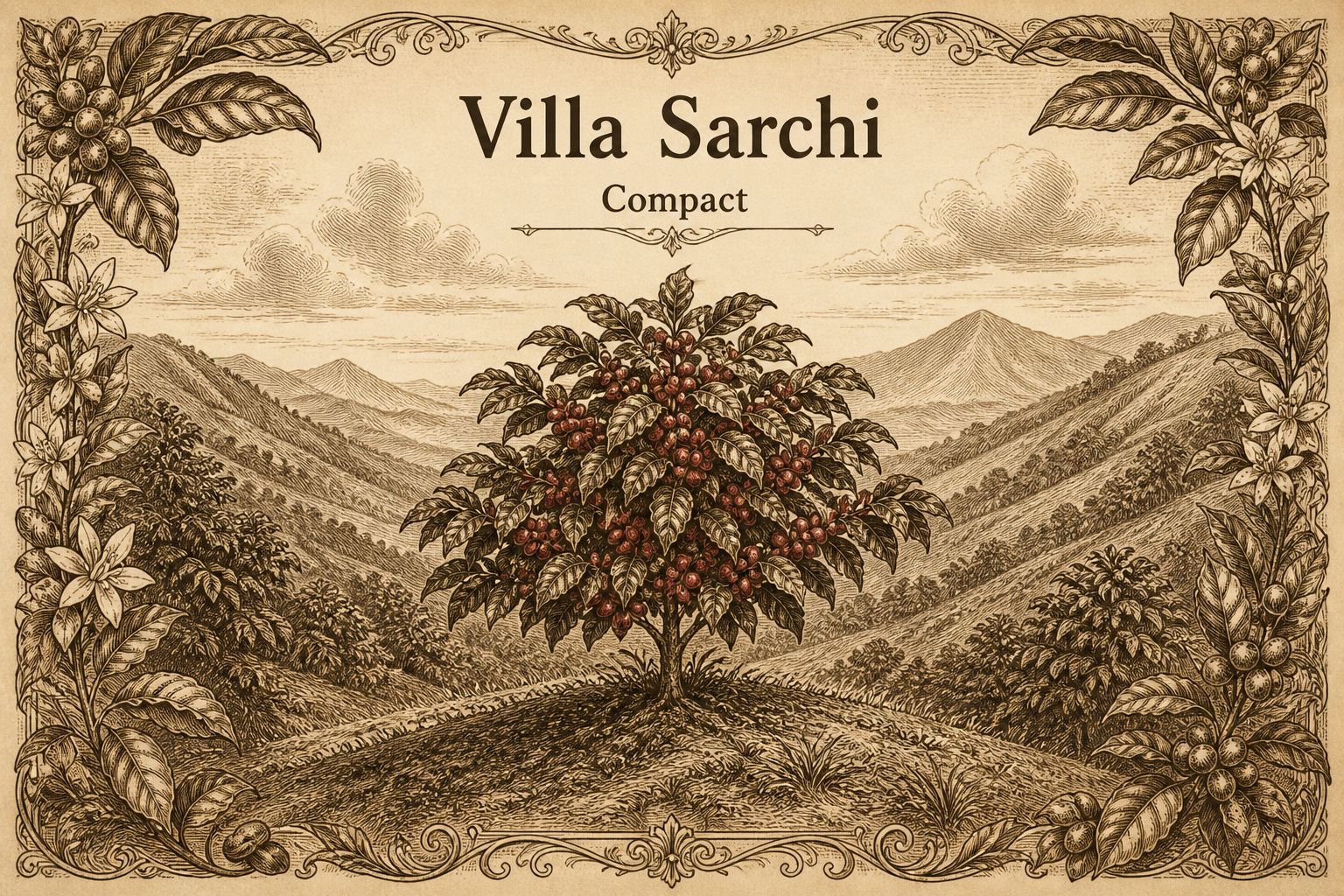
Villa Sarchi is a natural dwarf mutation of Bourbon, found in the 1950s or 1960s in northwestern Alajuela, Costa Rica. A single-gene change keeps the plant compact. World Coffee Research rates high-elevation cup quality as good and flags susceptibility to coffee leaf rust. It is the same class of mutation as Pacas and Caturra, not the same variety.
Updated: Sep 3, 2026Reviewed by: Content and layout review
What Villa Sarchi means on a coffee bag
Villa Sarchi identifies a coffee variety, while other label details describe its origin and processing.
It is a natural mutation of Bourbon. World Coffee Research records its discovery in northwestern Alajuela, Costa Rica, in the 1950s or 1960s. The Instituto del Café de Costa Rica (ICAFE) subsequently carried out pedigree selection. The catalog also lists the names La Luisa and Villalobos Bourbon.
Villa Sarchi has compact plants, below-average bean size, and medium yield, with first production in year three. It is susceptible to leaf rust, nematodes, and coffee berry disease. World Coffee Research rates its high-elevation quality potential as good and describes adaptation to very high elevations and tolerance of strong winds.
The name appears mainly on Costa Rican lots because cultivation elsewhere is limited. World Coffee Research records its introduction to Honduras by IHCAFE in 1974.
How it differs from Bourbon, Pacas, and Caturra
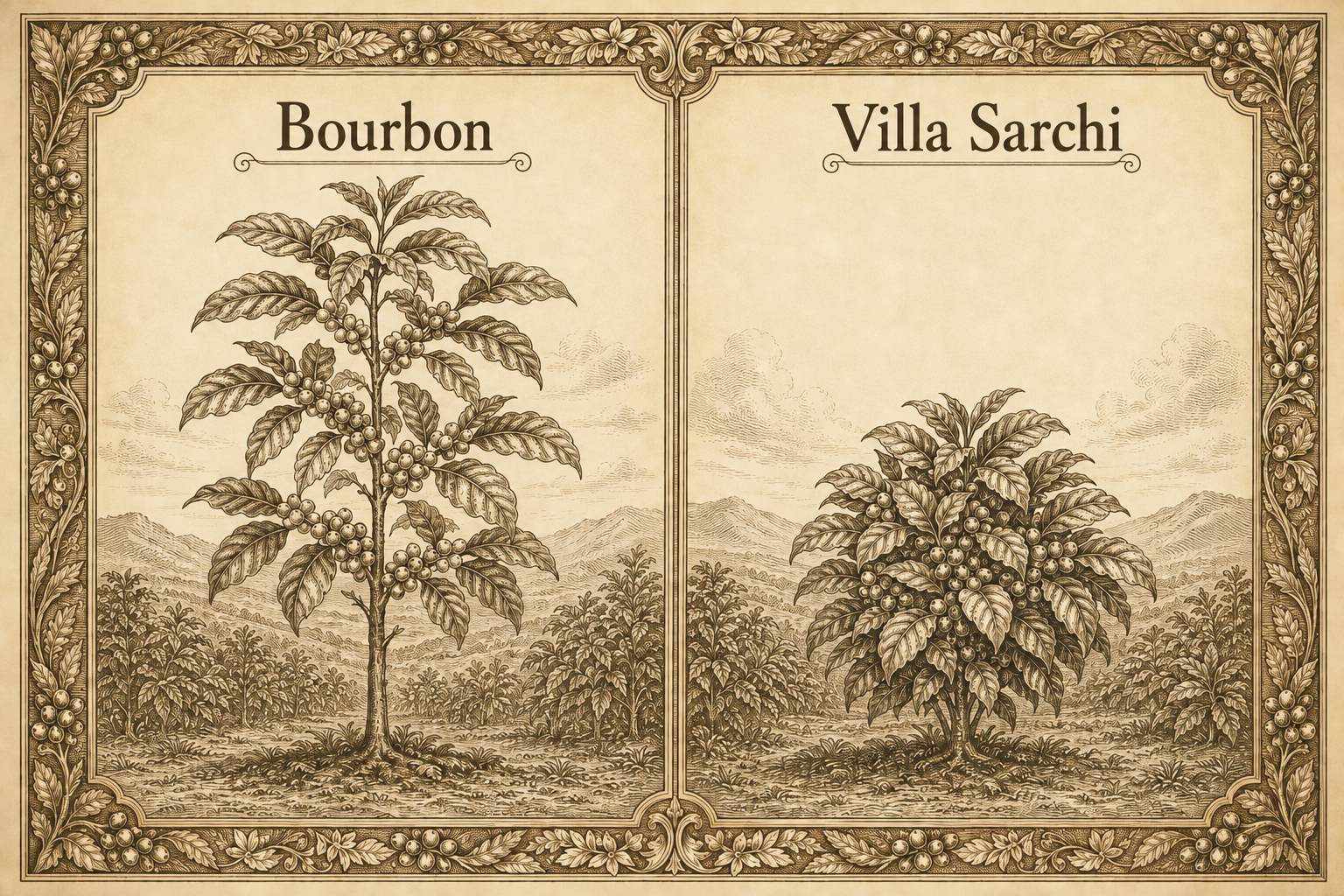
Villa Sarchi is closely related to Bourbon but has a compact form caused by a single-gene mutation, compared with Bourbon’s tall stature. World Coffee Research lists single-stem planting density at about 5,000 to 6,000 plants per hectare for Villa Sarchi and about 3,000 to 4,000 for Bourbon.
Pacas was independently discovered in El Salvador in 1949, while Caturra was found in Brazil around 1915 to 1918. World Coffee Research groups both with Villa Sarchi as similar dwarf Bourbon mutations, while recognizing them as distinct varieties.
Pacas has medium-sized beans, while Villa Sarchi’s beans are smaller than average. At high elevation, Bourbon’s quality potential is rated very good, compared with good for Villa Sarchi, Pacas, and Caturra.
The diagram compares tall Bourbon (left) with compact Villa Sarchi (right); it cannot identify an individual plant.
From left to right, Villa Sarchi was discovered in Costa Rica, Pacas in El Salvador, and Caturra in Brazil. All three are dwarf mutations of Bourbon; this illustration cannot identify an individual plant.
How it differs from Sarchimor
Coffee leaf rust reached Latin America in the 1970s. World Coffee Research writes that in 1967 the Coffee Rust Research Center in Portugal (CIFC) crossed a rust-resistant Timor Hybrid plant, HDT CIFC 832/2, with compact Villa Sarchi to make hybrid 361 (H361). That cross became the basis of the Sarchimor family, while crosses using Caturra and Timor Hybrid gave rise to the Catimor family.
Villa Sarchi remains susceptible to rust despite its role as a Sarchimor parent. For more on these hybrid families, see Catimor and Timor Hybrid.
Common Misconceptions
Is Villa Sarchi just Bourbon?
Villa Sarchi is a compact natural mutation of Bourbon. They are genetically related but remain distinct varieties.
Is it the same as Pacas or Caturra?
All three are distinct dwarf mutations of Bourbon. Villa Sarchi was discovered in Costa Rica, Pacas in El Salvador, and Caturra in Brazil.
Is Villa Sarchi the same as Sarchimor?
Villa Sarchi is a variety, while Sarchimor is a later hybrid family developed using Villa Sarchi and Timor Hybrid as parents.
Does Villa Sarchi taste better?
World Coffee Research rates its high-elevation quality potential as good, but origin, processing, and roasting still affect the flavor of each lot.
Why is the plant shorter?
A single-gene mutation keeps the plant compact, allowing denser planting, though this trait does not provide leaf-rust resistance.
World Coffee Research, Villa Sarchi: Records Villa Sarchi as a single-gene dwarf Bourbon mutation, also called La Luisa or Villalobos Bourbon, discovered in northwestern Alajuela, Costa Rica, in the 1950s or 1960s and subsequently selected by ICAFE. It is not widely grown outside Costa Rica, though IHCAFE introduced it to Honduras in 1974. Compact plants have below-average bean size, medium yield, and first production in year three, with susceptibility to leaf rust, nematodes, and coffee berry disease. High-altitude quality potential is rated good; the variety tolerates strong winds and is well adapted to very high elevations. Listed single-stem density is about 5,000 to 6,000 plants per hectare. CIFC crossed Timor Hybrid HDT CIFC 832/2 with Villa Sarchi to produce H361, the basis of the Sarchimor family. Crosses between Caturra and Timor Hybrid gave rise to the Catimor family.
World Coffee Research, Pacas: Describes Pacas as a separately discovered dwarf Bourbon mutation from El Salvador in 1949, with average-size beans and a distinct variety identity.
World Coffee Research, Caturra: Records Caturra as a separately discovered dwarf Bourbon mutation from Brazil around 1915 to 1918, recognized as a distinct variety.
World Coffee Research, Bourbon: Describes tall Bourbon plants, with listed single-stem planting density of about 3,000 to 4,000 plants per hectare and high-altitude quality potential rated very good.