Catuai is a compact arabica variety created by crossing Mundo Novo with Caturra and released in Brazil in 1972. It supports dense planting but remains susceptible to coffee leaf rust, and its red- and yellow-fruited forms do not guarantee different flavors.
Updated: Aug 20, 2026Reviewed by: Ah-Zhu (English-site batch review)
A Brazilian cross built for compact growth
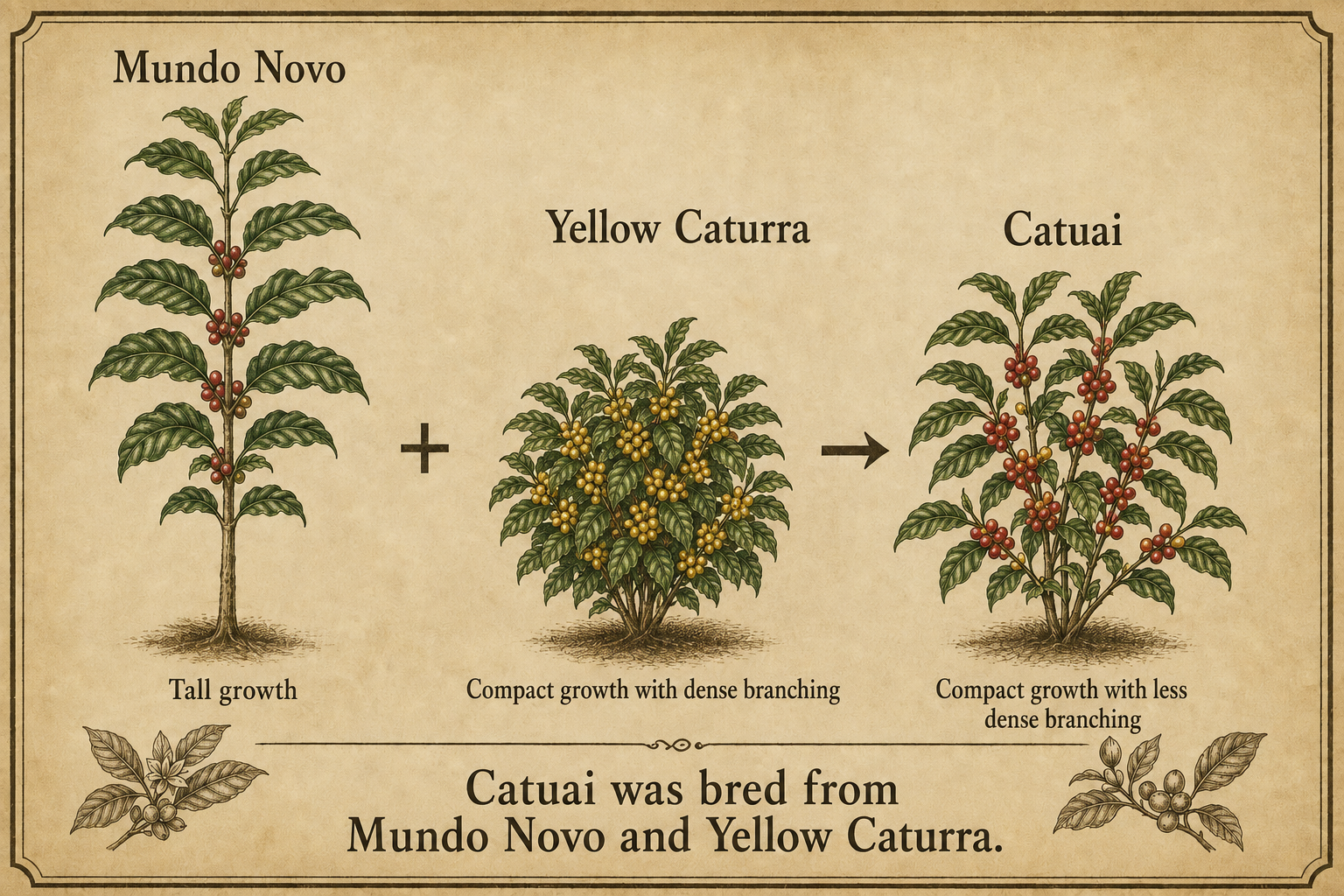
Catuai—or Catuaí—is an arabica variety created by Brazil’s Instituto Agronômico. Breeders crossed the tall, productive Mundo Novo with compact Caturra in 1949. Early material carried the code H-2077, and selected lines were released in Brazil in 1972.
Mundo Novo is a natural hybrid involving Typica and Bourbon ancestry. Caturra is a compact mutation of Bourbon. Catuai therefore combines ancestry from both foundational arabica groups; it is not a renamed Caturra.
The name comes from a Guaraní expression often translated approximately as “very good.”
Catuai and Caturra in the field
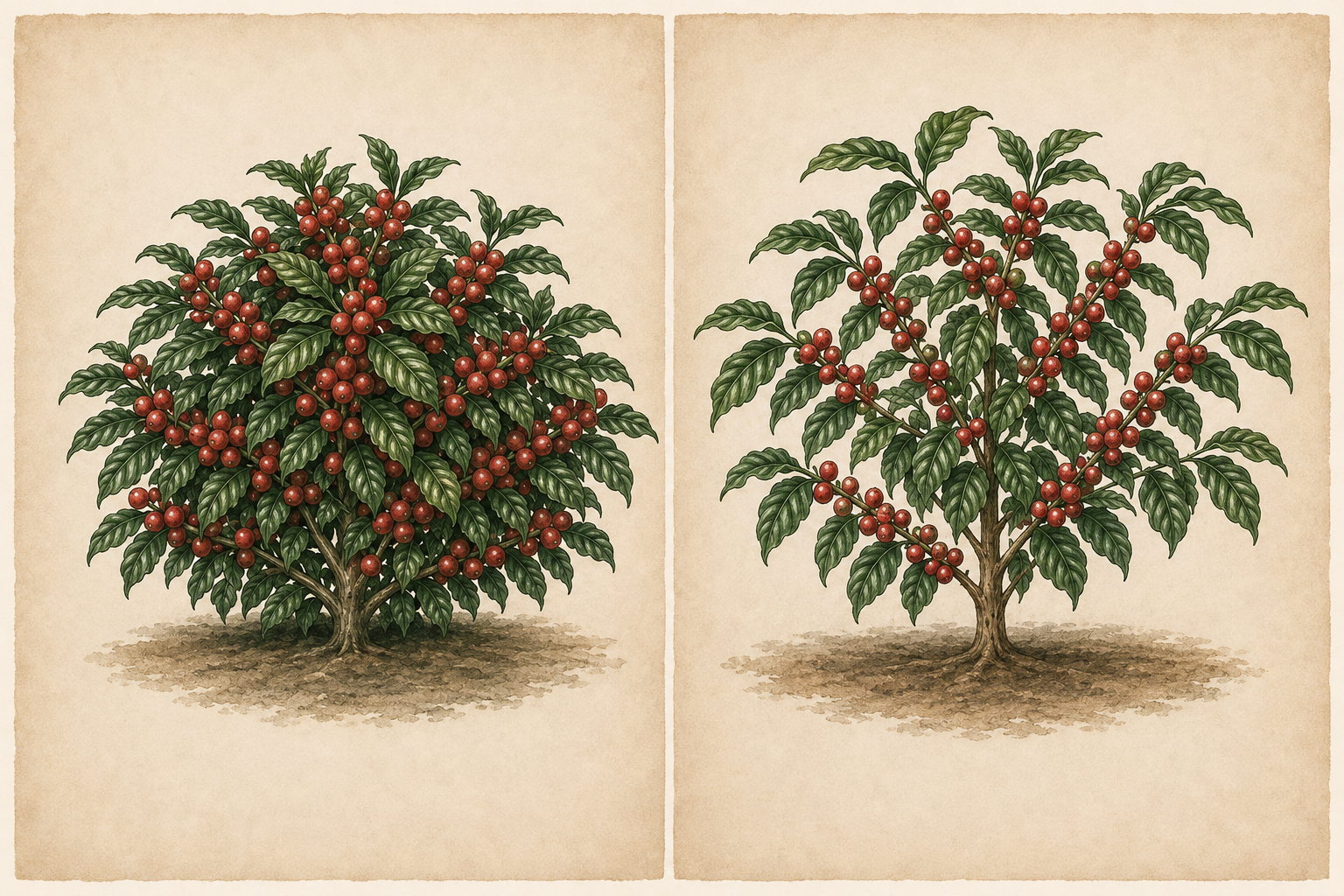
Both varieties are shorter than traditional Bourbon or Typica. World Coffee Research describes Catuai as vigorous and compact, though not as dense as Caturra. Its size supports closer spacing and easier field management. Yield is moderate, nutrient demand is high, and meaningful harvest commonly begins in the third year.
Caturra (left) and Catuai (right) both have compact growth, but Caturra has denser branching. The illustration compares their general form and cannot identify an individual plant.
Catuai is highly susceptible to coffee leaf rust, nematodes, and coffee berry disease. Brazilian farms may reduce risk through nutrition, mechanization, monitoring, and timely treatment, but those management conditions do not transfer automatically to every country.
Catuai was bred by crossing Mundo Novo with Yellow Caturra. A red-fruited Catuai selection is shown here; yellow-fruited selections also exist.
Where Catuai became important
Brazil grows numerous Catuai lines. The variety also became economically important in parts of Central America. World Coffee Research records introductions to Guatemala in 1970, Honduras in 1979 followed by commercial release in 1983, and Costa Rica in 1985.
Performance is not identical across regions. Research in Honduras and Costa Rica did not find a significant yield advantage over Caturra, and some Central American lines appear less productive than Brazilian material. This is a reminder that variety performance depends on environment and management.
How Catuai often tastes
World Coffee Research rates its high-elevation quality potential as good while noting that the variety is considered capable rather than unusually distinctive. Coffee Review similarly describes red- and yellow-fruited Catuai as respected and often good, but difficult to identify by flavor alone.
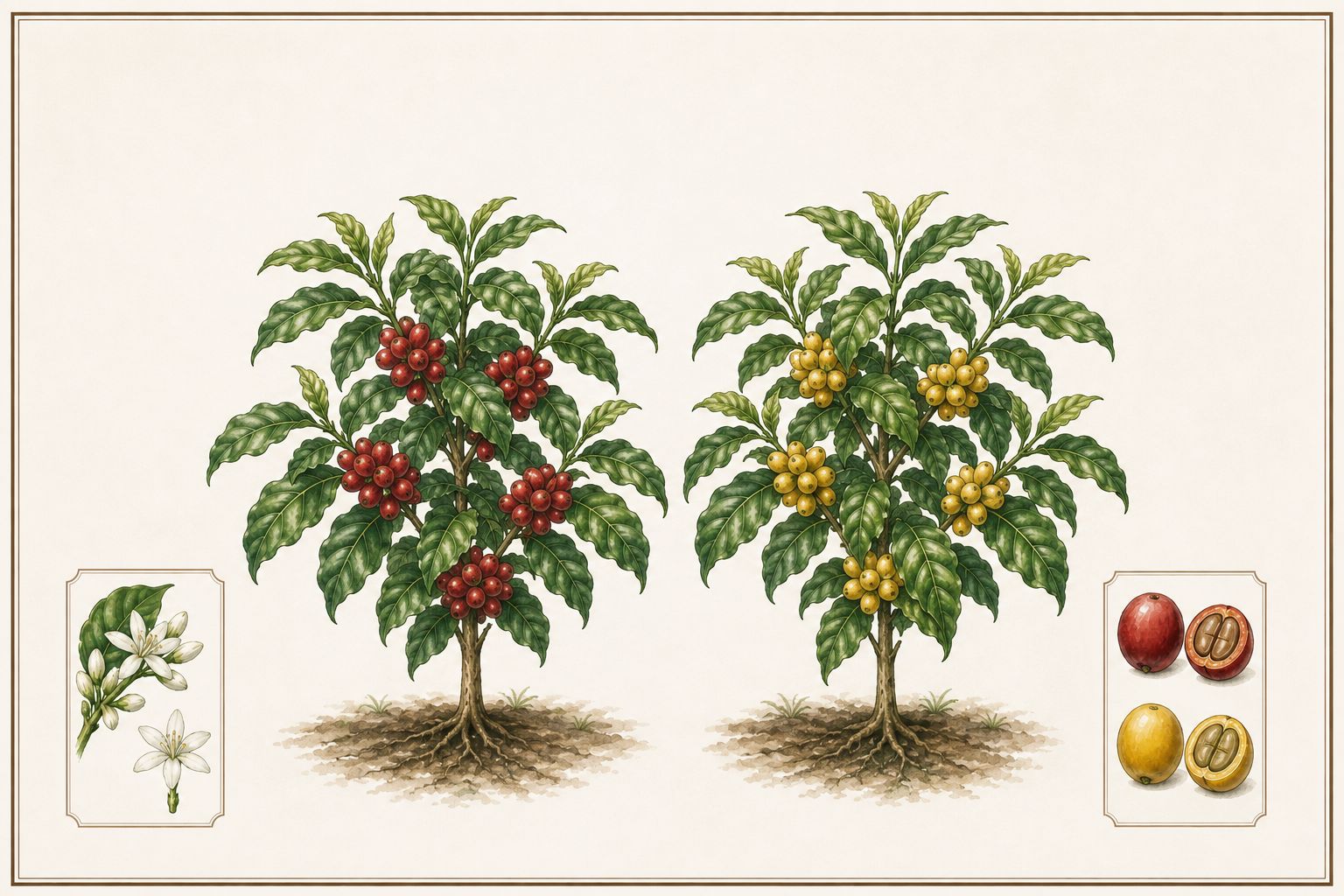
Red Catuai and Yellow Catuai refer to ripe fruit color. Available controlled evidence is not strong enough to promise that one is sweeter, heavier, or more aromatic. Origin, harvest, processing, roast, and brewing should carry more weight in a buying decision.
Common Misconceptions
Is Catuai the same as Caturra?
No. Catuai is a cross between Mundo Novo and Caturra. Both are compact, but Catuai is generally less dense in its architecture.
Is Catuai related to Bourbon and Typica?
Yes. Caturra came from Bourbon, while Mundo Novo arose from Typica and Bourbon material. Catuai carries ancestry from both foundational groups.
Do Red Catuai and Yellow Catuai taste different?
Their ripe cherries differ in color, but strong controlled evidence for a consistent flavor split is limited. Do not use fruit color as a sweetness or body guarantee.
Is Catuai resistant to coffee leaf rust?
No. It remains highly susceptible, so production depends on monitoring, nutrition, and disease management.
World Coffee Research, Catuai: Describes the cross and its selection history in Brazil, agricultural traits, and spread across growing regions. It also records disease susceptibility and quality potential.