Why Does Brazilian Coffee Often Taste Nutty and Low in Acidity?
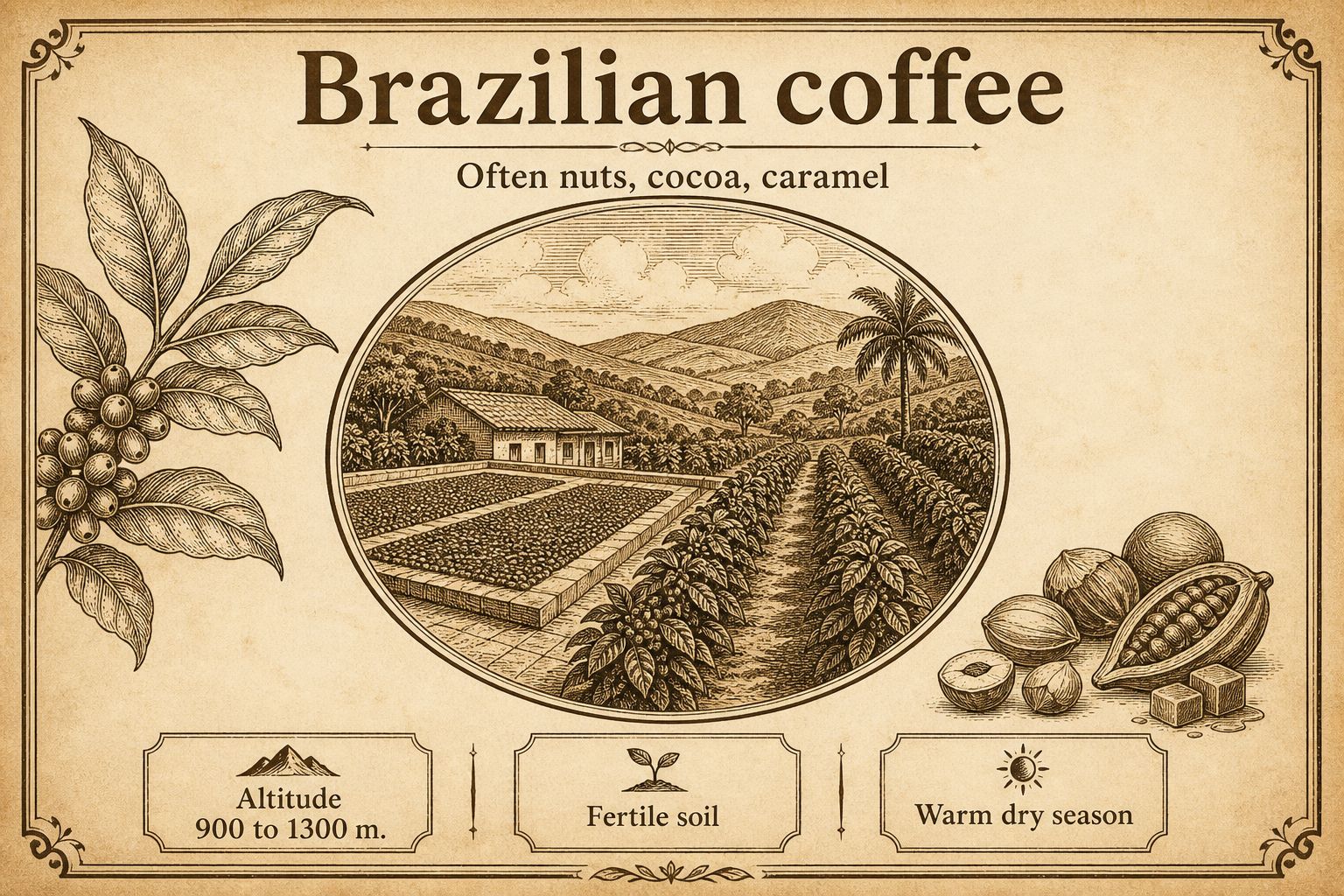
Much Brazilian arabica grows around 800–1,200 meters and is finished through natural or pulped-natural processing. Rounded acidity, chocolate, and nuts are common reference notes, which also make Brazil important in espresso blends.
Updated: Aug 26, 2026Reviewed by: Ah-Zhu (English-site batch review)
The world’s largest coffee origin
Brazil has led global coffee production for more than 150 years and remained the world’s largest producer and exporter in the USDA’s 2026 annual report. Its scale influences commodity coffee, espresso blends, and specialty single-origin markets. It also sits inside the typical coffee belt.
Most Brazilian coffee acreage is arabica, concentrated heavily in Minas Gerais. São Paulo is also strongly associated with arabica. Espírito Santo is a major center for canephora—commonly called conilon in Brazil. The Brazilian bag in a specialty shop is likely arabica, but the country grows both major commercial species.
Brazil is often used in blends because a rounded chocolate-and-nut profile can provide a stable foundation, especially for espresso and milk drinks. That commercial role does not limit the origin to blended coffee.
Why the familiar profile is rounded
Coffee Review places much Brazilian production on plateaus and rolling land around 800–1,200 meters. That is generally lower than many celebrated East African highlands, and the resulting acidity is often perceived as softer rather than sharply defined.
Processing is another major influence. Brazil has a long tradition of natural coffee, drying whole cherries on patios or through combined patio and mechanical systems during a relatively dry harvest season. Since the 1990s, producers have also expanded pulped natural: removing the skin and drying the parchment coffee with mucilage attached.
Compared with a whole-fruit natural, pulped-natural lots often show less fermentation character and a lighter, more clearly defined profile. Neither method guarantees chocolate, sweetness, or low acidity; they help create the common direction when combined with region and variety.
Brazilian bags frequently name Bourbon, Mundo Novo, or Catuai. Farms may harvest and sell mixed varieties, while Yellow Bourbon sometimes appears as a separated specialty lot.
The comparison shows broad tasting tendencies rather than fixed continental flavor categories.
Sul de Minas, Cerrado, and Mogiana
Sul de Minas is a large and important producing area in southern Minas Gerais, visible in both volume production and specialty competitions. Cerrado Mineiro occupies a higher, relatively dry plateau with significant large-farm production and strong lot consistency. Mogiana lies in São Paulo near the Minas border and is often associated with rounded sweetness and substantial body.
Chapada Diamantina in Bahia also produces specialty coffee. Espírito Santo is best known nationally for conilon, while mountainous areas near Minas include smaller arabica farms.
Coffee-region names identify areas used in trade and do not always match current administrative boundaries.
The name Brazil Santos 2/3 refers to a port and commercial grading tradition rather than a growing region. A specialty bag that names a farm, municipality, cultivar, process, and harvest provides much stronger traceability.
What to expect in the cup
A natural Brazilian coffee often begins with a reasonable expectation of rounded acidity, chocolate, nuts, caramel-like sweetness, and medium body. A pulped-natural lot may feel cleaner and less fermentation-driven. Light-roasted high-quality lots can still show lively fruit, flowers, and transparent acidity.
Choose Brazil when you want a comfortable espresso base, a lower-acid reference, or a single origin whose sweetness leans toward chocolate and nuts. Then judge the actual lot rather than treating the national profile as a limit.
Common Misconceptions
Does all Brazilian coffee have low acidity and chocolate flavor?
No. Those are common reference points. Elevation, region, variety, process, lot selection, roast, and brewing can produce brighter fruit, flowers, or stronger fermentation character.
Is Brazilian coffee only useful in blends?
No. Its rounded structure is valuable in espresso blends, but Brazil also produces traceable single-origin and competition-level lots.
Is pulped natural the same as honey process?
Their core steps often overlap, but pulped natural has a strong Brazilian context and should not be treated as a globally identical honey-process recipe.
Is Santos a coffee-growing region?
Usually the name refers to a port and commercial grading tradition rather than a precise growing origin.