What Is Coffee Leaf Rust? Can Resistant Varieties Still Get It?
Coffee leaf rust is a disease of coffee leaves caused by the fungus Hemileia vastatrix. Pale yellow spots may appear on the upper leaf surface, with yellow-orange powdery spores beneath them. Severe infections can cause early leaf drop and reduce production. A rust-resistant variety has lower risk under some conditions, but it is not immune everywhere.
Updated: Sep 28, 2026Reviewed by: Content and layout review
What does it look like on a coffee tree?
Coffee leaf rust is a leaf disease caused by the fungus Hemileia vastatrix. The name refers to the yellow-orange powder that can develop on infected leaves; the coffee beans themselves are not rusting.
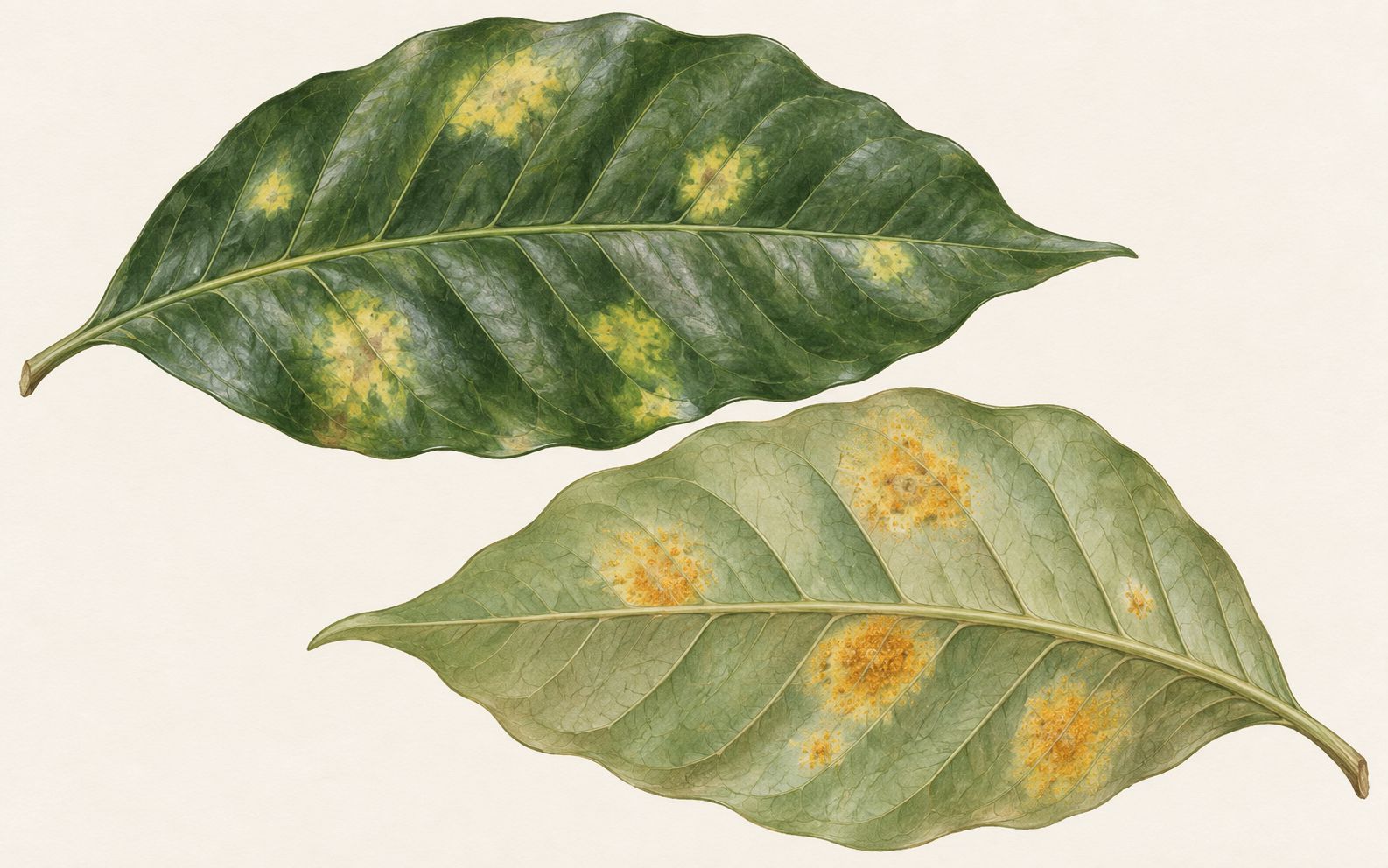
An infected leaf may show pale yellow spots on its upper surface. Turn it over and yellow-orange, powdery spore clusters may appear beneath those spots. As lesions develop, their centers can dry and become brown. Symptoms vary with the stage of infection, the environment, and how susceptible the tree is. A single yellow spot or schematic drawing cannot confirm a diagnosis. The Hawaiʻi Department of Agriculture fact sheet includes photographs of actual symptoms.
The two leaves in the illustration above represent the upper and lower surfaces. They show where signs can appear, rather than what every infected leaf will look like.
How does rust spread, and why does it matter to a harvest?
Rust spores can travel on wind and rain. If they land on a susceptible leaf and moisture conditions allow, they may germinate, enter the leaf, and produce a new lesion. That lesion can release more spores, continuing the spread within a farm.
Water does not have a single, simple effect. Research described by World Coffee Research found that rain can move spores, while some rain also washes them off leaves. Shade changes how raindrops reach the canopy and can alter both effects. A rainy day or a shaded plot, on its own, cannot tell a grower how severe an outbreak will be.
From left to right: spores reach a leaf, lesions develop, and severe infection may lead to early leaf drop. This diagram does not mean every infected leaf falls, and it cannot diagnose a tree.
Leaves support the tree’s growth through photosynthesis. A severe infection can make leaves drop before their time, reducing the healthy leaf area available to the plant. Growth, yield, and coffee quality may then suffer. The size of the loss depends on when infection occurs, the tree’s condition, and farm management; one loss percentage would not describe every farm.
What does “rust-resistant” mean on a variety profile?
Rust resistance describes a plant’s response to disease pressure, not the flavor of its coffee. The World Coffee Research variety catalog distinguishes highly resistant, intermediate, and susceptible responses. These labels help with growing decisions, but they are not cup-quality scores.
Caturra is susceptible to rust. Castillo and Catimor lead to different breeding stories involving Timor Hybrid-derived material and the search for resistance. Breeders also consider plant shape, yield, and cup quality. Calling all rust-resistant coffees the same variety would hide those differences.
Resistance has limits. A 2025 field study observed 29 varieties at 23 sites and found that the variety, the site, and their interaction all affected rust symptoms. No variety in that study was symptom-free at every site. Local rust populations and growing conditions can change, so “resistant” should never be read as “will never become infected.”
What can growers do about it?
Growers and local agricultural specialists can combine leaf monitoring with varieties suited to the area, plant nutrition, canopy management, and other controls when warranted. A handbook from World Coffee Research, CATIE, and USAID treats rust management as a set of decisions shaped by local conditions, not a universal treatment schedule.
For someone buying coffee, leaf rust helps explain why a grower might plant Castillo or a Catimor-family variety. It is a farm-health issue; whether a single cup tastes good cannot tell you if the trees where it was grown had leaf rust. For the difference between a plant’s species and a named variety, continue with Arabica and Robusta.
Common Misconceptions
Does a yellow spot on a coffee leaf mean it has leaf rust?
A yellow spot by itself is not enough to tell. Coffee leaf rust often produces yellow-orange powdery spores on the corresponding lower surface, but symptoms change with disease stage and growing conditions. A local plant-health specialist should assess a real tree.
Does leaf rust make coffee beans taste bitter?
Leaf rust primarily infects leaves. Severe disease can cause defoliation and affect later production and quality, but it has no fixed bitter flavor that lets you diagnose it in a cup. Variety, ripeness, processing, roasting, and brewing also shape flavor.
Is a rust-resistant coffee variety immune for life?
No. Resistance means the variety is less affected under certain conditions, not that it is immune. A multi-site field study found that responses changed by location and that all tested varieties showed some symptoms somewhere.
Why are Castillo and Catimor often called rust-resistant?
Both have breeding backgrounds involving Timor Hybrid, an important source of rust resistance. Actual performance depends on the variety, the local rust population, and growing conditions. The variety name does not guarantee a particular cup quality.
Hawaiʻi Department of Agriculture, Coffee Leaf Rust fact sheet: Describes pale yellow spots on the upper leaf surface and yellow-orange powdery spores on the corresponding underside. Lesions may enlarge and turn brown, and infected leaves can drop early. Symptoms vary by environment and plant, so a single image is not enough for diagnosis.
World Coffee Research, Arabica Varieties Catalog: The catalog grades leaf-rust response as highly resistant, intermediate, or susceptible. These are growing traits rather than cup-quality scores; suitability still depends on local pathogen populations, growing conditions, and management.
World Coffee Research, Caturra: Lists Caturra as susceptible to leaf rust, providing a useful contrast with the breeding histories described in the site's Castillo and Catimor articles.
World Coffee Research, T5296: Describes how Timor Hybrid material entered rust-resistance breeding and how crosses with Caturra led to the Catimor family.