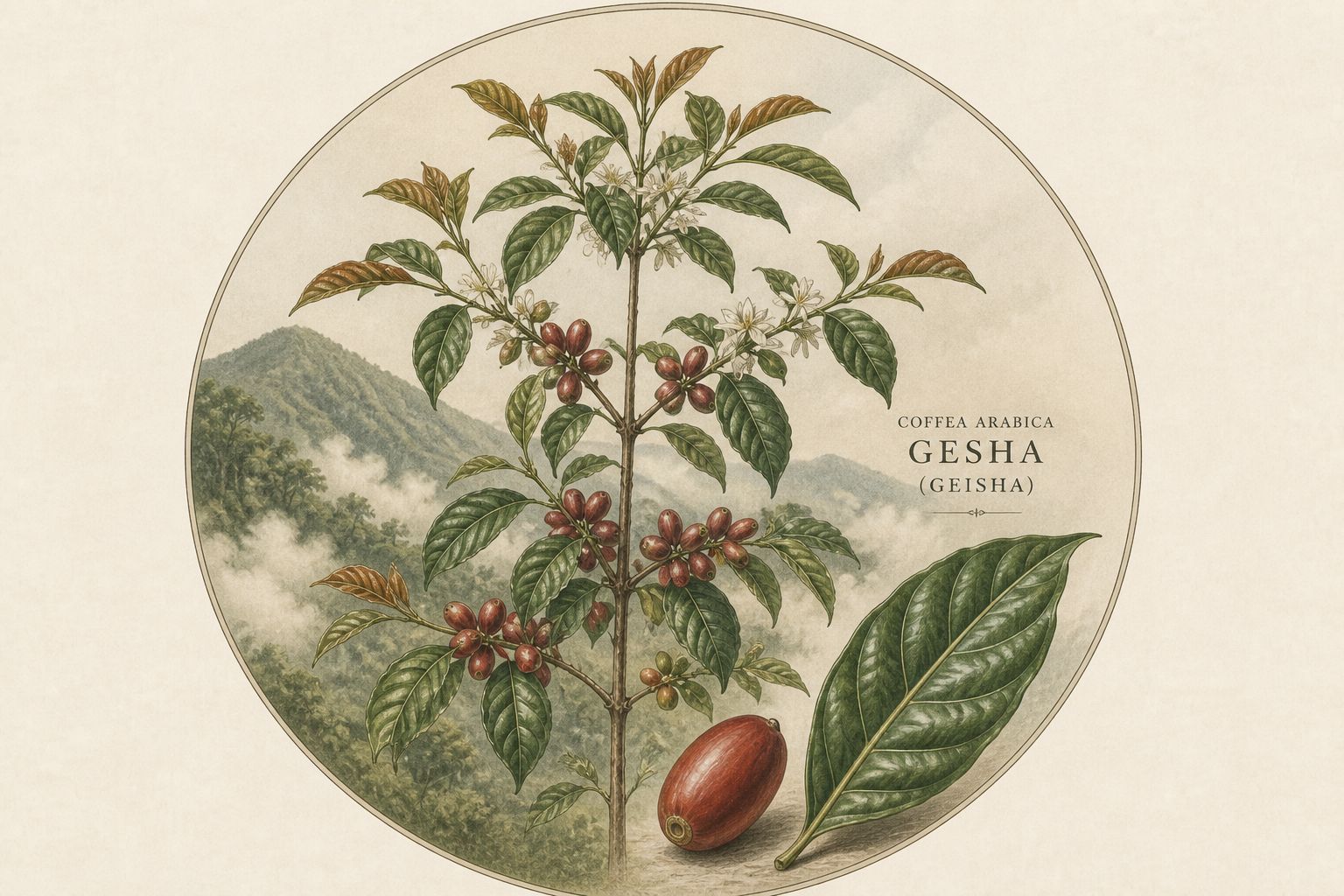
Gesha, also spelled Geisha, is an Ethiopian landrace whose Panama T2722 lineage became famous for jasmine-like florals and peach character at high elevation. Low yields, fragile branches, limited lots, and auction demand all contribute to its price.
Updated: Aug 20, 2026Reviewed by: Ah-Zhu (English-site batch review)
One name, more than one genetic line
Gesha and Geisha are two common spellings attached to an arabica landrace collected from coffee forests in southwestern Ethiopia. Gesha reflects the modern spelling of the nearby area, while Geisha appears in historical records and remains widespread on coffee bags.
The spelling does not settle the plant’s identity. World Coffee Research notes that genetically different trees have been called Geisha. The celebrated Panama line is comparatively traceable: it descends from accession T2722 at CATIE in Costa Rica.
When a coffee carries a premium price for the Gesha name, look for information about its genetic line, seed source, lot separation, and growing elevation. A name without traceability may not point to the Panama material that established the reputation.
From Ethiopian forest to Panama
The material associated with T2722 was collected in Ethiopia in the 1930s, passed through research collections in East Africa, and entered CATIE in 1953. It reached Panama in the 1960s because it showed some tolerance to coffee leaf rust.
Farmers did not immediately embrace the variety, whose tall plants have fragile branches and low yields. Good cup quality also depends on suitable management and elevation.
The famous Panama T2722 line traveled through research collections before its sensory potential gained attention.
The market turning point came with Hacienda La Esmeralda and Best of Panama. A 2004 Esmeralda Geisha green-coffee lot sold for about $21 per pound, then an extraordinary record; World Coffee Research highlights the 2005 competition and auction period as the moment the variety became globally prominent.
Today’s prices reflect both growing conditions and market demand. Low production and small, separately marketed lots can limit supply, while competition results, producer reputation, auction scarcity, and collector demand can also raise prices. A high price does not guarantee that the flavor will suit your preferences.
How Gesha often tastes
Well-managed, high-elevation Panama T2722 is frequently associated with delicate florals, jasmine, peach, citrus, and tea-like structure. Washed processing may present those notes with clearer separation, while natural processing can push the fruit toward riper and fuller expressions.
These flavors are common tendencies rather than guaranteed traits. A lower-elevation or mixed lot may show them less distinctly, and an Ethiopian coffee labeled Gesha may contain different local material. Roast development and brewing can also mute or emphasize the qualities buyers expect.
Gesha can offer exceptional quality under the right conditions, especially when the plant line is traceable. The name and price alone do not guarantee floral flavors or high scores.
Common Misconceptions
Are Gesha and Geisha different coffee varieties?
The two spellings usually refer to the same variety name. Gesha reflects the Ethiopian place-name spelling; Geisha appears in historical accession records and remains common in trade.
Does every bag labeled Geisha contain Panama T2722 material?
No. Genetically different trees have carried the name. Panama's famous lineage descends from the CATIE accession T2722, so traceability matters.
Does Gesha always taste like jasmine and peach?
No. Those are common high-quality expressions of well-managed T2722 at suitable elevation. Genetics, growing environment, processing, roasting, and whether the lot includes other plant material all affect its flavor.
Why is Gesha so expensive?
The plants are tall, branches can be fragile, yields are low, and exceptional quality is associated with suitable high-elevation sites. Small lots and auction demand add scarcity and market value.
Does Gesha mean the coffee was grown in Ethiopia?
No. Gesha is a variety name with Ethiopian origins, while Ethiopia on a bag identifies where the coffee was grown. Gesha can be grown in Ethiopia, Panama, and other countries.
Why might Ethiopian and Panamanian Gesha taste different?
Trees carrying the Gesha name may belong to different genetic lines. Panama's well-known lineage descends from T2722, while an Ethiopian Gesha lot may contain different local material. Growing elevation, processing, and roasting also affect flavor.
World Coffee Research, Geisha (Panama): Traces Geisha from coffee forests in Ethiopia through research stations to CATIE accession T2722 and its introduction to Panama. The catalog explains the name, plant characteristics, quality potential at suitable elevations, and later market prominence. It also distinguishes the Panama T2722 lineage from genetically different trees that share the Geisha name.