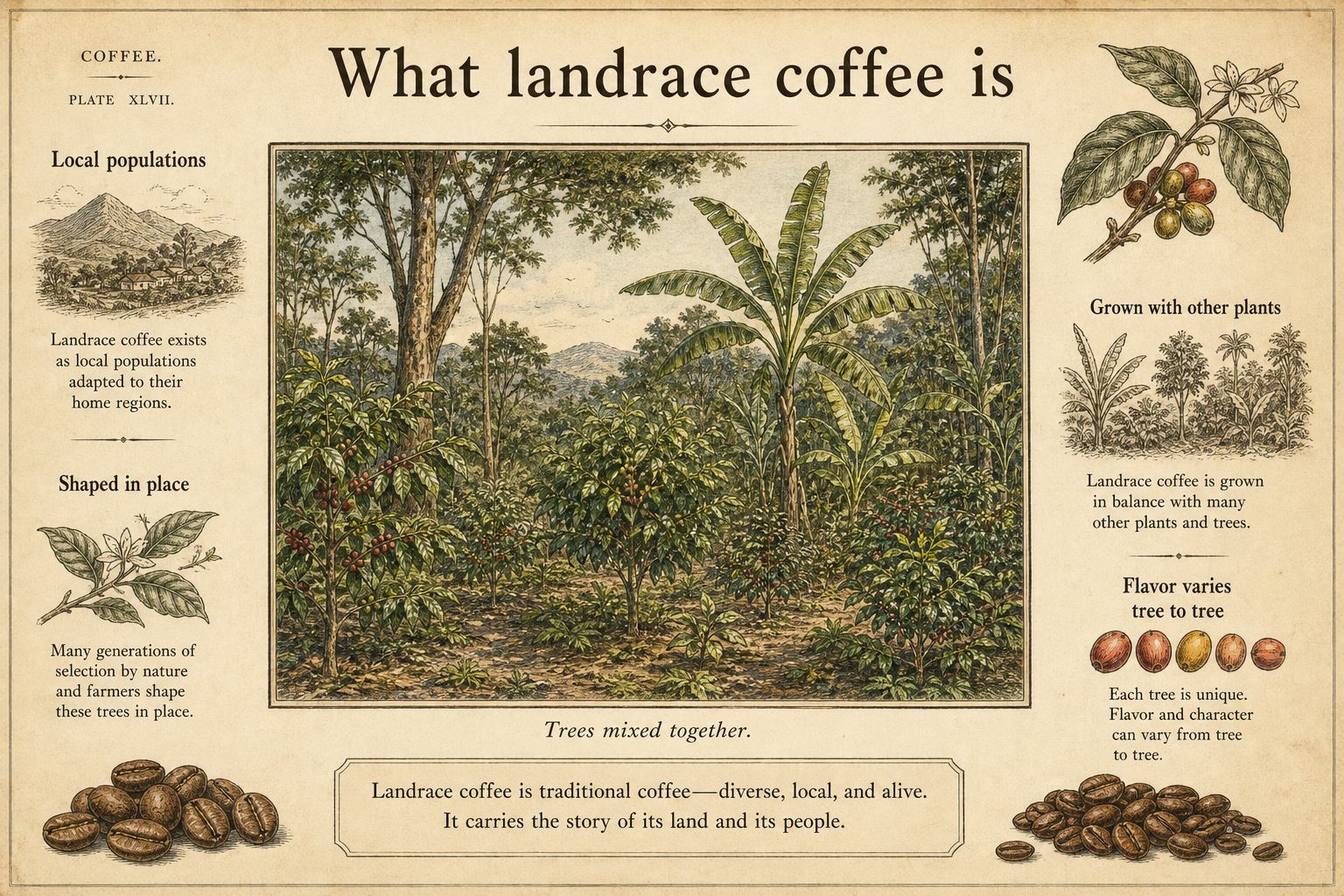
Landrace describes traditional coffee populations adapted to a local environment, while heirloom is often a broad trade label. An Ethiopian coffee marked heirloom may come from many locally named or unidentified trees rather than one uniform variety.
Updated: Aug 20, 2026Reviewed by: Ah-Zhu (English-site batch review)
Why heirloom is not usually one variety
On coffee bags, heirloom often serves as a broad label for traditional local trees—especially in Ethiopia. A single lot can combine many plant types grown in one area or delivered to one washing station. The label is therefore different from a named, more traceable variety such as Typica or a defined breeding line.
Landrace is the more specific population term used by World Coffee Research. It describes traditional material shaped through cultivation, local selection, and adaptation to an environment over time. Plants within a landrace can be genetically diverse rather than uniform.
Some exporters and roasters now use regional or local variety names when traceability supports them. When the identity is not known, heirloom may be honest shorthand—but it should not be mistaken for one verified cultivar.
Heirloom often refers broadly to a local population, while a variety name can identify a more specific lineage when supported by records.
Why Ethiopia is central to the term
Arabica originated in Ethiopia, where the species retains far more genetic diversity than most commercial farms elsewhere. Southern and southwestern production still includes many locally adapted populations rather than only the varieties that later dominated Latin America.
A smaller portion of this coffee diversity was brought from Ethiopia into Yemen. Genetic research connects much of the arabica that later left Yemen with the Bourbon and Typica groups. Those lineages and their descendants became the foundation for most commercial arabica outside Ethiopia. World Coffee Research gives Brazil as an example, reporting that it accounts for about 40% of global coffee production and that 97.55% of its coffee cultivars derive from Typica and Bourbon. The page does not specify the statistical year for either figure.
Much of global commercial arabica descends from a narrow branch of a much more diverse Ethiopian population.
This difference helps explain the wide range of flavors found in coffees labeled Ethiopian heirloom, although the label does not guarantee floral or fruity flavors. The growing region, mix of coffee plants, processing method, separation of lots, roasting, and brewing all influence the result.
Where Gesha fits
Gesha began as landrace material collected from Ethiopian coffee forests. Once accessions were recorded, selected, and propagated, particular descendants became more traceable. Panama’s famous line is associated with CATIE accession T2722.
Gesha’s history shows how a named variety can be selected from a landrace population. The name provides more specific information when it follows a documented line, while a bag that says only heirloom usually describes a broader population.
When buying, look for the region, farmer or washing station, locally named varieties, lot separation, and processing. These details help you understand the coffee beyond what the heirloom label alone can tell you.
Common Misconceptions
Are heirloom and landrace the same thing?
They overlap in coffee trade language, but landrace more specifically describes a traditional population adapted to its local environment. Heirloom is often a broad bag label for traditional local material and may not identify one genetically uniform variety.
Is Ethiopian heirloom one coffee variety?
Usually not. A lot may combine cherries from numerous locally named or unidentified trees grown by many smallholders.
Are Bourbon and Typica Ethiopian landraces?
They ultimately descend from arabica's East African origin, but coffee labels generally use Bourbon and Typica for named lineages that passed through Yemen and later spread through commercial production.
Is Gesha a landrace?
It was collected as Ethiopian landrace material. The Panama T2722 descendants later became a more traceable named line.
Does a landrace label guarantee better flavor?
No. Landraces can have good cup quality potential, but the label does not guarantee a particular flavor. The growing region, mix of coffee plants in the lot, processing, and roasting still affect the result.
World Coffee Research, History of Arabica: Defines landraces as locally adapted traditional populations and explains the Ethiopian diversity and narrow Bourbon/Typica foundation of most commercial arabica.
World Coffee Research, Geisha (Panama): Identifies Gesha as an Ethiopian landrace and distinguishes traceable Panama T2722 descendants from other material carrying the name.