Are There Naturally Low-Caffeine Coffee Varieties—and How Are They Different From Decaf?
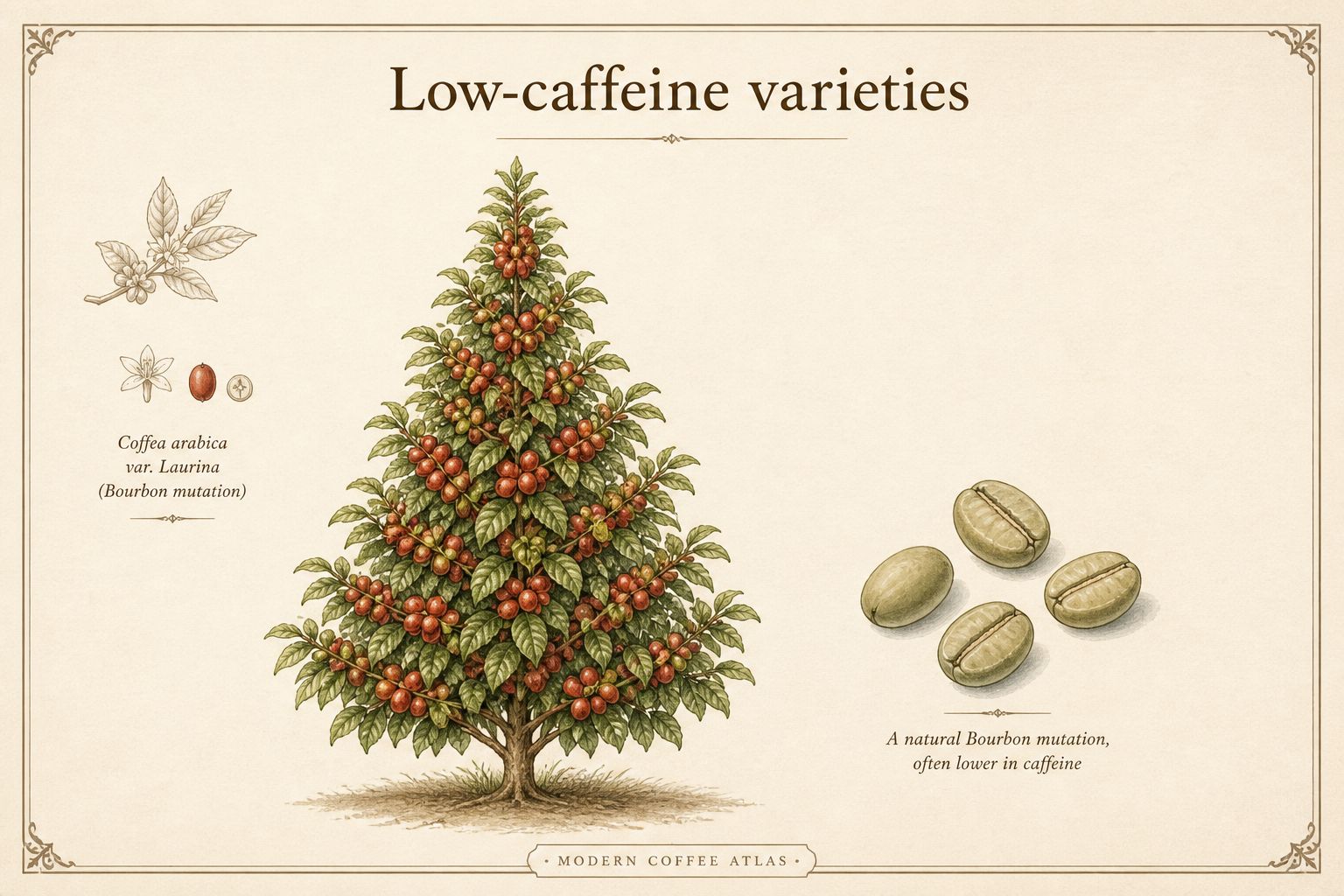
Laurina, also called Bourbon Pointu, is a natural Bourbon mutation whose green beans have about half the caffeine of other arabica cultivars. Its lower caffeine content is inherited, unlike decaf processing, which removes caffeine from green coffee. Almost caffeine-free experimental cultivars and caffeine-free Coffea species also exist, but are rarely sold as ordinary retail coffees.
Updated: Aug 25, 2026Reviewed by: Content and layout review
What a low-caffeine variety on a bag usually means
Coffee plants make caffeine, but not every variety makes the same amount.
The International Trade Centre reports typical green-bean caffeine levels of about 0.8%–1.7% in arabica and 1.5%–2.5% in robusta. Most retail arabica falls within the stated arabica range, and specialty coffee does not necessarily contain less caffeine: caffeine content and cup quality measure different things.
Some bags identify a naturally low-caffeine arabica cultivar, such as Laurina. Its lower caffeine content comes from inherited traits, whereas decaf processing removes caffeine after harvest.
The left side represents a naturally low-caffeine variety; the right shows caffeine removal from green coffee. This is a conceptual illustration rather than a photograph of a processing facility.
Getting to know Laurina
Laurina is also called Bourbon Pointu. Lécolier and colleagues wrote in Euphytica in 2009 that it is a Coffea arabica mutant, generally described as selected on Bourbon Island—now Réunion—in the early nineteenth century. The same paper says the origin stories do not agree, so the discovery year is unsettled.
Compared with ordinary Bourbon, Laurina has a shorter, conical tree resembling a Christmas tree. A second 2009 paper in Trees attributes this growth habit to the recessive, single-locus laurina mutation, which shortens the internodes and changes the tree’s size and shape. The seeds are often more pointed, as the name pointu describes.
In their 2000 paper, Silvarolla and colleagues cite Carvalho’s figures of about 0.6% caffeine in Laurina green beans versus about 1.2% in other arabica cultivars. Perfect Daily Grind likewise describes Laurina as having roughly half the caffeine of other arabica varieties.
Perfect Daily Grind reports that caffeine helps deter pests, so plants with less caffeine may be more vulnerable. Daterra representative Gabriel Agrelli told the publication that Laurina requires extensive care and that he therefore expected the farm’s production to remain small. This describes one farm’s experience, not the costs or yields that every grower should expect.
Bourbon, on the left, typically grows taller than the conical Laurina plant on the right. This illustration shows typical traits and cannot be used to identify a plant.
How experimental cultivars, other species, and decaf differ
Beyond Laurina, low-caffeine research includes experimental cultivars and other coffee species. These differ in their botanical classification and availability for cultivation.
Silvarolla, Mazzafera, and Fazuoli reported in Nature in 2004 that three Ethiopian arabica plants at the Instituto Agronômico de Campinas, designated AC1, AC2, and AC3, were almost caffeine-free. Their seeds averaged about 0.76 milligrams of caffeine per gram of dry weight, compared with about 12 milligrams per gram in the Brazilian cultivar Mundo Novo. These are research accessions rather than common retail varieties.
In 2008, Stoffelen and colleagues described Coffea charrieriana from Cameroon as having caffeine-free seeds, the first such record for Central Africa and the second for the African continent. It is a separate species from arabica. Establishing whether a wild species can become a reliable farm crop involves field trials and agricultural extension.
Decaf coffee undergoes processing to remove caffeine from green beans, as explained in how decaf coffee is made. This treatment is distinct from a variety’s naturally lower caffeine content.
A bag labeled Laurina or Bourbon Pointu identifies a variety whose lower caffeine content is inherited. Your actual intake still depends on how much ground coffee you use, how you brew it, and how much you drink. The caffeine article explains these factors in more detail.
Common Misconceptions
Are there coffee varieties that are naturally lower in caffeine?
Yes. Laurina, also called Bourbon Pointu, is one example. Published figures put its green-bean caffeine content at about half that of other arabica cultivars, while most other retail arabica falls within the usual range.
Is that the same as decaf?
No. Decaf processing removes caffeine from green coffee, while a naturally low-caffeine variety inherits its lower content and usually still contains caffeine. The articles on decaf processing and caffeine explain the distinction in more detail.
Is Laurina a kind of Bourbon?
Laurina is a natural mutation of Bourbon within the same species. Its tree is shorter and its seeds are often more pointed, which is why it is also called Bourbon Pointu.
Is robusta lower in caffeine?
Robusta generally contains more caffeine. The International Trade Centre reports higher average levels in robusta green beans than in arabica, so choosing robusta does not mean reducing caffeine intake.
Does naturally lower caffeine mean a better or safer cup?
Not necessarily. Flavor depends on origin, processing, and roasting, while caffeine intake depends on how much ground coffee you use, how you brew it, and how much you drink. Consult a doctor if you have health concerns.
International Trade Centre, The Coffee Guide, Fourth Edition, 2021: Reports typical green-bean caffeine ranges of about 0.8%–1.7% in arabica and 1.5%–2.5% in robusta, sometimes up to 4%. The ranges overlap, and most retail arabica falls within the typical arabica range.
Jackson, What is Laurina coffee?, Perfect Daily Grind, 2022: Reports that Laurina has about half the caffeine of other arabica cultivars and cites growers' observations that lower caffeine may make plants more vulnerable to pests. This industry reporting does not establish yields for individual farms.