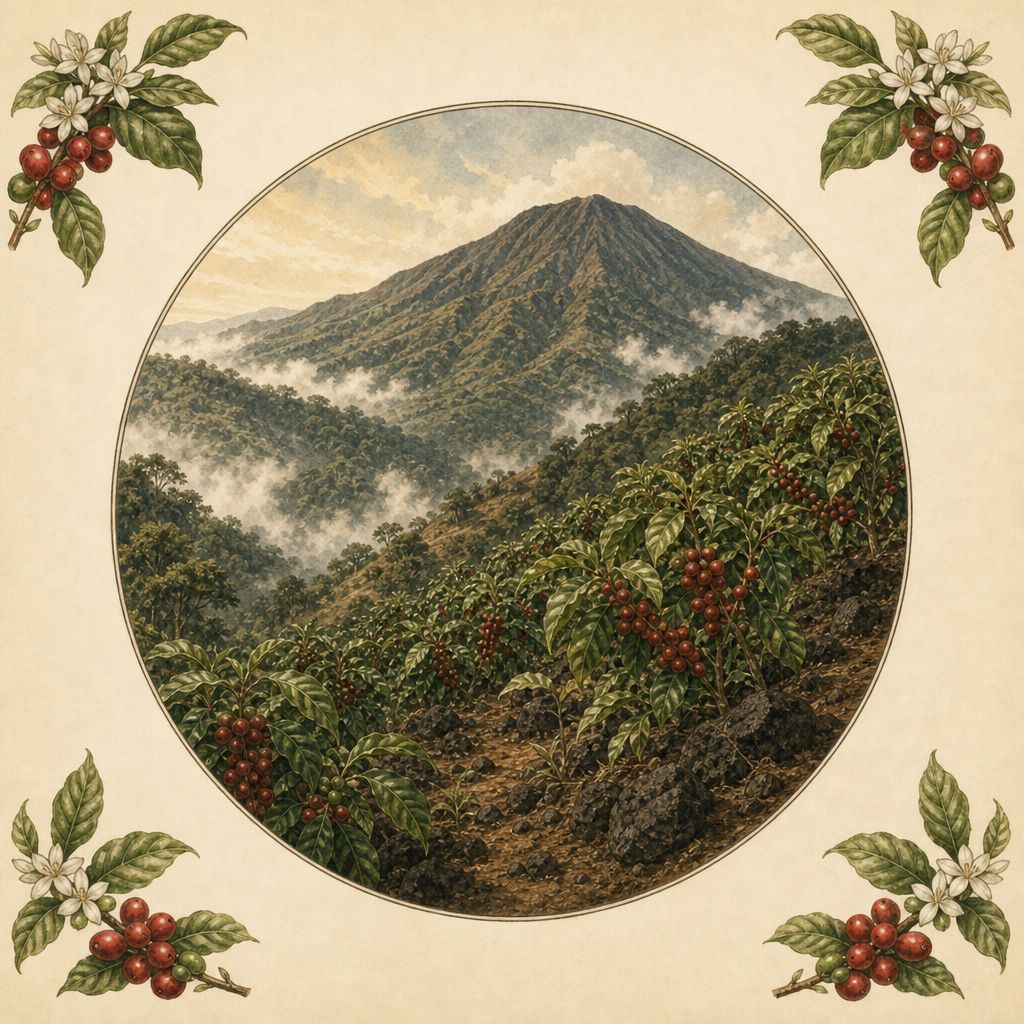
Panama became inseparable from Gesha after a separated Hacienda La Esmeralda lot transformed Best of Panama auctions in 2004–2005. The country produces very little coffee overall, and many Chiriquí highland lots use other varieties and conventional washed processing.
Updated: Aug 20, 2026Reviewed by: Ah-Zhu (English-site batch review)
A tiny origin with an outsized reputation
Panama produces very little coffee in global terms. USDA listed about 80,000 60-kilogram bags for 2025/26, roughly 0.04% of world output. Its visibility on specialty menus comes from quality, competitions, auctions, and especially Gesha rather than volume.
Most celebrated farms lie in the western Chiriquí highlands near Costa Rica. Volcán Barú separates two familiar areas: Boquete to the east and southeast, and Volcán-Candela to the west and southwest. Specialty farms commonly occupy elevations around 1,100–1,600 meters amid volcanic soils, rain, cloud, and complex mountain exposures.
Country, region, variety, and process remain separate. A bag marked Panama Boquete washed still does not tell you whether the plants were Gesha, Caturra, Catuai, Typica, Bourbon, or a mixture.
The Esmeralda lot that changed the market
Gesha material reached Panama decades before it became famous. Farmers had little reason to favor a tall, fragile, low-yielding plant until its sensory potential was recognized and the variety was separated from other cherries.
Hacienda La Esmeralda’s Peterson family entered a separated Gesha lot in Best of Panama. Coffee Review reported that the 2004 green coffee sold at auction for about $21 per pound, then a record. World Coffee Research highlights the 2005 competition and auction period as the variety’s global breakthrough.
The cup’s delicate flowers, jasmine, peach, citrus, and tea-like structure stood apart from the region’s familiar coffees. Panama and Gesha became linked in buyer expectations, and auction scarcity amplified the price.
Alongside Gesha, producers continue to export traditional washed lots of Caturra, Catuai, Typica, Bourbon, and other varieties, often with clean, gentle, balanced fruit and floral notes.
Gesha built the modern reputation, but it is one variety within a broader highland coffee origin.
Boquete, Volcán, and Candela
Boquete is the best-known geographic name and includes a long-established town and surrounding mountain farms. Volcán and Candela identify highland production on the other side of Barú. Other trade-area names include Paso Ancho, Piedra de Candela, and Renacimiento.
The illustration shows relative positions, not precise administrative or farm boundaries.
Washed coffee remains common, while competition and auction catalogs also feature natural and experimental processes. A high auction price may reflect variety, farm, lot size, score, reputation, and collector demand. It should not be generalized to every Panamanian bag.
When buying, check the variety, growing area and farm, processing method, and whether the coffee is an auction, competition, or regional lot. These details explain the coffee more clearly than the country name alone.
Common Misconceptions
Is all Panamanian coffee Gesha?
No. Panama is the origin; Gesha is a variety. Caturra, Catuai, Typica, Bourbon, and other varieties continue to grow in the same highlands.
Is every Panamanian coffee expensive?
No. Auction-winning high-elevation Gesha can be extremely expensive, while regional washed lots and other varieties belong to different price categories.
Is Boquete another name for Gesha?
No. Boquete is a growing area in Chiriquí. Gesha grows there and elsewhere, and Boquete also produces many other varieties.
Is Panama a large coffee producer?
No. USDA listed about 80,000 60-kilogram bags for 2025/26, approximately 0.04% of world production.
World Coffee Research, Geisha (Panama): Describes the market breakthrough of T2722 descendants, the relationship between elevation and quality potential, and their auction history.