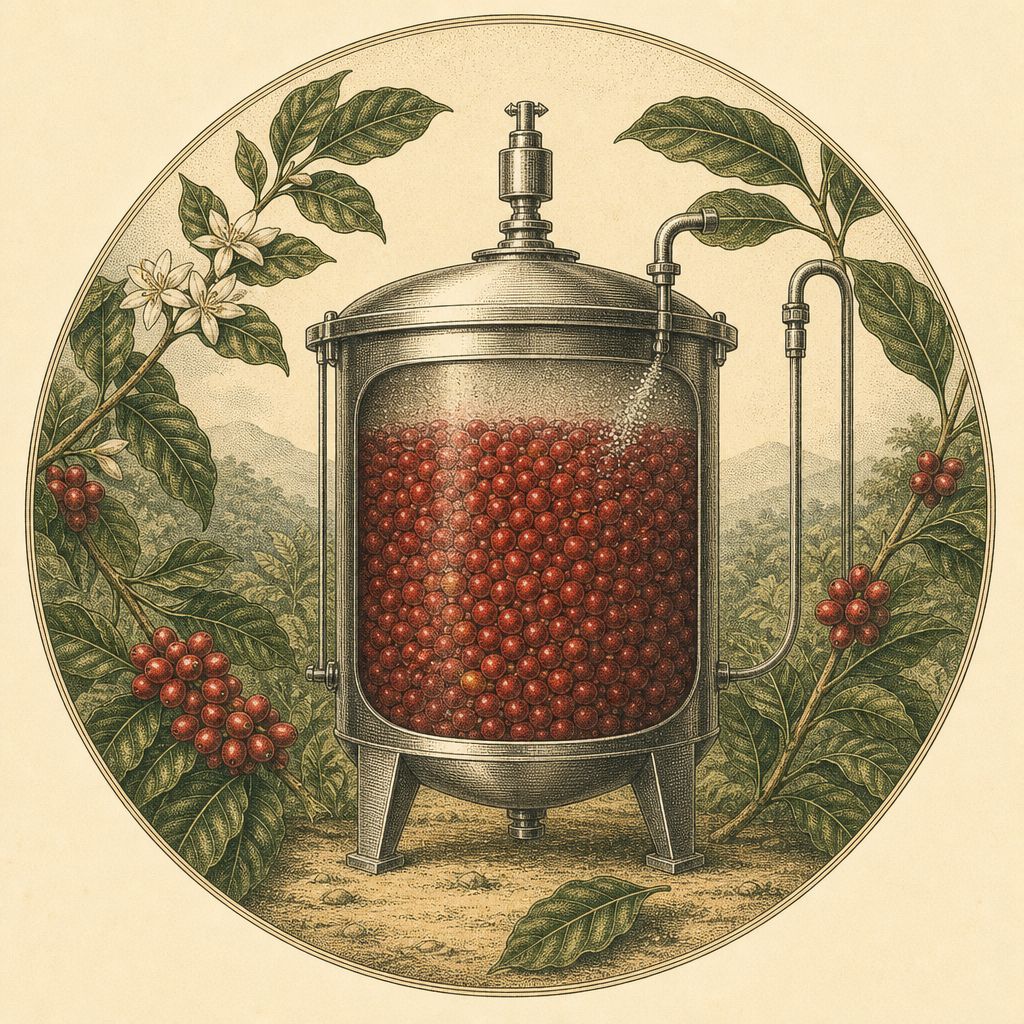
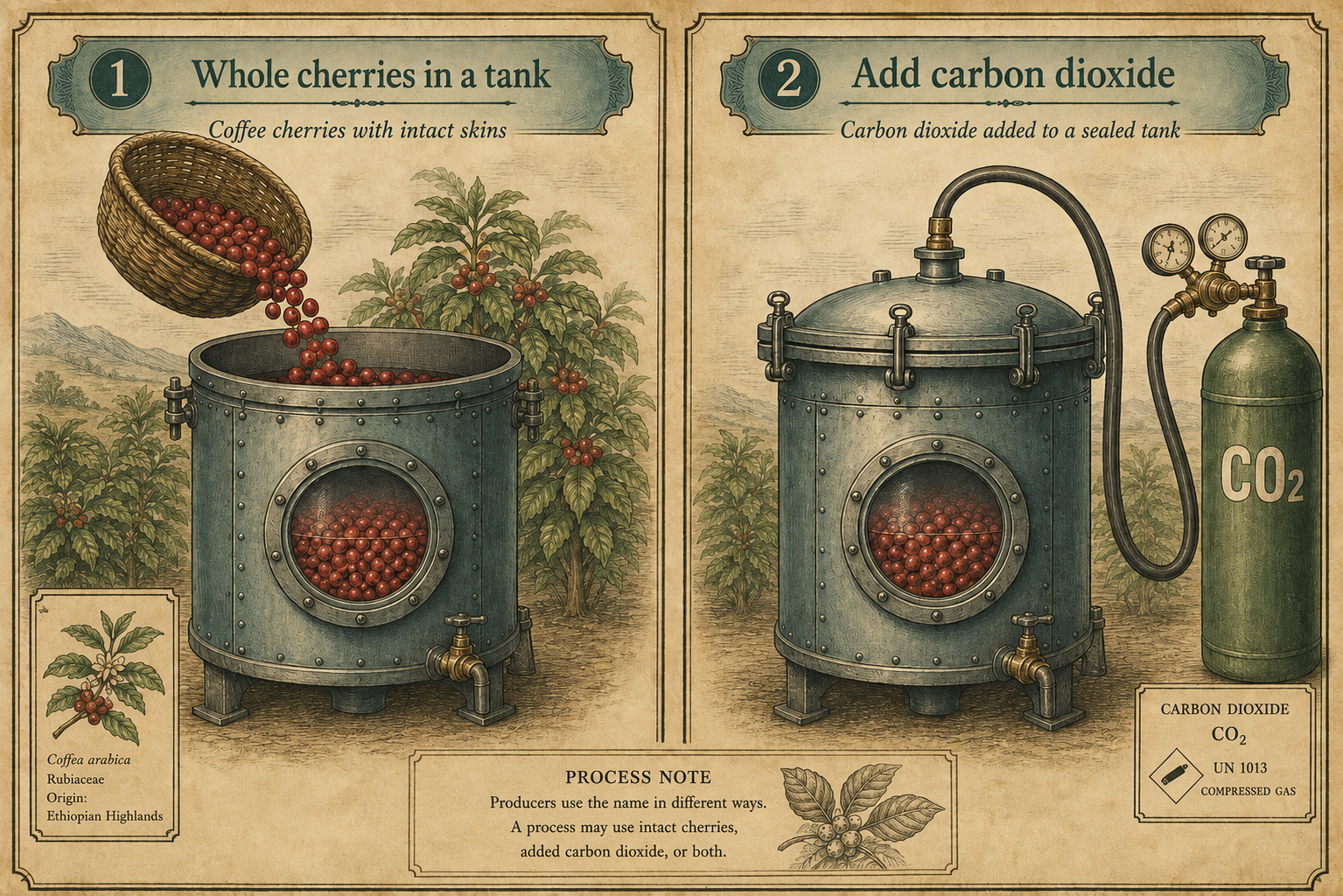
Coffee borrowed the term carbonic maceration from winemaking, but the industry does not use it consistently. It may mean sealed whole-cherry fermentation, deliberate carbon-dioxide injection, or both.
Updated: Aug 20, 2026Reviewed by: Ah-Zhu (English-site batch review)
Washed Process
Pick ripe coffee cherries
Remove the skin and pulp
Break down the mucilage through fermentation
Wash the coffee
Dry the parchment coffee
Natural Process
Pick ripe coffee cherries
Dry the whole cherries
Turn them regularly
Remove the dried fruit and parchment
Prepare the green coffee
Honey Process
Pick ripe coffee cherries
Remove the skin while retaining some mucilage
Dry the coffee with mucilage attached
Remove the parchment after drying
Prepare the green coffee
Wet-Hulled Process
Pick ripe coffee cherries
Depulp, then briefly ferment or wash
Remove the parchment while moisture remains high
Continue drying
Prepare the green coffee
Anaerobic Fermentation
Pick ripe coffee cherries
Place the coffee in a sealed or low-oxygen vessel
Control fermentation time and temperature
Finish with a washed, natural, or honey process
Dry the coffee
A term borrowed from winemaking
Carbonic maceration entered coffee vocabulary from wine, where intact grapes ferment in a carbon-dioxide-rich environment. In coffee, the shared ideas are intact or partly intact fruit, a sealed vessel, abundant carbon dioxide, and restricted oxygen.
The term gained broad specialty-coffee attention after Sasa Sestic used a coffee described as washed carbonic maceration in his winning 2015 World Barista Championship routine. Wider use did not produce one binding technical definition, however.
Coffee borrowed the name from whole-fruit wine fermentation, then adapted it in more than one way.
Two common definitions
One industry explanation distinguishes the methods by what enters the tank: anaerobic fermentation commonly uses depulped coffee with mucilage attached, while carbonic maceration uses intact cherries. The unbroken skin changes how fermentation develops inside and around the fruit.
Another explanation distinguishes them by the gas. Coffee sealed in a vessel generates carbon dioxide on its own as microbes and fruit metabolize. Under this definition, the process becomes carbonic maceration when the producer actively introduces additional carbon dioxide.
A producer may use either definition—or combine intact cherries with injected carbon dioxide.
The definitions overlap when a producer places whole cherries in a sealed tank and adds carbon dioxide, while another producer may depulp first and still use gas injection. A clear process description identifies the fruit condition, gas source, time, temperature, pressure, and finishing steps, which the name alone cannot establish.
What happens after the tank
Carbonic maceration is a fermentation stage, not the entire postharvest process. Coffee leaving the vessel still needs to be depulped when appropriate and dried. It may be finished through natural, washed, or honey practices.
That explains labels such as washed carbonic maceration. They are not necessarily contradictory: one phrase describes the sealed fermentation environment, and the other describes how fruit and mucilage were removed before final drying.
How it often tastes
Chris Kornman’s Daily Coffee News article describes distinctive spice and confectionery notes in anaerobic coffees he tasted, then separately describes berry, grape, date, browned-butter, maple-syrup, and sage notes in a carbonic-maceration lot fermented with added water. These are observations of particular coffees. Other published reports describe carbonic-labeled lots with only subtle fermentation character, so there is no required “carbonic” flavor.
Whole or depulped fruit, injected or self-generated gas, fermentation length, temperature, tank pressure, microbial activity, drying, roast, and brewing all change the cup. Excessive process character can also obscure origin and variety. Treat the label as a reason to seek details, not as proof of a particular flavor or quality level.
Common Misconceptions
Is carbonic maceration the same as anaerobic fermentation?
They overlap and both involve sealed, oxygen-limited conditions. Some writers distinguish them by whole cherries; others distinguish them by added carbon dioxide.
Must a producer inject carbon dioxide?
Under one common definition, yes. Under another, intact cherries in a sealed vessel are enough. The bag may not tell you which definition the producer follows.
Does carbonic-maceration coffee always taste like wine?
No. The name comes from winemaking, not from a guaranteed flavor. Results range from subtle to intensely fruit- or fermentation-driven.
Is the coffee finished when it leaves the sealed tank?
No. Producers still need to remove fruit as appropriate and dry the coffee, often following a natural, washed, or honey-style path.