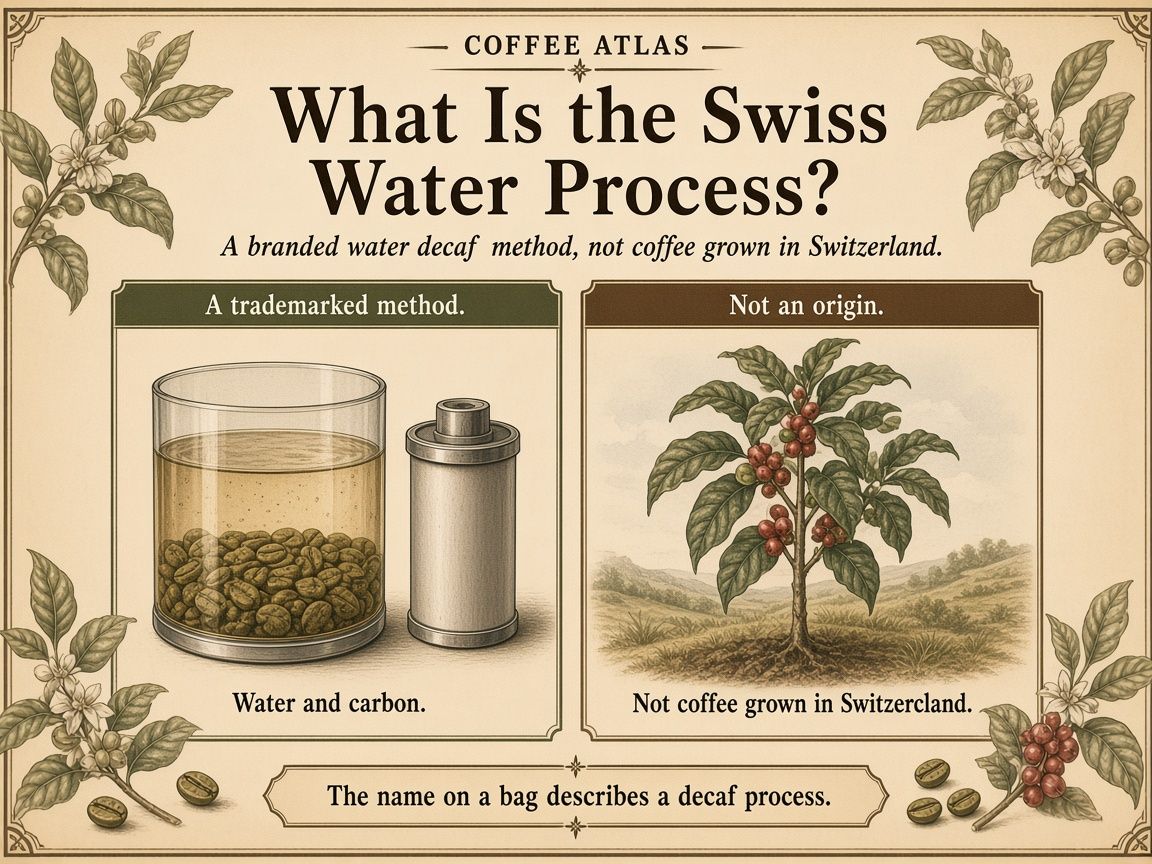
The Swiss Water® Process is a branded water-and-carbon method for removing most of the caffeine from green coffee. It is a Canadian trademark, not coffee grown in Switzerland, not caffeine-free, and not a guarantee that the cup will taste better.
Updated: Sep 15, 2026Reviewed by: Content and layout review
Washed Process
Pick ripe coffee cherries
Remove the skin and pulp
Break down the mucilage through fermentation
Wash the coffee
Dry the parchment coffee
Natural Process
Pick ripe coffee cherries
Dry the whole cherries
Turn them regularly
Remove the dried fruit and parchment
Prepare the green coffee
Honey Process
Pick ripe coffee cherries
Remove the skin while retaining some mucilage
Dry the coffee with mucilage attached
Remove the parchment after drying
Prepare the green coffee
Wet-Hulled Process
Pick ripe coffee cherries
Depulp, then briefly ferment or wash
Remove the parchment while moisture remains high
Continue drying
Prepare the green coffee
Anaerobic Fermentation
Pick ripe coffee cherries
Place the coffee in a sealed or low-oxygen vessel
Control fermentation time and temperature
Finish with a washed, natural, or honey process
Dry the coffee
The name on a bag is a branded water decaf
Swiss Water or Swiss Water® Process on a bag usually means most of the caffeine was taken out of unroasted green coffee with a water-and-carbon method, then the beans were dried and roasted. Swiss Water® Process is a registered trademark of Swiss Water Decaffeinated Coffee Inc., a Canadian company. It is not an origin and not a coffee variety.
It is one water-process route inside how decaf coffee is made. That step is separate from washed processing, which describes how fruit becomes green coffee. The company’s annual information form places operations in Delta, British Columbia. “Swiss” in the brand name is not a claim that the coffee was grown in Switzerland.
What the water and carbon are doing
The company describes making a Green Coffee Extract, or GCE, by soaking green beans so water picks up soluble coffee solids. Activated carbon then adsorbs caffeine from that liquid. Fresh, still-caffeinated beans are immersed in the extract, which already holds other solubles and is low in caffeine. Caffeine diffuses out of the beans into the extract. Because the extract is already loaded with other solubles, the company says those compounds are less likely to leave the beans in large amounts. The caffeine-rich extract is filtered through carbon and reused.
When Green Coffee Extract already holds other solubles, caffeine is what mainly moves out, then carbon traps it.
The Conversation dates commercial Swiss water use to the early 1980s and notes that it is chemically hard to dissolve only caffeine. Even when a water process tries to keep flavor compounds in the bean, the cup is not guaranteed to match the same lot before decaffeination.
The company frames the method as not using solvents such as methylene chloride or ethyl acetate. That describes what is not added in this process. It does not, by itself, prove a safer or better-tasting cup. Solvent residue rules and other routes are on how decaf is made.
How much caffeine leaves, and whether it tastes better
The annual information form says beans stay in the extract until no more than 0.1% caffeine remains. The company also uses 99.9% caffeine free. The Conversation lists Swiss water removal at about 94% to 96%. The National Coffee Association’s general decaf reference is about 97% removed, with about 2 to 15 milligrams left in a cup. These figures come from different sources and are not a lab sheet for one bag. They also are not zero caffeine.
Typical amounts in drinks are in caffeine. Plants that start lower are low-caffeine varieties, which is a different fact from this green-coffee treatment.
Left, the company’s 99.9% caffeine-free / no more than 0.1% in the bean claims. Right, other published ranges and the fact that some caffeine remains. Amounts still vary by lot and brew.
Taste still depends on the coffee, the roast, and the brew. The company stresses origin flavor. Older commodity solvent decaf is often described as flatter, and specialty bags more often name a water process. Those are common patterns, not proof that Swiss Water® always wins a cupping.
A bag without the trademark may still use another water process or carbon dioxide. The trademark only describes this decaf step. It does not score the rest of the coffee.
Common Misconceptions
Is Swiss Water coffee processed in Switzerland?
No. Swiss Water® is a Canadian company trademark. The annual information form places operations in Delta, British Columbia. The name on a bag is a decaf method, not a Swiss growing origin.
Does it always taste better?
No. The company stresses a solvent-free process and origin flavor, but the cup still depends on the coffee, the roast, and the brew. Chemistry also makes it hard to remove only caffeine.
Is it caffeine-free?
No. The company treats beans until caffeine is no more than 0.1% and often describes the coffee as 99.9% caffeine free. The Conversation lists Swiss water removal at about 94% to 96%. Some caffeine remains.
Is this the same as a low-caffeine variety?
No. Swiss Water is a green-coffee treatment. A low-caffeine variety is genetically lower in caffeine.
If the bag does not say Swiss Water, was a solvent used?
Not necessarily. Bags often skip the method. Another water process or carbon dioxide may have been used. A solvent name also does not predict how the cup will taste.
Swiss Water Decaffeinated Coffee Inc., Our Coffee Decaffeination Process: The company describes the Swiss Water® Process as using water, temperature, and time, plus Green Coffee Extract and carbon filters, without esters or solvents. That is its account of its own process. Other water processes exist.
Swiss Water Decaffeinated Coffee Inc., Annual Information Form, year ended 31 December 2025: States that the company operates in Delta, British Columbia, and exclusively owns the Swiss Water® trademark. The decaffeination business is described as nearly forty years old. Green coffee extract is made from water and the soluble solids of green coffee, then decaffeinated with activated carbon; beans stay in that extract until no more than 0.1% caffeine remains. The filing also frames the process as a chemical-free alternative to methylene chloride. These are company claims, not an independent lab result for every bag.
National Coffee Association, Decaffeinated Coffee: U.S. industry association figure that decaffeination typically removes about 97% of the caffeine, with about 2–15 mg remaining in an 8-ounce cup versus about 95 mg in regular coffee. An association reference for decaf in general, not a Swiss Water® legal threshold.