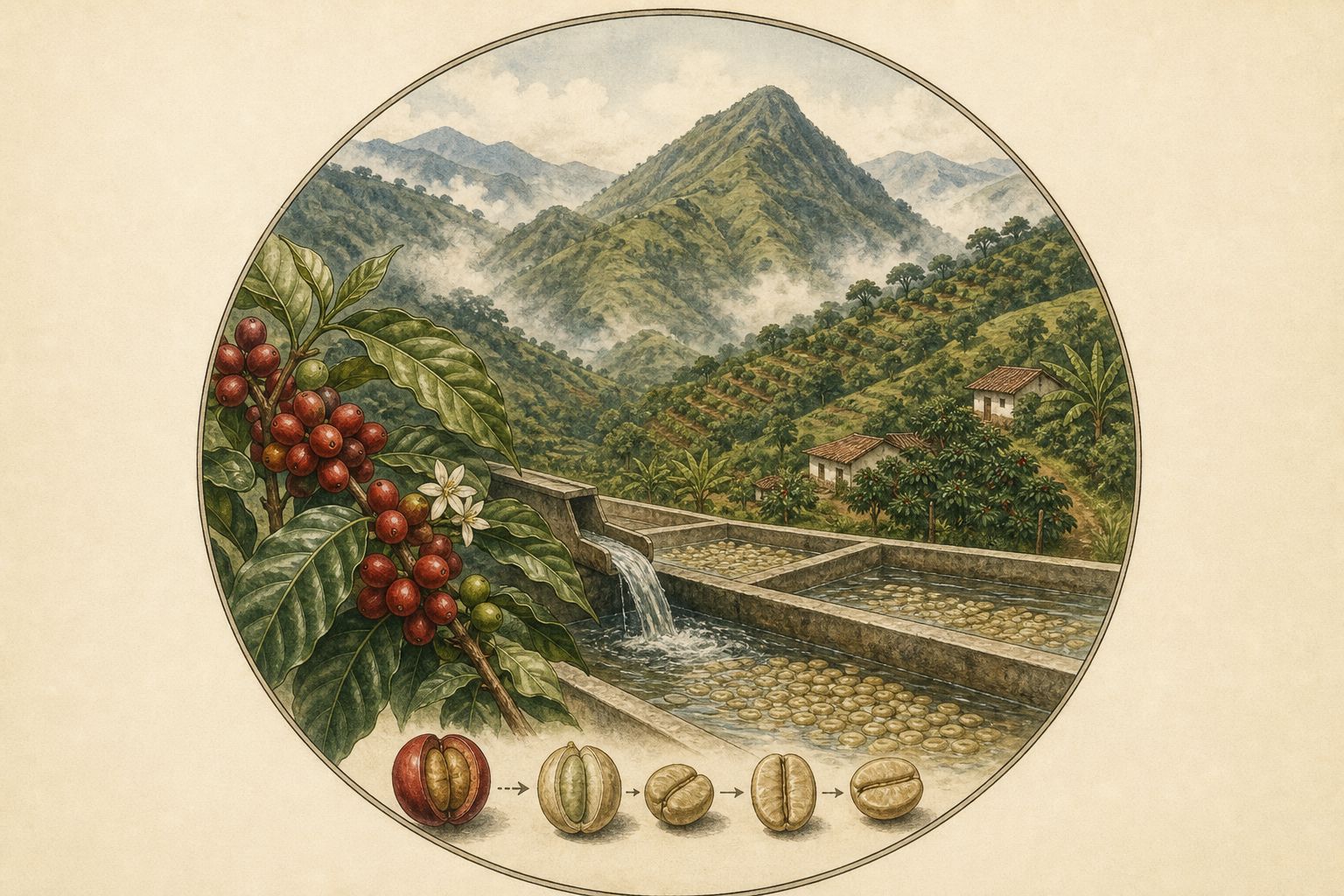
What Does Colombian Coffee Taste Like—and What Is Supremo?
Colombia is known for high-elevation washed arabica with clean structure, clear but often rounded acidity, and balanced sweetness. Supremo and Excelso describe bean-size ranges rather than cup scores.
Updated: Aug 24, 2026Reviewed by: Ah-Zhu (English-site batch review)
Colombia’s classic coffee identity
Colombia produces arabica across multiple Andean ranges, largely through smallholder farms and washed processing. Coffee Review describes it as the largest producer in the broad category of mild, high-grown washed coffees.
A 2025 USDA report projected about 12.5 million 60-kilogram bags for the 2025/26 crop and counted more than 550,000 producers. The Federación Nacional de Cafeteros—FNC or Fedecafé—represents the national sector and supports the familiar Café de Colombia identity.
Scale does not make the country uniform. Northern, central, and southern landscapes have different harvest patterns, climates, elevations, varieties, and market structures. A bag that names a department, municipality, association, producer, and microlot tells you much more than Colombia alone.
Why the cup is often described as balanced
High-elevation cultivation and washed processing commonly produce clear structure. Classic tasting descriptions combine citrus-like acidity, caramel or sugar sweetness, chocolate, a clean finish, and medium-to-full body. Acidity is present but may feel rounder than in a vivid Kenyan coffee.
Plant material also matters. Specialty lots may include Caturra, Typica, Bourbon, the Colombia hybrid, Castillo, and newer specialty varieties. USDA reported that rust-resistant improved varieties cover about 87% of planted area, reflecting decades of disease pressure and breeding.
Colombia is also a center for experimental processing. Bags may mention anaerobic fermentation, co-fermentation, added yeast or bacteria, enzyme process, or thermal shock. Individual examples use hot then cold water after fermentation and may combine multiple named stages. Enzyme processing usually involves adding pectinase to help remove mucilage. This differs from adding yeast to support fermentation. These terms are not fully standardized, and experimental lots remain much smaller than conventional washed production.
These are broad reference profiles, not a rule separating every Colombian and Brazilian lot.
Supremo and Excelso are size terms
Green coffee is passed through screens with measured openings. A common Colombian trade reference places Excelso at screen 15 and above and Supremo at screen 17 and above. Screen numbers represent sixty-fourths of an inch, so screen 17 is approximately 17/64 inch.
The same harvest can be separated into different size lots. A Royal New York comparison roasted and tasted screen separations from one coffee and found no simple positive relationship between larger size and flavor. Larger, uniform beans may command a visual premium or simplify roasting, but Supremo is not a sensory grade.
Screen size describes physical sorting, not an automatic difference in cup quality.
North, center, and south
Northern areas such as Sierra Nevada de Santa Marta and Magdalena are often associated with softer, sweeter, rounder profiles. Central highlands frequently produce brighter acidity and substantial body. Southern departments such as Huila, Nariño, and Cauca are widely known for layered acidity and aromatic complexity.
These are tendencies across very large areas. Huila alone can produce classic washed coffee, intensely fermented microlots, and numerous variety-specific profiles. The department provides a broad indication of origin; farm, variety, processing, and harvest details help explain an individual lot more precisely.
Common Misconceptions
Does Colombian coffee always taste balanced?
No. Clean balance is a classic tendency, while region, elevation, variety, process, roast, and newer fermentation styles can create much brighter or more intense cups.
Is Supremo better than Excelso?
Not automatically. The terms sort beans by size. Larger and more uniform beans may look attractive and roast predictably, but they do not receive a higher cup score merely for being larger.
Is all Colombian coffee washed?
Most production is traditionally washed, but natural, honey, anaerobic, co-fermented, and thermal-shock microlots also appear in the specialty market.
What does the 100% Colombian logo mean?
The triangular Café de Colombia mark verifies that the coffee content is entirely Colombian. It is not a region, process, variety, or cup score.