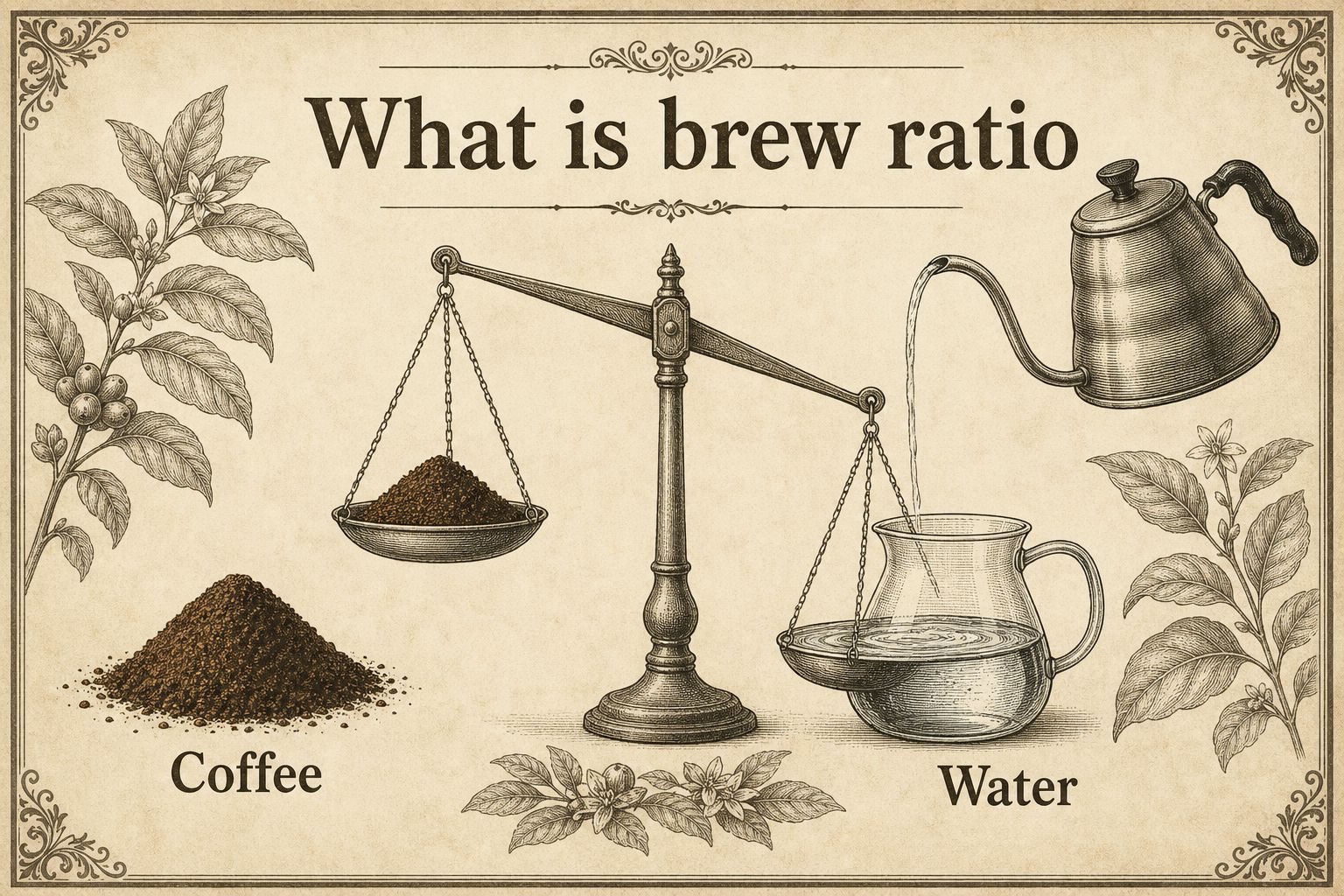
What Is Brew Ratio—and How Is It Different From Strength?
Brew ratio compares the weight of coffee with the weight of brewing water. At a similar level of extraction, more coffee relative to water usually makes a stronger drink. Strength describes the concentration of the finished coffee, while extraction yield measures the proportion of the dry coffee that dissolved into the water.
Updated: Sep 5, 2026Reviewed by: Content and layout review
What the numbers mean
Ratios such as 1:16 and 1:17 appear frequently in pour-over instructions. They compare coffee and water by weight, providing a starting point for understanding brew strength.
A ratio of 1:16 usually means one part coffee to sixteen parts water by weight—for example, 15 grams of coffee and 240 grams of water. The brew ratio calculator can work out the amounts for your brew. To estimate how much the beans cost per serving, use the cost per cup calculator.
Both filter and immersion brewing use coffee-to-water ratios. Espresso usually compares the dry coffee dose with the weight of the extracted beverage instead. Because those ratios measure different things, a filter ratio such as 1:16 should not be applied directly to espresso.
How it differs from strength
Conceptual illustration of ratio and strength: at a similar level of extraction, more coffee relative to water usually makes a stronger drink, while more water makes a lighter one.
People sometimes use “strong” to describe a dark roast or heavy body. To separate those sensations from concentration, consider how brewing works: extraction moves soluble material from the grounds into the water, while brew ratio is one of the direct influences on the concentration of the finished drink.
If the dose is extracted to a similar degree, more coffee relative to water usually makes a stronger drink; more water usually makes a lighter one. But grind, contact time, and temperature also change extraction efficiency, so strength changes with them.
Adjusting either brew ratio or grind size one at a time makes it easier to tell which change affected the strength and flavor.
It is not extraction yield
Conceptual illustration: the drink on the left represents concentration; the material leaving the grounds on the right represents extraction.
Extraction is the process of water drawing soluble material out of coffee grounds. Strength measures the concentration of the finished drink, while extraction yield measures the proportion of the original dry coffee that dissolved. A strong drink can still be under-extracted; a thoroughly extracted coffee can become lighter when diluted with more water.
For more on why sourness or bitterness alone cannot identify a brewing error, see over-extraction and under-extraction. Water composition also affects extraction and acidity; the guide to brewing water explains the role of minerals and acid buffering.
How to read the common reference
The 2015 SCAA Golden Cup recommendation for filter coffee is 55 grams of coffee per liter of water, plus or minus 10%. As a weight ratio that sits roughly between 1:16.5 and 1:20; 55 grams to 1,000 grams of water is close to 1:18. The same document puts brew strength near 1.15% to 1.35% TDS from an 18% to 22% extraction yield.
These figures are filter-brewing references from that period, rather than settings every dripper must follow or a guarantee of personal enjoyment. A Perfect Daily Grind interview gives around 1:16 as another common starting point. In a 2021 filter-coffee study, participants preferred a broad range of strengths and extraction yields, forming two preference groups.
Weigh the coffee and water so you can repeat the ratio, then adjust one variable at a time if the drink is stronger or lighter than you prefer.
Common Misconceptions
Is brew ratio the same as strength?
No. Ratio is how much coffee and water you start with. Strength is how concentrated the finished drink is. A higher coffee dose usually makes a stronger cup, but grind, time, and temperature still change how thoroughly the dose is extracted.
Do I have to brew at 1:16 or 1:18?
No. The SCAA Golden Cup filter recommendation is 55 g coffee per liter of water, plus or minus 10%, roughly 1:16.5 to 1:20. About 1:16 is a common example. Espresso uses a different ratio language; see the espresso page.
If I change the ratio, should I also change the grind?
Change one variable at a time so you can tell what caused the difference. Brew ratio affects strength more directly, while grind size affects water flow and extraction efficiency. See the guide to grind size for more detail.
Can I measure with a spoon?
A spoon measures volume, so a spoonful can weigh differently depending on the roast. Darker-roasted coffee is lighter for the same volume. A scale makes it easier to keep the coffee-to-water weight ratio consistent.
Is a stronger cup always better?
Not necessarily; people prefer different strengths. A 2021 study of filter coffee found that participants enjoyed black coffee across a wide range of concentrations.
SCAA Standard, Golden Cup, revised 23 December 2015: The 2015 filter-brewing recommendation gives 55 g of coffee per liter of water, plus or minus 10%. Golden Cup specifies 11.5 to 13.5 g/L of dissolved solids (about 1.15% to 1.35%) from an 18% to 22% extraction yield, with water at about 93°C, plus or minus 3°C, on contact. These are filter-brewing references, not universal settings or guarantees of personal enjoyment.