What Water to Brew Coffee With—and How Hard Water Differs from Soft
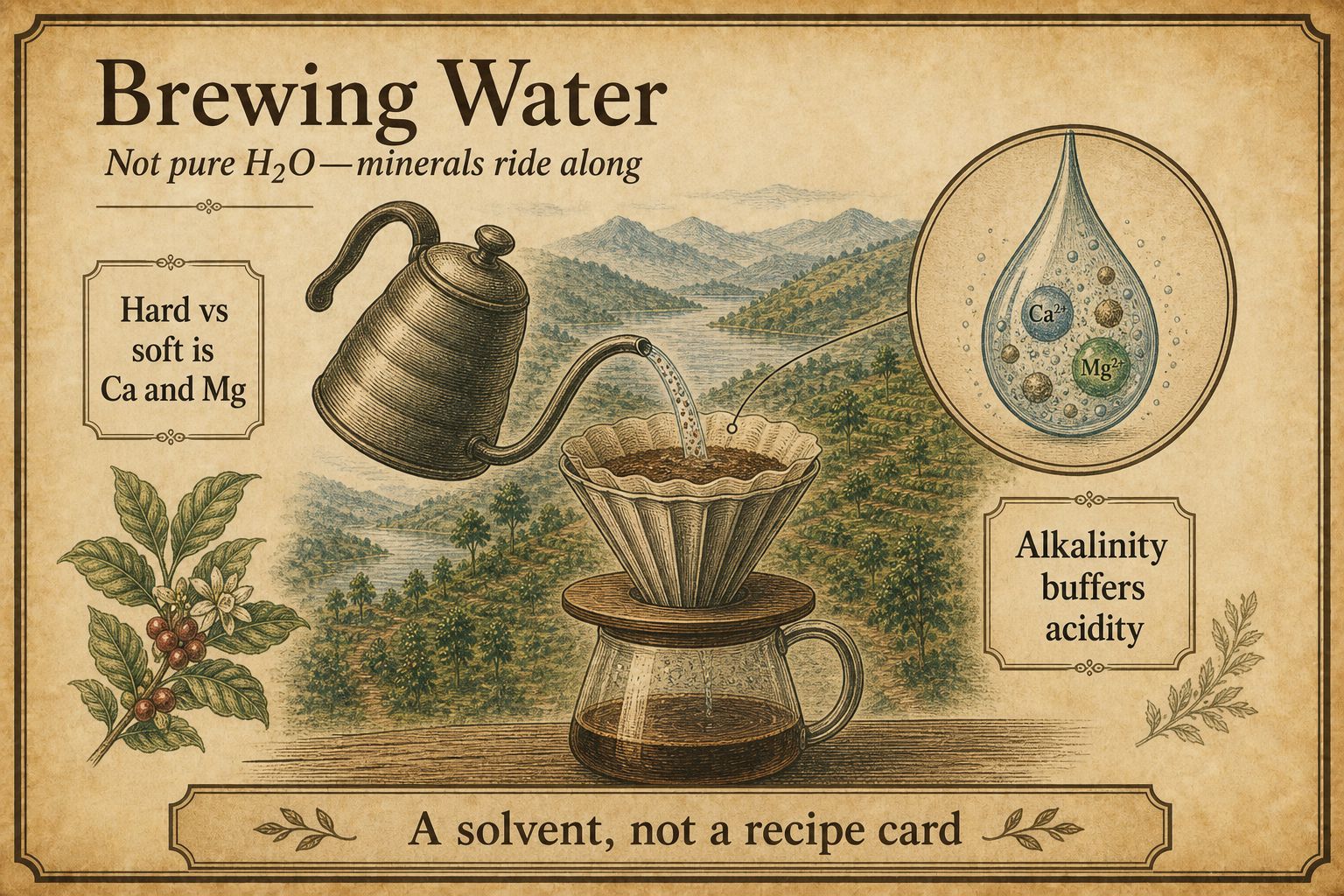
Brewing water usually contains calcium, magnesium, bicarbonate, and sometimes chlorine from municipal treatment. Hardness mainly reflects calcium and magnesium content, while alkalinity describes how much acid the water can neutralize. Understanding both helps explain changes in coffee acidity and scale buildup in equipment.
Updated: Sep 5, 2026Reviewed by: Content and layout review
What brewing water is
The hot water used for pour-over usually contains dissolved substances, unlike pure laboratory water.
Water acts as a solvent, carrying soluble coffee compounds into the cup through extraction. Tap, bottled, and filtered water usually contain calcium, magnesium, bicarbonate, and sometimes chlorine used to disinfect the supply. These components affect extraction and the resulting flavor.
The 2009 SCAA standard Water for Brewing Specialty Coffee specifies odor-free, clear water with 0 mg/L total chlorine and a TDS target of 150 mg/L within an acceptable range of 75 to 250 mg/L. These are industry reference values; home brewing does not require every kettle to match them exactly, and meeting them does not guarantee a flavor you enjoy.
Understanding brewing water involves considering its dissolved minerals and other components alongside its temperature.
Hard water versus soft water
The U.S. Geological Survey defines hardness as dissolved calcium and magnesium. As calcium carbonate, 0 to 60 mg/L is soft, 61 to 120 moderately hard, 121 to 180 hard, and more than 180 very hard.
Hard water can form calcium-carbonate scale when heated, allowing deposits to build up in kettles and home coffee makers over time. Poor soap lather and a film on glass are other household signs commonly associated with hardness.
SCAA set a calcium-hardness target of 68 mg/L, acceptable from 17 to 85 mg/L. Calcium hardness is only part of the total hardness used by USGS, which also includes magnesium, so the two ranges cannot be compared directly. Hardness alone does not determine whether coffee will taste good. Very high hardness raises scale risk. Water with almost no calcium or magnesium is a different solvent again.
A 2014 computational study by Hendon and the Colonna-Dashwoods found magnesium typically binds coffee compounds more strongly than calcium, while sodium binds weakly to most neutral compounds. Their inference: magnesium-rich water is favorable if you want more extraction; sodium-rich softened water does little for flavor.
Hardness mainly reflects calcium and magnesium content. This conceptual illustration cannot replace a water-quality test.
Hardness is not alkalinity
Hard water is sometimes assumed to produce a heavy cup with muted acidity, but alkalinity often has more influence on acidity than hardness itself. Writing in SCA 25 magazine, Marco Wellinger describes alkalinity as the water’s capacity to neutralize acid and resist changes in pH. When the water is already near neutral, alkalinity usually affects coffee acidity more than the pH reading does.
His working comparison: perceived acidity tracks acids extracted from the coffee neutralizing alkaline substances in the water. High alkalinity is better at muting bright, fruit-like acidity.
Hardness is set mainly by how much calcium and magnesium are in the water. Alkalinity is mostly bicarbonate and related buffers. Ion-exchange softeners often replace calcium and magnesium with sodium: hardness drops, alkalinity may not. That matches Hendon’s warning that extra sodium does little for most flavor compounds.
Wellinger notes reports of over-extracted flavor at very high total hardness and under-extracted flavor at very low hardness. The same article says experiments find overall extraction efficiency may not move much across a reasonable hardness range. There is no single answer. Filter coffee and espresso also use very different beverage ratios, so one water target should not be copied from one method to the other.
The left side shows hardness related to calcium and magnesium; the right shows alkalinity, or acid-neutralizing capacity. They are separate water-quality measures.
Does this affect coffee you brew at home?
Tap-water quality varies by location. USGS advises checking local utility information rather than treating a regional hardness map as a measurement for an individual home.
The 2009 SCAA reference sets a target of 0 mg/L total chlorine. Municipal water is often chlorinated, and without appropriate treatment the coffee can develop a disinfectant smell. Removing chlorine and odors is a separate goal from adjusting mineral content: a carbon filter commonly addresses the former without necessarily changing hardness or alkalinity.
Distilled and reverse-osmosis water often sit below the SCAA TDS floor of 75 mg/L.
Mineral composition and acid-neutralizing capacity affect extraction and flavor, but coffee strength relates more directly to brew ratio. Extraction speed also depends on grind size and contact time. Consider these brewing conditions together when investigating sourness or bitterness.
Common Misconceptions
Does hard water make bad coffee?
Not automatically. USGS defines hardness as calcium and magnesium. The 2009 SCAA reference concerns calcium hardness, which cannot be compared directly with total-hardness categories. Softer water is not automatically better for flavor. Very hard water scales equipment more readily. High alkalinity is a better suspect when acidity tastes muted. It still depends on the water and the coffee.
Are hardness and alkalinity the same thing?
No. Hardness is mostly calcium and magnesium. Alkalinity is mostly bicarbonate and related buffers. Wellinger writes that near neutrality, alkalinity usually moves cup acidity more than the pH number. Ion-exchange softeners often swap calcium and magnesium for sodium, so hardness falls while alkalinity may not.
Is distilled or pure water best because it is clean?
Not necessarily. The 2009 SCAA reference places acceptable TDS between 75 and 250 mg/L, above the level in water with almost no minerals. Wellinger notes that coffee brewed with very low total hardness is sometimes described as tasting under-extracted. Cleanliness, chlorine removal, and mineral content are separate considerations.
Is tap water unusable?
Not by default. Check chlorine odor, hardness, and alkalinity where you live. SCAA sets a target of 0 mg/L total chlorine. Municipal supplies vary too much for one city to stand in for all tap water.
If the water is wrong, is the cup over-extracted or under-extracted?
Not necessarily. Grind, brew ratio, and contact time still change extraction. Water more often changes which minerals are in the hot water and how much acidity is neutralized. See over-extraction and under-extraction.
SCAA Standard, Water for Brewing Specialty Coffee, 21 November 2009: This 2009 industry reference specifies clear, odor-free water with 0 mg/L total chlorine. It gives a TDS target of 150 mg/L within an acceptable range of 75–250 mg/L, calcium hardness of 68 mg/L as CaCO3 within 17–85 mg/L, and total alkalinity of about 40 mg/L. The pH target is 7.0 within 6.5–7.5, with sodium at about 10 mg/L. These are brewing reference values rather than requirements for every home kettle or guarantees of flavor.
U.S. Geological Survey, Hardness of Water: Defines hardness in terms of dissolved calcium and magnesium. Expressed as calcium carbonate, 0–60 mg/L is soft, 61–120 moderately hard, 121–180 hard, and more than 180 very hard. Heated hard water can form calcium-carbonate scale in home coffee makers. Hardness itself is generally not treated as a health hazard; local utility data provide more relevant information for individual homes than a national map.
Hendon, Colonna-Dashwood, and Colonna-Dashwood, The Role of Dissolved Cations in Coffee Extraction, Journal of Agricultural and Food Chemistry, 2014: Dissolved sodium, magnesium, and calcium coordinate to compounds in coffee and change what is extracted. Density-functional results: magnesium typically binds more strongly than calcium; sodium binds weakly to most neutral compounds. The authors argue magnesium-rich water is favorable if higher extraction yield is the goal, and sodium-rich softened water is of little flavor benefit. Bicarbonate/carbonate can neutralize some acids; that interaction is flagged as important but not fully modeled in the paper.
Wellinger, Water and Coffee Acidity, SCA 25 Magazine, Issue 9: Alkalinity is the water's resistance to pH change, and near neutrality it usually matters far more for cup acidity than the pH reading. Perceived acidity tracks extracted coffee acids neutralizing alkaline substances in the water. Total hardness and alkalinity are not the same measurement. Reports of over-extracted flavor at very high hardness and under-extracted flavor at very low hardness are noted as tendencies; experimental work in the article finds overall extraction efficiency may not move much across a reasonable hardness range. Filter and espresso beverage ratios differ enough that one water target should not be copied across methods. At publication, SCA was still harmonizing the earlier SCAA standards.
SCAA Standard, Golden Cup, revised 23 December 2015: Provides filter-coffee references for brew ratio, contact temperature, and extraction yield. Water quality needs to be considered alongside grind, ratio, and other brewing variables; mineral composition and acid-neutralizing capacity cannot explain every flavor difference on their own.